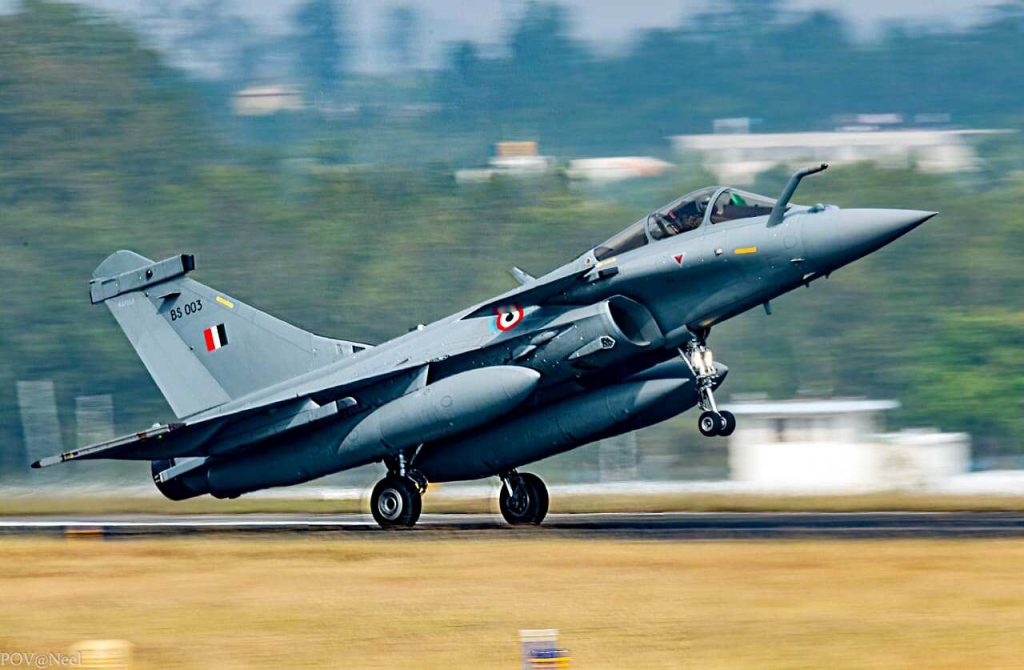
New Delhi: India has approved a massive ₹3.25 lakh crore proposal to procure 114 Rafale fighter jets for the Indian Air Force (IAF), marking the largest defence acquisition in the country’s history.
The clearance was granted by the Defence Acquisition Council (DAC), chaired by Defence Minister Rajnath Singh, which accorded Acceptance of Necessity (AoN) to the programme. The decision comes ahead of French President Emmanuel Macron’s forthcoming official visit to New Delhi.
The proposal now awaits final approval from the Cabinet Committee on Security (CCS), chaired by Prime Minister Narendra Modi.
Deal Structure: 18 Off-the-Shelf, 96 Made in India
Under the proposal, 114 Rafale multirole fighter jets will be procured from French defence major Dassault Aviation.
18 aircraft will be delivered in fully operational condition (off-the-shelf) from France.
96 aircraft will be manufactured in India under a strategic partnership model.
The agreement includes transfer of advanced fighter jet technologies and is designed to significantly strengthen the government’s “Make in India” initiative.
Read also: Exercise MILAN 2026: Indian Navy Launches Cultural Hub for 70+ Participating Nations
Major Boost to ‘Make in India’ and Indigenisation
The indigenous production of 96 jets represents a landmark push for self-reliance in defence manufacturing. Around 60% of the components for the India-built Rafales will be sourced locally.
Likely production partners include:
- Hindustan Aeronautics Limited (HAL)
- Tata Advanced Systems
- Reliance Aerostructures
This localisation will involve airframes, avionics systems, composite materials, weapon pylons, and potentially engine integration. The initiative aims to create a long-term ecosystem for advanced fighter jet assembly, maintenance, and supply chain development within India.
Officials say the move could position India as a regional hub for fighter aircraft production.
Strengthening Air Power Amid Regional Tensions
According to the Ministry of Defence, the induction of 114 Rafales will significantly enhance air defence capabilities, particularly along sensitive border areas.
The multirole jets are equipped with:
- Advanced avionics
- AESA radar systems
- Beyond-visual-range (BVR) missiles
- Electronic warfare suites
- Precision strike capabilities
- Nuclear-capable variants
The procurement comes amid heightened tensions along the Line of Actual Control (LAC) with China and ongoing cross-border challenges from Pakistan. The addition of Rafales will strengthen India’s preparedness for potential two-front warfare scenarios.
Addressing Squadron Shortage in the IAF
The Indian Air Force is currently operating at around 31 squadrons, against an authorised strength of 42 squadrons.
The phased induction of 114 jets is expected to:
- Address critical squadron shortages
- Enhance quick reaction alert capabilities
- Improve deep-strike and air superiority missions
- Provide operational synergy with the existing Rafale fleet
India had earlier procured 36 Rafale jets in 2016 in a flyaway deal valued at over €7.8 billion. The new acquisition will significantly expand the fleet, leveraging existing pilot training, simulators, and maintenance infrastructure.
Financial and Strategic Implications
The ₹3.25 lakh crore programme will be executed through government-to-government negotiations to secure competitive pricing. Economies of scale and domestic production are expected to reduce per-unit costs compared to earlier benchmarks.
The funding will be drawn from the defence budget, with long-term maintenance and lifecycle support agreements built into the contract to ensure fleet readiness.
Strategically, the deal further deepens defence ties between India and France, reinforcing France’s position as a key defence partner amid competition from the US and Russia.
There is also potential for collaboration on advanced engine technologies, including possible support for indigenous programmes like the Kaveri engine revival.
Complementing Indigenous Fighter Programmes
The Rafale procurement complements India’s indigenous fighter projects, including:
- HAL Tejas Mk-2
- Advanced Medium Combat Aircraft (AMCA)
By blending foreign technology transfer with domestic production, India aims to maintain a balanced and modern air combat fleet while gradually building indigenous capabilities.
CCS Nod Awaited
The proposal cleared the Defence Acquisition Council on 16 January and now awaits final approval from the Cabinet Committee on Security. Once cleared, contract negotiations and production timelines are expected to be fast-tracked, with full operational capability targeted within the decade.
Officials describe the move as a transformational step in India’s quest for indigenised air power and strategic autonomy.
Read also: Rafale F4 Upgrade Approved: How 35 Indian Air Force Jets Will Gain an Edge Over Regional Rivals