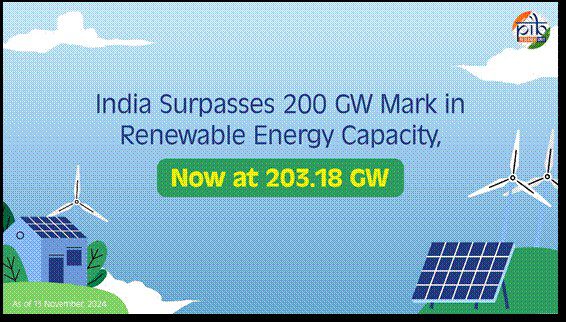
India has achieved a major milestone in its renewable energy journey, with the country’s total renewable energy capacity now surpassing 200 GW. This impressive progress supports India’s ambitious target of reaching 500 GW from non-fossil fuel sources by 2030.
According to the Central Electricity Authority, the total renewable energy-based electricity generation capacity now stands at 203.18 GW. This achievement underscores India’s growing commitment to clean energy and its progress in building a greener future. India’s total renewable energy installed capacity surged by an impressive 24.2 GW (13.5%) in just one year, reaching 203.18 GW in October 2024, up from 178.98 GW in October 2023. Additionally, when including nuclear energy, India’s total non-fossil fuel capacity rose to 211.36 GW in 2024, compared to 186.46 GW in 2023.
This milestone reflects the result of years of dedicated efforts to harness India’s natural resources. From sprawling solar parks to wind farms and hydroelectric projects, the country has steadily built a diverse renewable energy base. These initiatives have not only reduced reliance on fossil fuels but also strengthened the nation’s energy security. When factoring in the 8,180 MW (megawatt) of nuclear capacity, the total non-fossil fuel-based power now accounts for almost half of the country’s installed electricity generation capacity, signalling a strong move toward clean energy leadership on the global stage.
India’s total electricity generation capacity has reached 452.69 GW, with renewable energy contributing a significant portion of the overall power mix. As of October 2024, renewable energy-based electricity generation capacity stands at 203.18 GW, accounting for more than 46.3 percent of the country’s total installed capacity. This marks a major shift in India’s energy landscape, reflecting the country’s growing reliance on cleaner, non-fossil fuel-based energy sources.
A variety of renewable energy resources contribute to this impressive figure. Solar power leads the way with 92.12 GW, playing a crucial role in India’s efforts to harness its abundant sunlight. Wind power follows closely with 47.72 GW, driven by the vast potential of the coastal and inland wind corridors across the country. Hydroelectric power is another key contributor, with large hydro projects generating 46.93 GW and small hydro power adding 5.07 GW, offering a reliable and sustainable source of energy from India’s rivers and water systems.
Biopower, including biomass and biogas energy, adds another 11.32 GW to the renewable energy mix. These bioenergy projects are vital for utilizing agricultural waste and other organic materials to generate power, further diversifying India’s clean energy sources. Together, these renewable resources are helping the country reduce its dependence on traditional fossil fuels, while driving progress toward a more sustainable and resilient energy future.
In 2023, India’s renewable energy sector reached a significant milestone, with an estimated 1.02 million jobs created, according to the International Renewable Energy Agency’s (IRENA) 2024 Annual Review. The global renewable energy workforce expanded to 16.2 million in 2023, up from 13.7 million in 2022, with India playing a significant role in this growth. The report, created in collaboration with the International Labour Organization (ILO), underscores India’s increasing leadership in clean energy and its commitment to generating green jobs that fuel economic growth.
Hydropower emerged as the largest employer within the sector, providing around 453,000 jobs, which accounted for 20% of the global total, second only to China. The solar photovoltaic (PV) sector followed closely, employing approximately 318,600 people across both on-grid and off-grid systems. In 2023, India added 9.7 GW of solar PV capacity, ranking fifth globally for new installations and cumulative capacity, which reached 72.7 GW by the end of the year. Of the total solar workforce, 238,000 jobs were in grid-connected solar PV, reflecting an 18% increase from 2022, while around 80,000 individuals worked in the off-grid solar sector.
The wind sector employed about 52,200 people, with nearly 40% of these jobs in operations and maintenance and 35% in construction and installation. Other renewable energy subsectors also contributed to job creation, with liquid biofuels providing 35,000 jobs, solid biomass contributing 58,000 jobs, and biogas generating 85,000 jobs. Additionally, the solar heating and cooling sector employed 17,000 people, highlighting the diverse and expanding employment opportunities within India’s renewable energy industry.
India Rising to Global Commitments
India’s commitment to addressing climate change is reflected in its enhanced Nationally Determined Contributions (NDCs) under the Paris Agreement, incorporating the five elements outlined at COP26 in Glasgow. These efforts align with the principles of equity and Common but Differentiated Responsibilities and Respective Capabilities (CBDR-RC), considering national circumstances. As part of the updated NDC submitted to the UNFCCC (United Nations Framework Convention on Climate Change) in August 2022, India has committed to reducing its emissions intensity by 45% by 2030 (compared to 2005 levels), achieving 50% of cumulative electric power capacity from non-fossil fuel sources by 2030, and promoting a sustainable way of living through the ‘LIFE’ (Lifestyle for Environment) movement. These targets also contribute to India’s long-term goal of reaching net-zero emissions by 2070, supported by the ‘Long-term Low Carbon Development Strategy’ submitted to the UNFCCC in November 2022.
Several states in India have emerged as leaders in renewable energy capacity, contributing significantly to the nation’s progress. Rajasthan tops the list with an impressive 29.98 GW of installed renewable energy capacity, benefiting from its vast land and abundant sunlight. Following closely is Gujarat, which boasts a capacity of 29.52 GW, driven by its strong focus on solar and wind energy projects. Tamil Nadu ranks third with 23.70 GW, leveraging its favourable wind patterns to generate substantial energy. Karnataka rounds out the top four with a capacity of 22.37 GW, supported by a mix of solar and wind initiatives.
In conclusion, India’s renewable energy journey has reached a significant milestone, marked by the impressive achievement of over 200 GW of installed capacity. This accomplishment is a testament to the nation’s commitment to a sustainable energy future, driven by a diverse array of renewable sources, including solar, wind, hydro, and bioenergy. The proactive initiatives such as the National Green Hydrogen Mission, PM-KUSUM, PM Surya Ghar, and the PLI schemes for solar PV modules underscore the government’s strategic focus on enhancing energy generation capacity while reducing reliance on fossil fuels. With ambitious targets set for the future, including a goal of 500 GW from non-fossil sources by 2030, India is well- positioned to emerge as a global leader in renewable energy, contributing to environmental sustainability and energy security. These ongoing efforts reflect a holistic approach to building a greener economy, ensuring that India not only meets its energy needs but also addresses the pressing challenges of climate change and resource conservation.