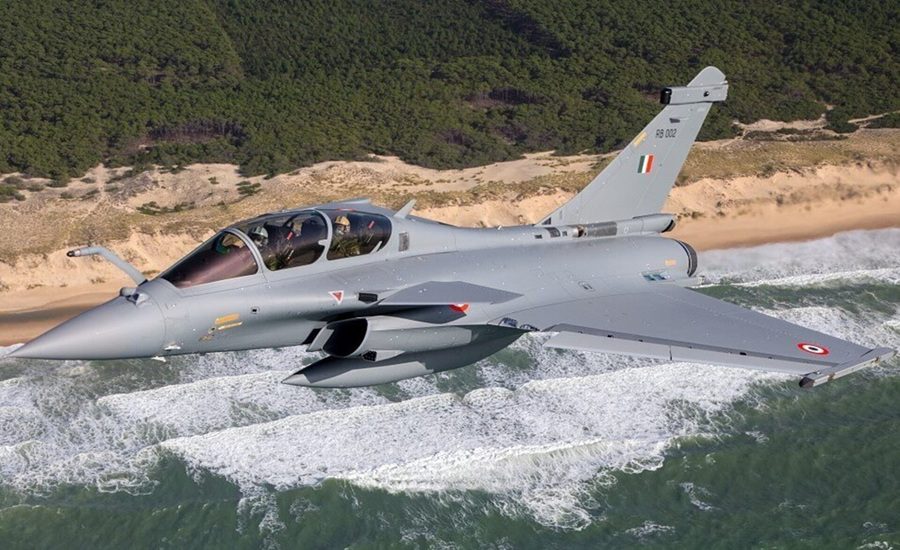
New Delhi: India has taken a historic step toward strengthening its military might. The long-awaited decision on the procurement of 114 additional Rafale fighter jets has finally been cleared by the Defence Acquisition Council (DAC), chaired by Defence Minister Rajnath Singh. Alongside this, approval has also been granted for the purchase of six additional P-8I Poseidon maritime reconnaissance aircraft for the Indian Navy.
Valued at an estimated ₹3.25 lakh crore, this Rafale deal is set to become the largest defence procurement in India’s history. The proposal now awaits final approval from the Cabinet Committee on Security (CCS), chaired by Prime Minister Narendra Modi.
Defence Acquisition Council Gives Green Signal
The approval was granted during a high-level meeting of the Defence Acquisition Council (DAC) held on Thursday under the leadership of Defence Minister Rajnath Singh. The DAC is the highest decision-making body for defence procurement in India.
Read also: Rafale Jets Made in India? Inside Dassault’s Plan to Produce Fighters in Nagpur
What is the Defence Acquisition Council (DAC)?
The DAC:
Is chaired by the Defence Minister
- Includes the Chief of Defence Staff, Defence Secretary, and senior officials
- Approves the purchase of new weapons, aircraft, and military equipment
- Makes procurement decisions based on budget and operational requirements
- Promotes indigenous manufacturing under the ‘Make in India’ initiative
The DAC provides initial approval for major defence deals. The final clearance must come from the Cabinet Committee on Security (CCS).
Rafale Deal: Numbers, Cost and Strategic Importance
Number and Cost
114 additional Rafale fighter jets approved
Estimated cost: ₹3.25 lakh crore
- 18 aircraft will be delivered in fly-away condition
- Remaining 96 will be manufactured in India
Once approved by the CCS, a contract will be awarded to French defence major Dassault Aviation.
Why India Needs 114 More Rafales
Squadron Shortage in the Indian Air Force
Currently:
The Indian Air Force (IAF) has 29 squadrons
Required strength: 42 squadrons
The new Rafales will help bridge this gap and replace aging aircraft such as the MiG-21 and other retiring platforms.
With the induction of these 114 jets, the IAF’s squadron strength is expected to rise to approximately 35–36 squadrons.
Rafale’s Combat Capabilities
The Rafale is a multi-role fighter aircraft, capable of performing:
- Air-to-air combat
- Air-to-ground strike missions
- Maritime attacks
- Reconnaissance missions
- Nuclear weapon delivery
Advanced Weapon Systems
The aircraft is equipped with:
- Meteor air-to-air missile (long-range engagement capability)
- SCALP cruise missile (precision strikes beyond 250 km)
- Hammer precision-guided weapon
- Spectra electronic warfare system
Advanced radar systems
Rafale aircraft were used in Operation Sindoor following the Pahalgam terrorist attack last May. They carried out precision strikes on Pakistani targets, launching SCALP missiles with high accuracy.
The aircraft has also proven its capability during the Balakot airstrikes and the Ladakh standoff with China.
Air Force Vice Chief Air Marshal Nagesh Kapoor has stated that induction of advanced jets like Rafale will significantly enhance the Air Force’s operational strength.
Rafale in India: A Brief History
India first signed a deal for 36 Rafale jets in 2016, valued at ₹59,000 crore. These jets:
- Were delivered by 2022
- Are stationed at Ambala and Hashimara airbases
- Form two operational squadrons
The final delivery of the ‘C’ variant from the earlier deal is scheduled for December 2024.
The previous deal faced political controversy over the selection of Reliance Defence as a partner, but the Supreme Court later gave it a clean chit.
Make in India: Boost to Domestic Manufacturing
A major highlight of the new deal is domestic production.
- 96 out of 114 jets will be manufactured in India
- Production will be carried out by Dassault Aviation in partnership with an Indian company
- Technology transfer will be part of the agreement
- Thousands of jobs are expected to be created
In June last year, India and France announced four major agreements between Dassault Aviation and Tata Advanced Systems Limited to accelerate Rafale production and delivery in India.
This move strengthens India’s push toward ‘Atmanirbhar Bharat’ (Self-Reliant India) while maintaining access to advanced foreign technology.
P-8I Poseidon Aircraft: Strengthening Naval Surveillance
Alongside the Rafale approval, the DAC also cleared the purchase of six additional P-8I Poseidon aircraft for the Indian Navy.
Key Details
- Manufactured by Boeing (USA)
- Used for maritime surveillance and anti-submarine warfare
- India currently operates 12 P-8I aircraft
New acquisition will increase total strength to 18
Strategic Importance
The P-8I can:
- Detect enemy submarines, ships, and aircraft
- Conduct long-range maritime surveillance
- Strengthen maritime border security
This is particularly significant in the Indian Ocean Region, where China’s naval presence has been expanding.
Strategic Timing: Macron’s India Visit
The DAC approval comes just ahead of French President Emmanuel Macron’s visit to India for the AI Summit in Delhi (February 15–17). Defence cooperation is expected to be a key discussion point, further strengthening Indo-French ties.
The Rafale deal is structured as a government-to-government agreement, similar to the 2016 deal, ensuring greater transparency and strategic cooperation.
Other Defence Discussions at DAC Meeting
The DAC meeting also discussed additional proposals involving:
- High-altitude pseudo-satellites
- Indigenous ‘Vibhav’ anti-tank mines
- Defence collaborations with the US, France, and Russia
Earlier, in January 2026, the Defence Procurement Board (DPB) had approved the Rafale proposal before it was forwarded to the DAC.
What Happens Next?
After DAC approval:
- Proposal goes to the Cabinet Committee on Security (CCS)
- CCS, chaired by PM Narendra Modi, gives final clearance
- Contract awarded to Dassault Aviation
- 18 jets delivered in fly-away condition
- Remaining 96 manufactured in India
Timeline
Production and delivery expected to take 5–7 years
Challenges
- Budget constraints
- Balancing foreign procurement with indigenous platforms
- Debate over whether funds could have been allocated to Tejas MK-2
However, defence experts argue that the IAF urgently requires advanced, combat-ready jets to address immediate threats from China and Pakistan.
A Game-Changer for India’s Defence
This massive procurement marks a major leap in India’s defence modernization.
It:
- Addresses the fighter squadron shortage
- Strengthens deterrence against regional adversaries
- Boosts indigenous manufacturing
- Deepens Indo-French strategic partnership
- Enhances maritime security in the Indian Ocean
While it underscores India’s dependence on foreign technology for cutting-edge systems, it simultaneously advances the goal of self-reliance through local manufacturing and technology transfer.
India’s Air Force is poised to move closer to becoming a truly world-class force.