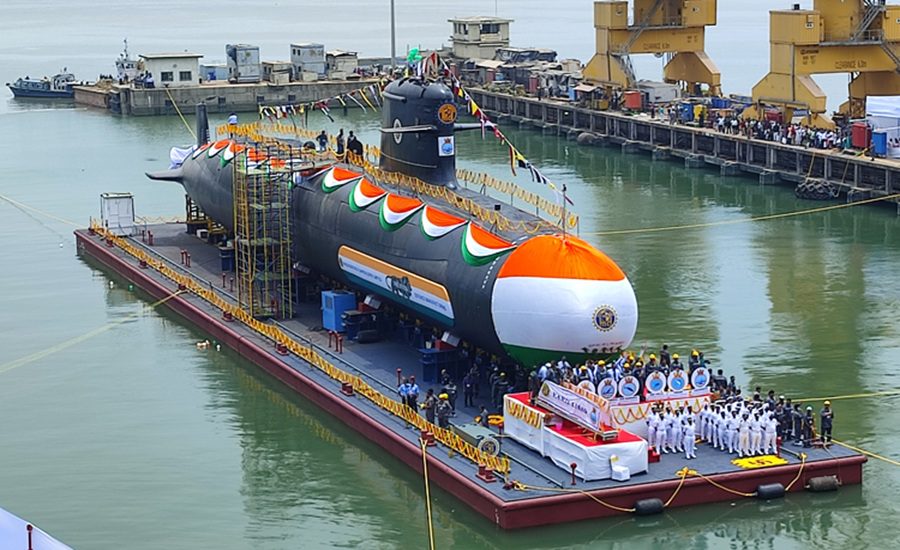
New Delhi: India’s Ministry of Defence (MoD) is accelerating approval for a landmark $8 billion submarine acquisition programme designed to strengthen the Indian Navy’s undersea warfare capabilities amid heightened regional naval competition, particularly against Pakistan’s growing Chinese-backed AIP submarine fleet.
The proposed submarine purchase is being advanced under Project-75I and seeks Cabinet Committee on Security (CCS) approval this fiscal year. Once sanctioned, construction of six advanced Air-Independent Propulsion (AIP) submarines will commence at Mazagon Dock Shipbuilders Limited (MDL) with partner ThyssenKrupp Marine Systems (TKMS) of Germany.
Background of AIP Submarine Deal
The push to fast-track this deal comes as Pakistan plans to induct eight new Yuan-class (Hangor) diesel-electric attack submarines equipped with AIP systems supplied by China between 2026 and 2028.
These submarines are expected to significantly enhance Islamabad’s area denial and sea-control posture in the Northern Arabian Sea—a region where India has traditionally held naval superiority.
Equipped with air-independent propulsion, these Yuan variants can stay submerged longer, increasing stealth and endurance. They are outfitted with heavyweight torpedoes, missile systems (including Pakistan’s nuclear-capable Babur-3 SLNCR), and modern sensors, bolstering Pakistan’s deterrence profile against India and complicating Indian naval planning.
Analysts also note this build-up fits within China’s broader effort to project naval power and support allied states in the Indian Ocean Region (IOR), shifting the regional underwater balance.
What is the Importance of Project 75I
The Project-75I submarines will represent India’s first significant induction of modern diesel-electric boats with fuel-cell-based AIP systems, allowing extended submerged operations with reduced need to snorkel for battery charging—crucial for stealth and survivability in contested waters.
They are expected to be fitted with surface-to-surface and submarine-launched cruise missiles such as Klub or Nirbhay, along with advanced sonar suites and combat systems integrated for modern networked warfare.
Construction, Technology Transfer & Indigenous Industry
Under the Atmanirbhar Bharat mission, design refinement, hull construction, and major systems will be delivered with significant Indian industry participation, leveraging MDL’s track record from the Kalvari-class submarine line.
German expertise from TKMS will facilitate the integration of AIP technology and other advanced systems.
The programme also serves strategic industrial goals by enhancing local shipbuilding capacity, technology assimilation, and skilled employment in India’s defence manufacturing ecosystem.
Complementary Naval Enhancements Underway
The AIP submarine initiative is part of a broader Indian naval modernisation drive. Asia’s largest navy is also:
- Leasing a Russian Akula-class submarine equipped with conventional weapons to bridge capability gaps before Project-75I boats enter service (expected 2027–28).
- Proceeding with Project-77 to build nuclear-powered attack submarines (SSNs) for global reach and undersea dominance.
- Expanding the nuclear deterrent fleet with additional SSBNs such as INS Aridhaman and INS Arisudan to reinforce India’s strategic underwater leg.
What are the Implications of AIP Submarine Deal
India’s rapid move to bolster its submarine force emerges against the backdrop of an increasingly contested Indo-Pacific maritime domain.
China’s submarine diplomacy—exemplified by its support to Pakistan’s Hangor-class programme—reflects Beijing’s strategy to extend influence through allied fleets.
Pakistan, meanwhile, positions its expanding submarine capability as vital to protecting its maritime interests, including strategic sea-lines of communication and deterrence against Indian naval operations.