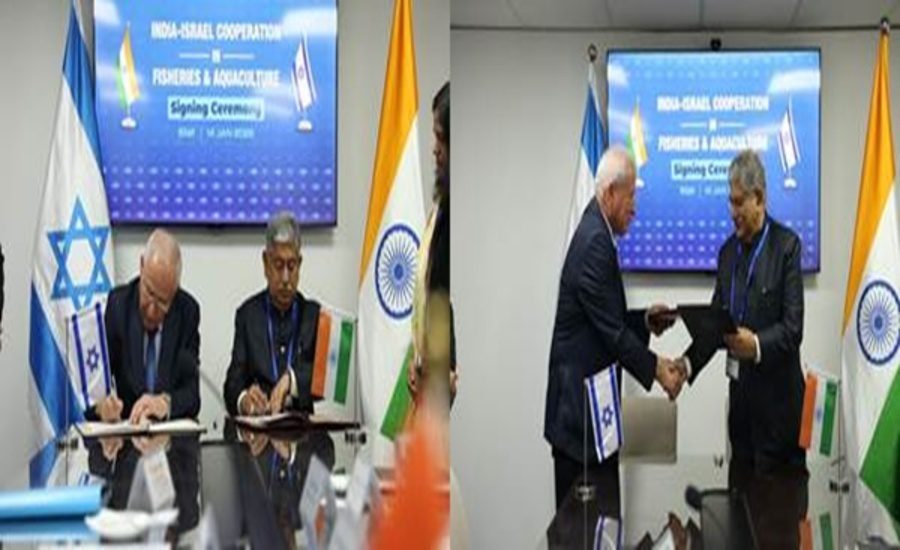
New Delhi: In a major boost to bilateral cooperation, India and Israel signed a Joint Ministerial Declaration of Intent to strengthen collaboration in the fisheries and aquaculture sectors during the Second Global Summit on Blue Food Security: Sea the Future 2026 held in Eilat, Israel.
The declaration was formalized on January 14, marking a significant step in advancing sustainable aquatic food systems, technology exchange, and economic growth for both nations.
Details of India–Israel Fisheries and Aquaculture Cooperation Deal
A high-level Indian delegation, led by Union Minister for Fisheries, Animal Husbandry and Dairying & Panchayati Raj, Rajiv Ranjan Singh, represented India at the summit from January 13–15.
The visit provided a strategic platform to align priorities on aquaculture innovation, resource management and blue economy development with Israeli counterparts.
The summit brought together policymakers, scientists, industry experts and international delegates focused on enhancing blue food security, sustainable practices, and climate-resilient aquatic food systems in a world grappling with growing food demands.
Key Pillars of the India–Israel Fisheries and Aquaculture Cooperation Deal
The Joint Ministerial Declaration maps out a comprehensive cooperation framework spanning research, technology, sustainability, trade facilitation and capacity building.
Major areas of focus include:
1. Advanced Aquaculture & Technology Transfer
Collaborative research and development in cutting-edge aquaculture systems, including Recirculating Aquaculture Systems (RAS), biofloc, cage culture, and aquaponics.
Joint efforts to develop pathogen-free seed programs, high-yield broodstock and genetic improvement initiatives for aquatic species.
Exploration of Israeli advanced water-saving and water-management technologies to optimize aquaculture operations in water-scarce environments.
These technologies leverage Israel’s globally recognized expertise in water technology and precision agriculture, offering potential benefits for India’s diverse yet resource-intensive coastal and inland aquaculture zones.
2. Blue Economy & Sustainable Practices
The declaration places strong emphasis on achieving a sustainable and climate-resilient blue economy by:
- Promoting responsible fish harvesting to conserve marine biodiversity and minimize environmental impact.
- Encouraging technology-enabled monitoring, data collection and traceability systems across fisheries value chains.
- Supporting innovation ecosystems including startups, incubators, and joint research hubs.
Such interventions aim to improve marine resource management while supporting livelihoods in fishing communities – particularly small-scale fishers often vulnerable to climate and market shifts.
3. Capacity Building and Knowledge Exchange
Recognizing the importance of human capital, both nations will explore structured exchange initiatives involving:
- Training programs for fishers, aqua-farmers, scientists and policymakers.
- Joint workshops on modern fish processing, marketing, vessel design and harbor infrastructure development.
- Collaboration on coastal aquaculture management and marine resource conservation.
These efforts will help ensure that technological advancements translate into real-world improvements in operational efficiency, environmental stewardship, and socio-economic upliftment.
Boosting Bilateral Trade and Market Access
The declaration also seeks to strengthen bilateral trade in fisheries and aquaculture products by:
- Facilitating structured dialogue on exports and imports.
- Addressing tariff and non-tariff barriers.
- Encouraging technology-driven traceability to improve compliance and market access.
Improved trade linkages are expected to enhance access to global seafood markets while ensuring quality standards and transparency throughout the supply chain.
Proposed Indo-Israel Centres of Excellence
A key highlight of the cooperation initiative is the exploration of new Indo-Israel Centres of Excellence for Fisheries and Aquaculture, modelled on the successful network of 43 Indo-Israel Agricultural Centres of Excellence operational in India.
These Centres of Excellence are envisioned to act as innovation hubs — bringing research, private sector engagement, start-ups and training under one roof to accelerate adoption of best practices across regions.
What is the Significance of India–Israel Fisheries and Aquaculture Cooperation Deal
The fisheries and aquaculture cooperation pact between India and Israel represents a strategic expansion of bilateral ties beyond traditional sectors such as defense and agriculture. It reinforces a shared commitment to sustainable development, food security, innovation and climate resilience.
For India, the agreement aligns with its broader Blue Economy ambitions by modernizing aquaculture, enhancing productivity and fostering sustainable livelihoods.
For Israel, collaboration leverages its leadership in water technology, precision agriculture and resilient food systems.
Moving forward, this partnership could pave the way for deeper innovation linkages, increased commerce in aquatic products, and enhanced knowledge exchange that strengthens regional food systems and environmental health.