New Delhi: India is rapidly advancing its ballistic missile defence architecture by integrating sea-based interceptor systems aboard frontline warships. According to recent reports from defence-watch outlets, the indigenous Defence Research and Development Organisation (DRDO), in collaboration with the Indian Navy, is pushing forward development of the Phase-II BMD interceptors — AD-1 and AD-2 — for eventual deployment on destroyers and other major naval combatants.
This move marks a significant shift: from a largely land-based ballistic missile shield to a truly multi-domain defensive posture that includes sea-based missile interception. The goal is clear — to establish mobile, flexible, and layered defence capability not just across land and air, but across the seas, safeguarding maritime assets, coastal infrastructure, and naval task forces against ballistic missile threats.
Background of AD-1 and AD-2 interceptors
India’s BMD efforts date back to the early 2000s, motivated by evolving missile threats from neighbours in South Asia and the broader region.
Read also: Indian Navy to Commission Indigenous ASW Vessel ‘Mahe’ , Boosting Coastal Defence Capabilities
The first phase of the Indian Ballistic Missile Defence Programme focused on creating a two-tier interceptor architecture to protect high-value urban and strategic centres (like Delhi and Mumbai) from medium-range ballistic missile (MRBM) threats (up to roughly 2,000 km).
Key components of Phase I included:
- Prithvi Air Defence (PAD) — designed for exo-atmospheric interception at high altitude.
- Advanced Air Defence (AAD) — for endo-atmospheric interception, targeting missiles that have re-entered the atmosphere.
Over the years, PAD and AAD underwent multiple tests and were declared ready for limited deployment and production around 2017–2018.
Phase II: Enter AD-1 and AD-2
Recognizing the need to counter longer-range and more sophisticated ballistic missile threats — including intermediate-range (IRBM) and longer-range missiles — India initiated Phase II of the BMD programme. This phase aims to neutralize missiles with ranges up to 5,000 km.
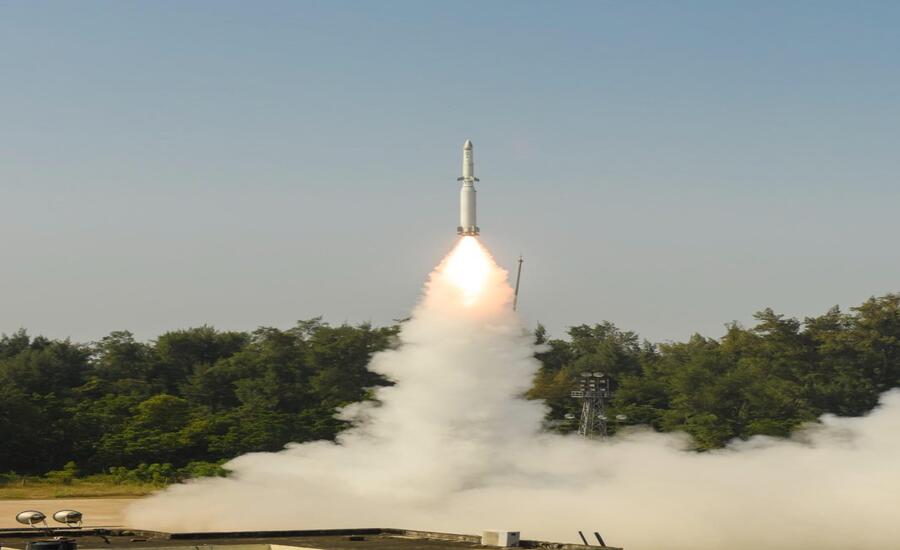
- AD-1 — a long-range interceptor capable of both endo-atmospheric and low exo-atmospheric engagement. It uses a two-stage solid-propellant motor and is equipped with advanced guidance, control, and navigation systems to precisely track and intercept long-range ballistic missiles or aircraft.
- AD-2 — primarily an exo-atmospheric interceptor, engineered to neutralize intermediate- to long-range ballistic missiles during their mid-course trajectory, at high altitudes, before they begin their terminal descent.
The Phase II timeline has seen concrete progress: maiden flight-test of AD-1 was conducted off the coast of Odisha on 2 November 2022. Meanwhile, fabrication of AD-2 is reported to be underway, with trials expected in 2026.
The New Development: Sea-Based BMD with Warship-Based AD-1 and AD-2 Interceptors
Traditionally, India’s BMD shield has been ground-based — radars and interceptor missiles protecting fixed geographic areas (metropolitan centres, strategic regions). The latest development, however, expands the protective umbrella to the maritime domain, enabling mobile sea-based interception capabilities.
By fitting frontline warships with AD-1 and AD-2 interceptors, the Indian Navy could transform these vessels into floating BMD forts — capable of defending carrier strike groups, critical coastal installations, offshore assets, naval bases, and shipping lanes from ballistic missile threats.
Moreover, sea-based BMD adds flexibility: interceptors can be repositioned, redeployed, and operate in coordination with land- and air-based radar and sensor networks, offering layered and redundant defence.
Latest Reports on Significance of AD-1 and AD-2 Interceptors
According to a December 8, 2025 report from a leading defence news outlet, DRDO and the Navy have formally initiated efforts to adapt AD-1 and AD-2 interceptors for integration aboard frontline warships, including destroyers and future combatants.
Once operational, these sea-based missiles will add a crucial maritime dimension to India’s overall BMD framework — complementing existing land- and air-based defences, and enabling a tri-service, multi-domain missile defence shield in line with modern strategic realities.
Strategic commentary suggests the move is aimed at enhancing fleet survivability, protecting high-value naval assets and platforms, and safeguarding maritime supply routes, offshore infrastructure, and coastal cities — particularly in a threat environment characterized by potential ballistic missile attacks from regional adversaries.
Strategic Implications of AD-1 and AD-2 Interceptors
1. Enhanced Deterrence & Maritime Security: The deployment of sea-based BMD interceptors strengthens India’s deterrence posture. Warships armed with AD-1/AD-2 become mobile defence bastions, able to guard against missile salvos aimed at both sea-based and coastal targets.
This increases the difficulty for potential adversaries to successfully launch surprise ballistic missile strikes against naval forces or critical maritime infrastructure.
2. Tri-Domain Layered Defence — Land, Air, Sea: With BMD coverage across land, air, and sea, India moves towards a truly integrated, multi-layered defence network. Such a network offers redundancy — if one layer fails or is saturated, others may still offer protection — thereby improving resilience against missile threats.
3. Shift in Regional Strategic Calculus: Given ongoing tensions and strategic rivalry in South Asia and the broader Indo-Pacific, enhancing ballistic missile defences sends a message of deterrence and self-reliance. It may force adversaries to reconsider ballistic missile strike strategies, knowing Indian naval formations — not just fixed land targets — are capable of missile interception.
4. Boost to Indigenous Defence Capabilities: The AD-series interceptors are developed indigenously by DRDO (in collaboration with manufacturing entities). Their adaptation for naval platforms underscores India’s increasing emphasis on self-reliance in defence hardware and reduced dependence on foreign systems — aligning with broader policies of domestic defence production.
Key Challenges in AD-1 and AD-2 Interceptors & Open Questions
While the sea-based BMD initiative is promising, several challenges and uncertainties remain:
Integration complexity: Adapting land-based interceptor systems and command-and-control infrastructure for naval platforms is nontrivial. Warships have limited space, power, and sensor capabilities compared to fixed land installations.
Sensor/Detection limitations at sea: Effective missile interception requires long-range, high-fidelity radar and tracking networks. Establishing and coordinating such sensors (over-the-horizon radars, shipborne radars, satellite/airborne sensors) poses technical and operational challenges. Some open-source analyses note that interceptors like AD-2 may require radars with scan ranges over 1,500 km for reliable target detection and tracking.
Probability of kill & saturation risk: Ballistic missile salvoes — especially if multiple missiles are launched — can saturate defence systems. No BMD system offers 100% interception guarantee, and effectiveness may vary depending on missile speed, decoys, MIRV (Multiple Independently Targetable Reentry Vehicle) capabilities, and evasive manoeuvres. Experts often caution against over-reliance on BMD as a “shield.”
Deployment timeline and operational readiness: While development is underway, full operationalisation on warships — involving trials, integration, and deployment — will take time. The real-world performance under conflict conditions remains to be seen.
What’s Next: The Road Ahead
Fabrication and trials of AD-2: As of mid-2025, DRDO has commenced fabrication of AD-2, with sea-based integration efforts moving forward. Trials — possibly including sea-based tests — are expected in coming years.
Integration with sensor and radar networks: To enable effective ship-based interceptions, India will need to expand its radar, early-warning, and command-control infrastructure — including over-the-horizon radars and perhaps satellite/airborne sensors.
Deployment on new and modern warships: Future and upcoming destroyers, frigates, and surface combatants will likely be designed (or retrofitted) to incorporate sea-based BMD capabilities, making them central to India’s maritime defence posture.
Towards a truly tri-service BMD shield: As sea-based BMD comes online, India may realize the long-held vision of a layered, integrated, multi-domain ballistic missile defence shield covering land, air, and sea. This could significantly alter strategic deterrence and maritime defence calculus in the region.