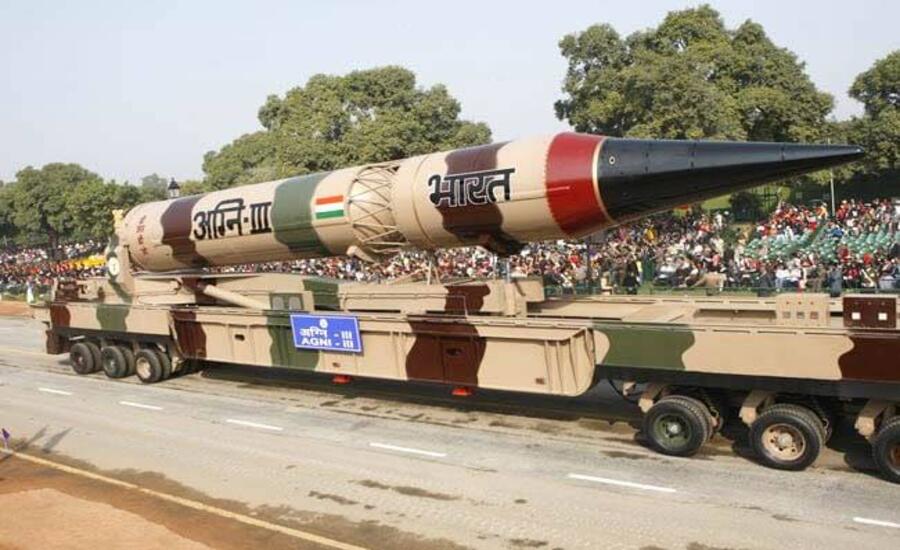
New Delhi: India has once again demonstrated its advancing strategic deterrence capabilities with the successful test-firing of the Agni-3 Intermediate Range Ballistic Missile (IRBM).
This test was conducted at the Integrated Test Range (ITR), Chandipur in Odisha, under the supervision of the Strategic Forces Command, validating all operational and technical parameters of the system as part of routine user training and readiness checks.
What is the Agni-3 Intermediate Range Ballistic Missile?
The Agni-3 IRBM is a two-stage, solid-propellant ballistic missile developed by India’s Defence Research and Development Organisation (DRDO). Classified as an Intermediate Range Ballistic Missile, it has an estimated strike range of 3,000–3,500 kilometres, enabling it to engage targets at strategic distances while enhancing India’s defence posture.
Read also: DRDO’s Microwave Weapon Explained: Technology, Range, and Strategic Impact on India’s Defence
The missile is road-mobile and rail-mobile, which enhances its deployment flexibility. It is capable of carrying a substantial payload, including conventional or nuclear warheads, and is integrated with advanced navigation and guidance systems to ensure reliable performance.
What is Significance of Agni-3 Missile
The recent test was carried out to verify all technical and operational parameters of the weapon system under actual launch conditions. This ensures that the missile and its associated infrastructure remain capable and ready for deployment when required by defence planners.
Strategic Forces Command at the Helm
The Strategic Forces Command (SFC) — responsible for managing India’s strategic nuclear arsenal — oversaw the launch. The SFC routinely conducts user training launches to maintain proficiency, accuracy, and preparedness across strategic assets.
Boost to India’s Deterrence Posture
The success of this test reinforces India’s comprehensive deterrence structure. Intermediate range ballistic missiles like Agni-3 are critical components of India’s surface-to-surface strike capability, complementing shorter-range systems and those with intercontinental reach.
Historical Context of Agni-3 Missile
The Agni-3 missile forms part of the broader Agni family of ballistic missiles, which range from short-range systems like Agni-I to longer-range missiles such as Agni-V. Agni-3 was inducted into India’s Strategic Forces Command in 2011 after a series of successful developmental tests.
Its predecessor Agni-II had a range of around 2,000 km, while Agni-3 extended that reach to approximately 3,500 km — a significant leap in capability that allows strikes deep into strategic target sets if ever needed.
Historically, Agni-3 has undergone multiple successful tests since its first launch in 2007, establishing its reliability over years of service.
Strategic Implications for India and the Region
Agni-3’s capabilities contribute to credible deterrence — a cornerstone of India’s defence strategy. The combination of range, mobility, and payload flexibility underpins India’s ability to respond to threats or escalate deterrence effectively.
Integration with Nuclear Deterrence
Ballistic missiles like Agni-3 form an integral part of India’s nuclear command and control structure, ensuring a robust strategic framework alongside land, air, and sea-based delivery platforms.
Future of India’s Strategic Missile Program
With continuing advancements in indigenous missile technologies, India is refining its strategic missile family. Tests of other Agni variants, investment in precision guidance technologies, and enhanced payload configurations foreshadow a future where India’s missile capabilities remain at the forefront of defence innovation.