New Delhi: The Indian Air Force clears DRDO’s NETRA AEW&C for full combat deployment, marking a significant milestone in India’s defence capabilities.
This move officially upgrades the indigenous NETRA Airborne Early Warning and Control (AEW&C) system to a fully mission-ready platform for combat operations.
The final operational clearance (FOC) confirms that the NETRA system now meets all stringent standards required by the Indian Air Force (IAF) for high-intensity deployments.
What is the NETRA AEW&C System?
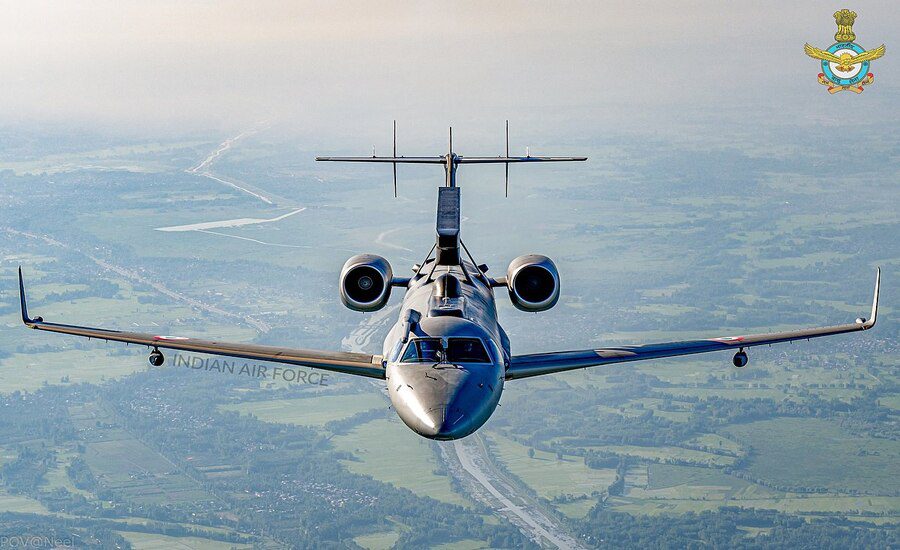
The NETRA AEW&C is an airborne surveillance and command system developed by India’s Defence Research and Development Organisation (DRDO) to provide early detection of aerial and surface threats. It is mounted on the Embraer EMB-145 airframe and integrates advanced radars, sensors, and communication systems to monitor a wide area of airspace.
Airborne Early Warning and Control (AEW&C) aircraft like NETRA act as “eyes in the sky”, detecting enemy aircraft, drones, and surface movements at long range. They also help guide friendly aircraft and relay battlefield data to command centres.
Modern AEW&C systems can significantly extend the reach and effectiveness of a nation’s air defence network.
Importance of Final Operational Clearance of DRDO NETRA AEW&C System
The Indian Air Force’s Final Operational Clearance (FOC) is the highest level of approval before a military system can be deployed in combat missions. After rigorous testing and evaluation, all three of the NETRA AEW&C platforms have now met the IAF’s performance benchmarks.
This clearance indicates that the aircraft has proven its:
- Radar detection range and tracking ability
- Communication and data-link performance
- Reliability under various flight conditions
- Mission systems integration with IAF ground and air networks
The system’s sensors can detect and track hostile threats over hundreds of kilometres, improving India’s early warning and airspace picture.
Enhancing India’s Defence Capabilities
With this clearance, the NETRA can now be fully integrated into the IAF’s combat operations. This enhances India’s situational awareness, especially along the northern and western borders, where security challenges persist.
The NETRA system strengthens India’s air defence by reducing reliance on imported platforms and boosting Atmanirbhar Bharat (self-reliance) in defence technology. It also enhances coordination with other key assets like fighter jets, missile systems, and ground radar networks.
A Long Development Path to Combat Readiness
DRDO began the NETRA AEW&C project in the early 2000s. Since its initial trials and partial operational use, the aircraft has undergone years of tests and improvements. Early versions demonstrated their capability in real-world scenarios, including surveillance and mission control during operational exercises.
The FOC comes after significant enhancements to radar systems, mission software, communication links, and operator interfaces. These upgrades have improved its effectiveness under dynamic operational conditions.
Looking Ahead: Next-Generation Surveillance Platforms
The NETRA AEW&C’s success paves the way for future variants. India has already cleared the development of NETRA Mk-2 aircraft on Airbus A321 platforms. These larger aircraft will carry more advanced AESA radars with 300–360 degree coverage and even greater range. Six such units have been approved in a project valued at approximately ₹19,000 crore.
This next generation is expected to further enhance India’s panoramic surveillance capability and link seamlessly with other advanced systems for real-time battlefield awareness.
Read also: DRDO Surya Laser Weapon Explained: Range, Technology, Capabilities, and Strategic Impact