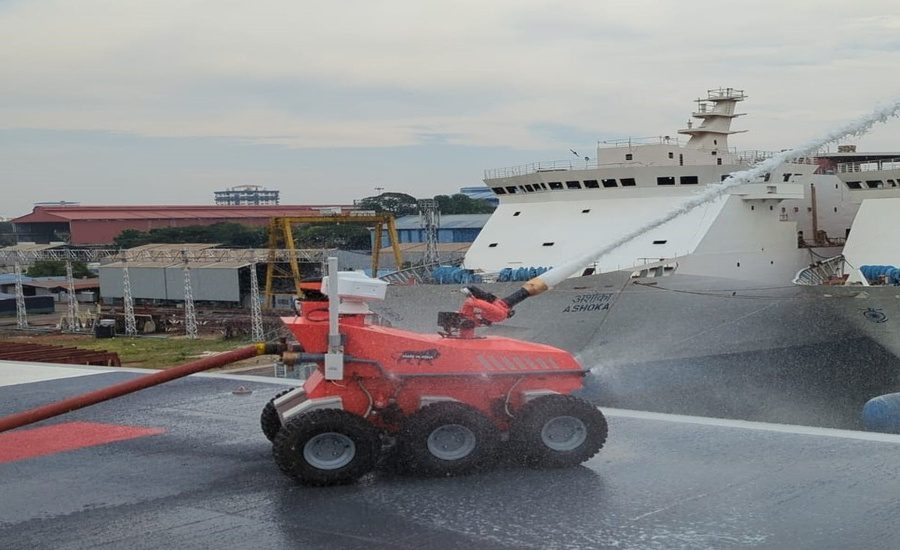
New Delhi: In a pioneering move that underscores greater tri-service integration and bolsters India’s indigenous defence innovation ecosystem, the Indian Army has signed a contract to procure an iDEX Firefighting Robot originally developed for the Indian Navy, marking a historic cross-service acquisition under the Innovations for Defence Excellence (iDEX) initiative.
This landmark deal not only strengthens battlefield support capabilities, but also highlights India’s commitment to Atmanirbhar Bharat in defence technology.
iDEX Firefighting Robot Deal: Historic Cross-Service Acquisition
On 13 January 2026, the Indian Army executed a procurement contract with Swadeshi Empresa Pvt Ltd, an Ahmedabad-based defence technology start-up, at its Capability Development Directorate in New Delhi.
The key highlight of this agreement is that the firefighting robot was originally developed for the Indian Navy under iDEX, and is now being adopted by the Army through the Single Stage Composite Trial (SSCT) mechanism — a first-of-its-kind acquisition across service branches.
This development represents a major step in inter-service technology transfer, avoiding redundant development cycles and accelerating field deployment of proven systems.
What Is the iDEX Firefighting Robot?
The iDEX Firefighting Robot is a compact unmanned ground vehicle (UGV) designed for high-risk fire suppression missions where human entry is unsafe.
Equipped with advanced sensors, thermal cameras, remote navigation, and fire suppression systems, the robot can operate in environments marked by:
- Extreme heat and toxic smoke
- Ammunition depots or fuel storage fire outbreaks
- Confined industrial spaces within military infrastructure
Its remote operation allows firefighting teams to tackle emergencies from safe distances, significantly reducing risk to personnel.
Strengthening the Defence Start-up Ecosystem
The iDEX initiative, launched by the Ministry of Defence in 2018, aims to connect startups and innovators with India’s armed forces. With over ₹1,500 crore allocated and more than 300 contracts already facilitated, iDEX has evolved into a central engine for defence indigenisation.
Swadeshi Empresa Pvt Ltd represents a growing wave of Indian defence innovators. Backed by rigorous trials and collaboration with defence research agencies, the company scaled the robot from a Naval platform to one suitable for Army use, demonstrating the adaptability of home-grown defence tech.
What are the Benefits of iDEX Firefighting Robot Deal
This procurement enhances the Indian Army’s emergency response posture by:
- Improving firefighter safety in dangerous environments
- Reducing response time during critical fire incidents
- Minimising human casualties in front-line and logistic installations
The robot’s robust design allows it to navigate complex terrain and fire zones that would otherwise be life-threatening to human crews.
The Single Stage Composite Trial Advantage
The use of the Single Stage Composite Trial (SSCT) process sets this deal apart. Traditionally, defence procurements involve prolonged multi-stage evaluations. SSCT consolidates prototype demonstrations, user trials, and validation into a single, streamlined phase — cutting down development and acquisition timelines from years to months.
This efficient process not only accelerates capability adoption, but also encourages startups to innovate without bureaucratic drag.
Strategic Importance for India’s Defence Posture
Fire incidents have historically threatened military assets and lives in forward areas, workshop facilities, and storage depots. With this acquisition, the Army is better positioned to safeguard both personnel and critical equipment.
Moreover, procuring an indigenous system reduces dependence on foreign products, supports local industry, and ensures greater supply-chain resilience — key components of the Atmanirbhar Bharat vision.
Read also: Big Push for Atmanirbhar Bharat: MoD Seals ₹659 Crore MKU Deal for Army’s SIG-716 Rifles