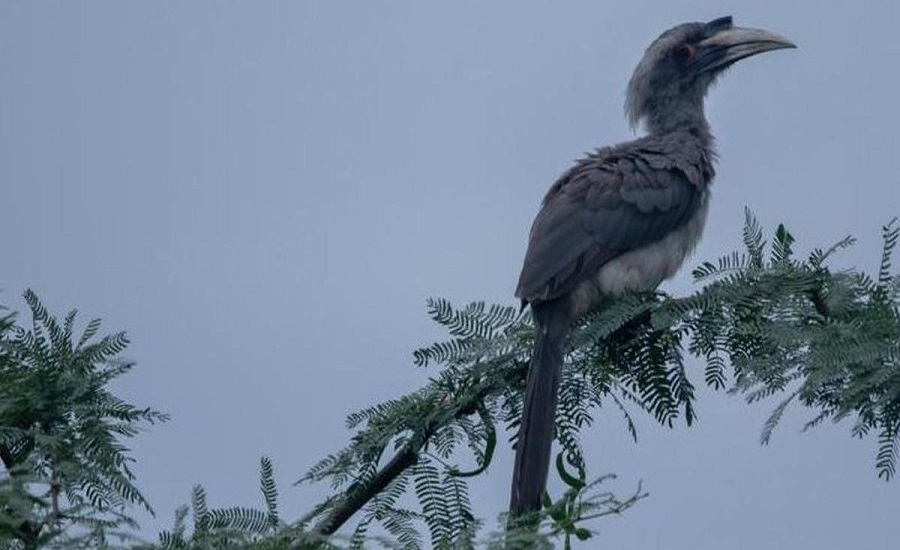
Gir, Gujarat: More than six decades after vanishing from Gujarat‘s iconic Gir forests, the Indian Grey Hornbill has successfully bred for the fourth consecutive year, marking a remarkable conservation achievement. A new scientific study has confirmed that the reintroduced population is now establishing itself naturally, offering hope for the long-term revival of a species that disappeared from the region between the 1950s and 1960s.
The findings have been published in the international peer-reviewed journal Birds, making it the first comprehensive scientific assessment of the Indian Grey Hornbill reintroduction programme undertaken by the Gujarat Forest Department and its conservation partners.
The milestone comes shortly after Gujarat celebrated another conservation success, with the second Great Indian Bustard chick raised through the “jump-start” technique surviving beyond the critical 40-day period.
Study Confirms Self-Sustaining Population Is Taking Shape
The research, titled “Reintroduction of Indian Grey Hornbills in Gir, India: Insights into Ranging, Habitat Use, Nesting and Behavioural Patterns,” documents how the birds have adapted to the Gir landscape since their release in 2021.
Researchers recorded successful breeding every year after the reintroduction, indicating that the birds are not only surviving but also reproducing naturally.
According to the study, one breeding pair nested successfully during the first year after release. In the second year, three additional breeding pairs produced offspring, demonstrating that the restored population is gradually becoming self-sustaining.
Species Returns After More Than 60 Years
The Indian Grey Hornbill disappeared from Gir sometime between the 1950s and 1960s, primarily due to hunting rather than habitat loss.
Conservationists believe that decades of habitat protection following the declaration of Gir Wildlife Sanctuary in 1965 and Gir National Park in 1975 created suitable ecological conditions for the species’ return.
The successful reintroduction marks one of India’s important examples of restoring a locally extinct bird species to its historical habitat.
40 Hornbills Released in Phases
The restoration programme involved the release of 40 Indian Grey Hornbills in two phases.
- 28 birds were released during 2021 and 2022
- 12 additional birds were released in 2023
The birds were translocated from healthy Indian Grey Hornbill populations in Gujarat’s Aravalli forests, where habitat conditions allowed sustainable relocation.
Before the translocation, extensive ecological assessments confirmed that Gir once again offered suitable habitat for the species.
Satellite Tracking Revealed Successful Adaptation
To understand how the birds adapted after release, researchers fitted 11 male hornbills with satellite transmitters.
The tracking data showed that immediately after release, the birds explored large areas, covering an average home range of nearly 61 square kilometres.
However, once they became familiar with the landscape, their home range reduced significantly to around 5.7 square kilometres, indicating successful territorial establishment.
Similarly, their average daily movement reduced from 4.3 kilometres during the exploratory phase to 1.4 kilometresafter settlement, another sign that the birds had adapted well to their new environment.
Preferred Habitat and Nesting Behaviour
The study found that the hornbills showed a strong preference for Gir’s dry mixed deciduous and teak forests.
Those that ventured beyond the protected area frequently used orchards, water bodies and landscapes close to human settlements.
For nesting, the birds selected mature trees with large trunk girths, particularly species such as:
- Sterculia urens
- Terminalia bellirica
Researchers also observed the birds feeding their chicks primarily on fruits from banyan, peepal, karamda and dhraman trees, while supplementing their diet with insects and other invertebrates.
A Key Species for Forest Regeneration
Scientists say the Indian Grey Hornbill plays an important ecological role as a long-distance seed disperser.
By consuming fruits and dispersing seeds across large distances, the birds contribute significantly to natural forest regeneration and biodiversity conservation.
Their successful return is therefore expected to benefit not only the species itself but also the long-term ecological health of the Gir landscape.
Officials Hail Conservation Success
Welcoming the findings, Gujarat Forest and Environment Minister Arjun Modhwadia said wildlife conservation in the state has entered a new phase, particularly in species recovery and protection of rare wildlife.
He said the Grey Hornbills released in 2021 have successfully established territories, adapted to the Gir ecosystem and produced offspring, making the project a significant conservation success.
Principal Secretary (Forests and Environment) Vinod Rao noted that the consecutive breeding records indicate the restored population is beginning to establish itself naturally. He also highlighted the hornbill’s vital role in dispersing seeds and supporting forest regeneration.
Meanwhile, Principal Chief Conservator of Forests (Wildlife) and Chief Wildlife Warden Jaipal Singh said historical evidence suggests hunting was the primary reason for the species’ disappearance decades ago, rather than habitat degradation.
According to him, improvements in habitat protection over the past several decades created favourable conditions for reintroducing the species.
A Model for Future Conservation Projects
Researchers believe the Gir reintroduction programme has now emerged as a successful model for future bird restoration projects across India.
The study concludes that the combination of successful breeding, stable habitat use, shrinking home ranges and behavioural adaptation demonstrates that the programme is moving steadily toward establishing a self-sustaining Indian Grey Hornbill population.
Conservation experts say the Gir experience could serve as a blueprint for restoring other bird species that have become locally extinct despite suitable habitats continuing to exist.