New Delhi: In a strategic move to enhance India’s maritime domain awareness and surveillance capabilities, the Indian Navy has confirmed the induction of 10 indigenous Drishti-10 Starliner Medium Altitude Long Endurance (MALE) drones into its operational inventory. The development marks a significant milestone in India’s naval modernization drive and its broader push for defence self-reliance.
What Is the Drishti-10 Starliner MALE Drone?
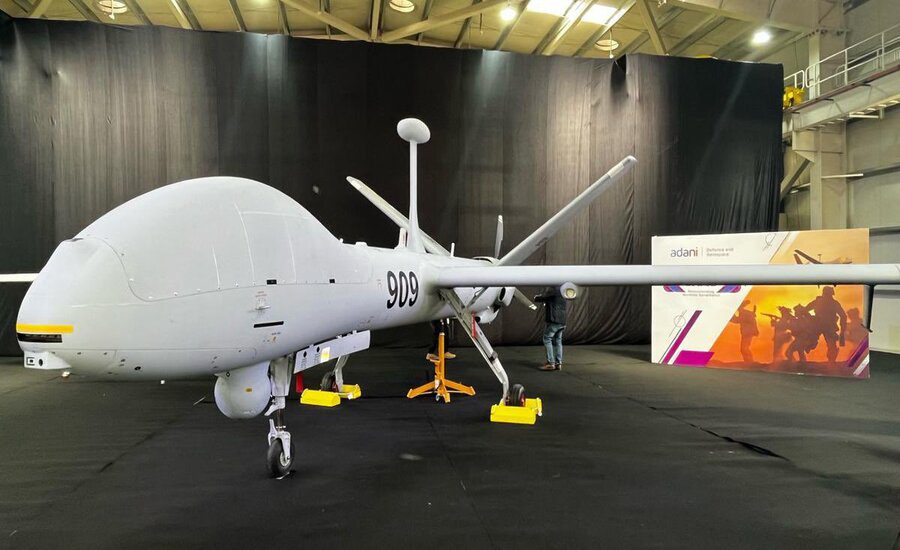
The Drishti-10 Starliner is an advanced unmanned aerial vehicle (UAV) developed by Adani Defence and Aerospace in Hyderabad under India’s defence industrial ecosystem.
Read also: DRDO Lock-Confirm-Kill Missile Brings ‘Think Before Strike’ Technology to Indian Arsenal
It is a medium-altitude, long-endurance (MALE) drone based on technology transfer and customization linked to the well-known Hermes 900 platform.
What is the Features of Drishti-10 Starliner MALE Drone
- 36+ hour flight endurance, allowing extended missions without the need to land.
- Payload capacity of up to 450 kg enabling advanced sensor and mission systems.
- Capability to operate at medium altitudes (up to 30,000–32,000 feet) for extensive surveillance reach.
- All-weather performance, suited to maritime and littoral zones.
- Equipped with state-of-the-art ISR (Intelligence, Surveillance, Reconnaissance) toolsets, including radars, electro-optical sensors, and signal-intelligence systems.
As a MALE platform, the Drishti-10 supports persistent monitoring across wide geographies, making it critical for India’s action in the Indian Ocean Region (IOR) — a strategic maritime corridor of global commerce and security interest.
What is the Importance of Drishti-10 Starliner MALE Drone
The Indian Navy’s leadership, including Chief of Naval Staff Admiral Dinesh K Tripathi, underscored that the Drishti-10 induction will dramatically enhance the service’s capability to conduct round-the-clock maritime surveillance across vast oceanic expanses.
These drones will significantly improve tracking of surface shipping, early warning of potential threats, and monitoring of illegal or hostile movements.
Already, one Drishti-10 aircraft is operational and being actively flown by trained Indian Navy personnel, with further units set to join squadron service as induction progresses.
Indigenization and Aatmanirbharta in Defence
The induction of Drishti-10 drones aligns closely with India’s Atmanirbhar Bharat (self-reliance) initiative in defence manufacturing.
The UAVs represent one of the highest levels of indigenization in India’s unmanned aircraft sector, with advanced systems built domestically and tailored to national operational needs.
Enhancing Deployment Across Naval Operations
Once fully operationalized, the Drishti-10 UAVs will be deployed across key Indian Naval Air Squadrons, particularly those focused on maritime reconnaissance. The Indian Navy already operates a mix of UAV platforms, including leased systems and home-grown variants, to augment its airborne ISR footprint.
The advanced endurance and payload versatility of the Starliner series means it can support wide-area maritime domain awareness, anti-piracy missions, search-and-rescue operations, and early warning surveillance — contributing to maritime security from the western Arabian Sea to the eastern Indian Ocean.
Operational Readiness and Training
Follow-on operational training programs are underway to ensure that Indian Navy personnel are fully proficient in flying, maintaining, and conducting mission operations using the Drishti-10 fleet. The drones, once fully inducted, promise to elevate India’s situational awareness capabilities far beyond traditional ship-based or short-range airborne platforms.
What is the Impact of Drishti-10 Starliner MALE Drone
The induction comes at a time of heightened strategic competition in the Indian Ocean region, where major powers increasingly assert their influence. Enhanced endurance UAVs like the Drishti-10 position India to better monitor maritime activity, safeguard sea lanes, and deter threats ranging from unlawful fishing to asymmetric military challenges.
Analysts suggest that improved ISR capabilities will also improve joint mission planning between the Indian Navy and other branches of the armed forces, as well as allied navies operating in the region.
Looking Ahead: Fleet Expansion and Modernisation
The Drishti-10 induction is part of a broader modernization agenda within the Indian Navy, which continues to expand its conventional fleet, aviation assets, and autonomous platforms.
According to defence planning documents, the Navy is pursuing a range of surface ships, submarines, and aerial ISR systems to maintain a credible and technologically advanced maritime force into the next decade.