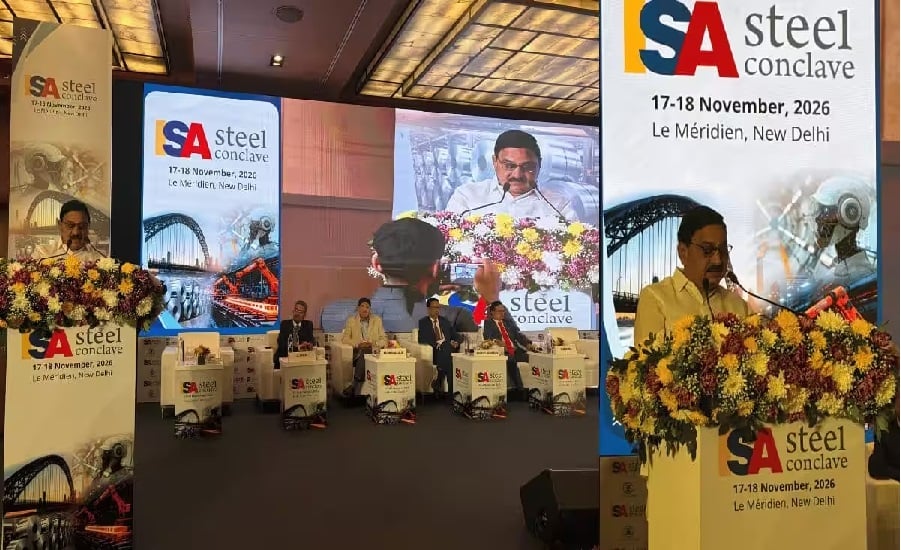
New Delhi: The Indian steel industry has called for a level playing field, stronger policy support and structural reforms to protect domestic manufacturing and improve its global competitiveness, as steelmakers face rising production costs, raw material constraints, growing import pressure and the challenges of transitioning towards green steel.
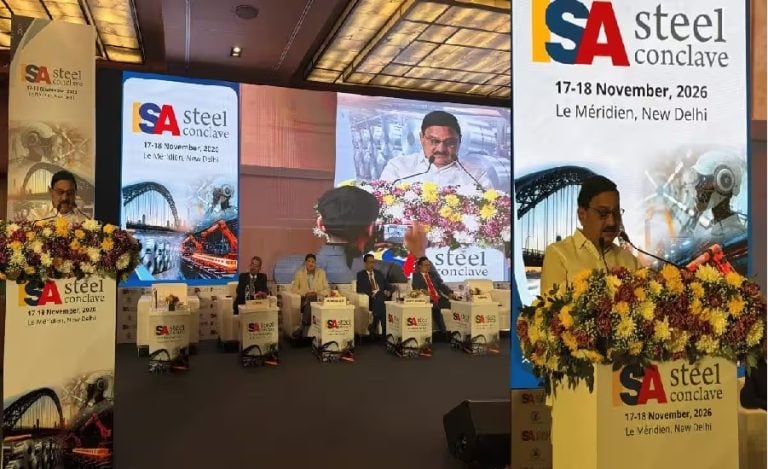
At the 7th edition of the Indian Steel Association’s (ISA) Steel Conclave, held in New Delhi on November 17 and 18, 2026, industry leaders highlighted the need for predictable policies, mining reforms, better logistics, tax rationalisation and improved access to domestic raw materials. They also cautioned against unfairly priced imports and steel products that fail to meet quality standards, warning that these could undermine Indian steel producers.
The industry is simultaneously pursuing an ambitious expansion plan, targeting capacity growth from around 220 million tonnes per annum (MTPA) in FY26 to 300 MTPA by FY31 and approximately 604 MTPA by 2047.
Naveen Jindal Calls for Stable Policies and Fair Trade
Indian Steel Association President Naveen Jindal, who is also Chairman of Jindal Steel, emphasised that India’s steel industry requires a stable and enabling policy environment to support large-scale, long-term investments.
He said predictability across mining, raw material availability, energy, logistics, taxation, trade and environmental regulation is critical for the industry to plan investments and sustain growth.
Jindal stressed that Indian steelmakers should compete on fair terms, particularly at a time when imports and international trade dynamics are creating pressure on domestic manufacturers.
“We also need to ensure a level playing field. India supports fair trade, but unfairly priced imports and products that do not meet quality standards cannot be allowed to undermine domestic manufacturing,” Jindal said.
His remarks underscored the industry’s demand for a balanced trade environment that supports competition while protecting domestic steel production from unfair pricing practices and substandard imports.
Read also: SAIL Rourkela Steel Plant Achieves Record CRNO Production of 7,445 Tonnes in October 2026
Steel Industry Flags Rising Costs and Raw Material Constraints
India’s leading steelmakers have highlighted several structural challenges affecting the industry’s cost competitiveness. High production expenses, constraints in securing raw materials and the increasing risk of steel imports, particularly from China, are emerging as major concerns.
Industry leaders have called for further reforms in mining and taxation, along with improvements in logistics and greater availability of domestic raw materials. These measures, they believe, could reduce cost pressures, improve supply-chain efficiency and help Indian steel producers compete more effectively in international markets.
The industry is also seeking policy measures that encourage investment in domestic resource development and make the steel production ecosystem more resilient to global market disruptions.
Green Steel Transition Remains a Major Challenge
The steel industry has acknowledged its responsibility in India’s climate transition, with energy efficiency, increased scrap utilisation, renewable energy, coal-gas-based technologies with carbon capture and utilisation, and green hydrogen expected to play important roles in the future of steelmaking.
Naveen Jindal said India has the potential to emerge as a trusted global supplier of responsibly produced, low-carbon steel. He emphasised that the industry’s transformation would depend on adopting cleaner technologies and improving the sustainability of manufacturing processes.
However, industry leaders cautioned that the shift towards green steel would remain challenging over the coming decade. Technologies such as hydrogen injection in blast furnaces and carbon capture are still not economically viable in India at the scale required, making the transition complex for steel producers.
The industry will have to balance its decarbonisation commitments with the need to remain commercially competitive, maintain production levels and support the country’s growing demand for steel.
AI and Technology to Shape Steel Production
Jindal also highlighted the growing role of technology in transforming the steel sector, particularly through the adoption of artificial intelligence (AI).
AI is expected to help improve plant operations, optimise processes, enhance productivity, reduce inefficiencies and support more sustainable steel production. Technology-driven improvements will be increasingly important as manufacturers expand capacity while working to reduce emissions and operational costs.
The adoption of advanced technologies is expected to become a key pillar of the industry’s modernisation and competitiveness.
Dilip Oommen Flags Duties Outside GST Framework
Dilip Oommen, Vice-Chairman of ArcelorMittal India and a board member of AMNS India, pointed to additional cost pressures arising from duties and levies that are not subsumed under the Goods and Services Tax (GST).
He said these charges were adding significantly to steelmakers’ overall costs, further complicating the industry’s efforts to improve competitiveness and invest in cleaner production technologies.
The concern over non-GST levies comes amid broader calls for tax reforms that could rationalise the cost structure of steel production and create a more supportive environment for capacity expansion and technological upgrades.
Chinese Steel Exports and Trade Barriers Pose Challenges
JSW Steel CEO Jayanta Acharya highlighted the pressure created by Chinese steel exports and increasing trade barriers in developed economies.
He noted that China has a substantial surplus across several sectors, while domestic consumption has not been growing sufficiently to absorb its production. As a result, surplus output is increasingly finding its way into export markets, creating competitive pressure for steel producers in other countries, including India.
Acharya also pointed to tariff and non-tariff barriers imposed by developed economies, which are creating additional challenges for Indian steel exporters and the broader domestic industry.
“China has a huge surplus in probably every sector. And their consumption is unfortunately not growing, so therefore that is finding its way into the export market. And that’s one challenge which we need to be aware of. The second one is that the developed world is putting tariff barriers and non-tariff barriers,” he explained.
The twin pressures of Chinese steel exports and protectionist measures in developed markets have made trade policy and market access increasingly important for India’s steel industry.
India Targets 300 MTPA Steel Capacity by 2031 and 604 MTPA by 2047
India’s steel sector is preparing for a major expansion in production capacity over the coming decades. The industry aims to increase capacity from around 220 MTPA in FY26 to 300 MTPA by FY31 and approximately 604 MTPA by 2047.
SAIL Chairman and Managing Director Ashok Kumar Panda said India’s steel industry has the potential to reach 300 million tonnes by 2030-31 and around 600 million tonnes by 2047.
However, he emphasised that achieving these targets would require addressing several important challenges, including the transition to green steel, increasing high-end steel production and reducing dependence on imports through import substitution.
The capacity expansion will require substantial investment, reliable access to raw materials, supportive policy frameworks, infrastructure development and technological advancement.
Steel Industry Seeks Reforms to Strengthen India’s Global Position
The discussions at the 7th Steel Conclave highlighted the multiple challenges confronting India’s steel sector as it prepares for an ambitious expansion phase. While growing domestic demand presents significant opportunities, high production costs, raw material availability, trade pressures and the economics of green technologies remain key concerns.
Steelmakers are seeking a stronger policy framework that supports investment, improves the availability of domestic resources, streamlines taxes and levies, strengthens logistics and ensures fair competition in the domestic market.
As India moves towards its long-term steel production targets, the ability to address these structural challenges will be critical to building a globally competitive industry while advancing its low-carbon transition.
Read also: India’s Steel Production Reaches 85.1 Million Tonnes in H1 FY 2026-27, Consumption Rises 7.5%