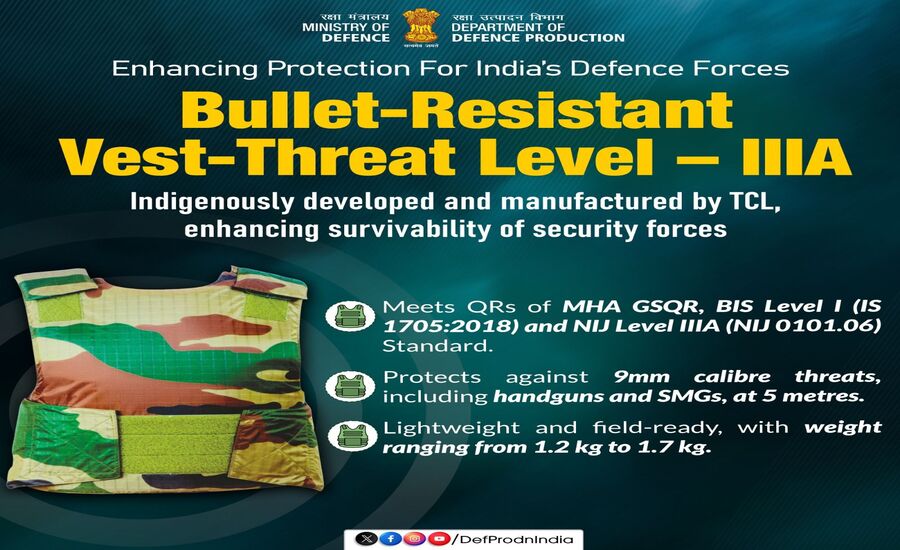
New Delhi: India has taken another significant step toward strengthening indigenous defence manufacturing with the development of a Bullet-Resistant Vest (Threat Level IIIA) designed to meet the operational demands of modern battlefields and internal security scenarios.
Engineered to provide reliable protection while maintaining mobility and endurance, the vest reflects the country’s growing focus on self-reliance in critical personal protection equipment.
The system has been developed and manufactured by TCL Kanpur, reinforcing India’s capability to design and produce advanced ballistic protection solutions domestically.
What is Indigenous Level IIIA Bullet-Resistant Vest
An Indigenous Level IIIA Bullet-Resistant Vest is a domestically developed personal protection system designed to safeguard defence and security personnel against common handgun threats.
It offers Level IIIA ballistic protection, capable of stopping high-velocity pistol rounds while remaining lightweight and field-ready.
Developed under India’s defence indigenisation efforts, the vest enhances mobility, endurance, and operational effectiveness across modern battlefield and internal security scenarios.
Modern military and internal security operations require equipment that balances protection, agility, and comfort. The newly developed bullet-resistant vest has been engineered specifically to address these evolving requirements.
Threat Level IIIA protection ensures resistance against commonly encountered handgun threats, making the vest suitable for:
- Counter-insurgency operations
- Urban warfare scenarios
- Internal security and law enforcement deployments
- High-risk patrol and static duty assignments
By focusing on operational practicality, the vest supports prolonged use without compromising soldier effectiveness.
Compliance with Recognised Ballistic Safety Standards
A key highlight of the vest is its compliance with recognised ballistic safety standards, ensuring reliability and consistency in protection.
Adherence to established testing and certification norms is essential for equipment intended for frontline deployment, where failure is not an option.
Such compliance also enhances the credibility of indigenous systems, making them viable alternatives to imported personal protection equipment.
Importance of Indigenous Level IIIA Bullet-Resistant Vest in Battlefield
One of the most critical challenges in personal armour design is weight management. Excessive weight can reduce soldier endurance, slow reaction times, and increase fatigue during extended missions.
The Level IIIA bullet-resistant vest incorporates a lightweight, field-ready configuration, allowing:
- Improved mobility in urban and close-quarter environments
- Reduced physical strain during long-duration deployments
- Better adaptability across diverse terrains and climatic conditions
This design philosophy aligns with the operational realities faced by Indian defence and security personnel.
Ensuring Reliable Protection for Defence and Security Personnel
Personal protection equipment plays a decisive role in soldier survivability and mission success.
Building India’s future-ready force protection 🇮🇳
— Defence Production India (@DefProdnIndia) January 2, 2026
Engineered to address the operational requirements of modern battlefield and internal security scenarios, the Bullet-Resistant Vest (Threat Level IIIA) reflects India’s advancing self-reliance in critical personal protection… pic.twitter.com/fSmoihfcGk
The introduction of an indigenous Level IIIA bullet-resistant vest ensures that Indian defence and security forces have access to reliable, modern, and locally supported protective gear.
As threats continue to evolve, the emphasis on indigenous research, development, and manufacturing will remain central to India’s defence preparedness.
Strategic Significance Going Forward
The successful development of this bullet-resistant vest highlights a broader trend in India’s defence ecosystem—a shift from import dependency to design-led self-reliance.
With continued investment in testing, materials science, and user feedback, indigenous personal protection systems are expected to play an increasingly prominent role in future deployments.