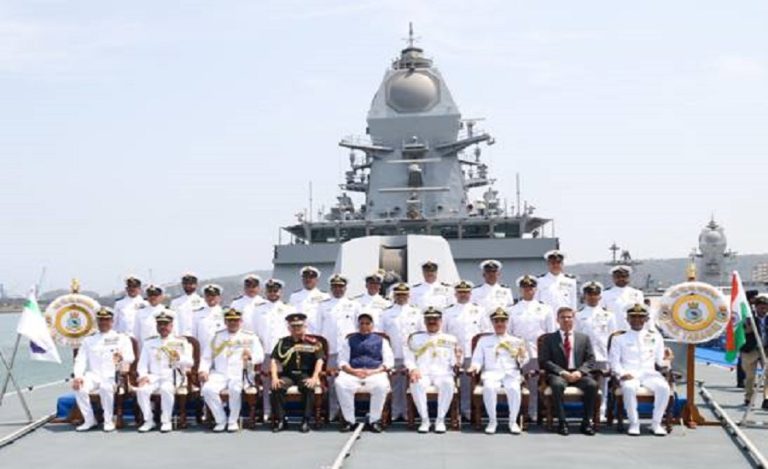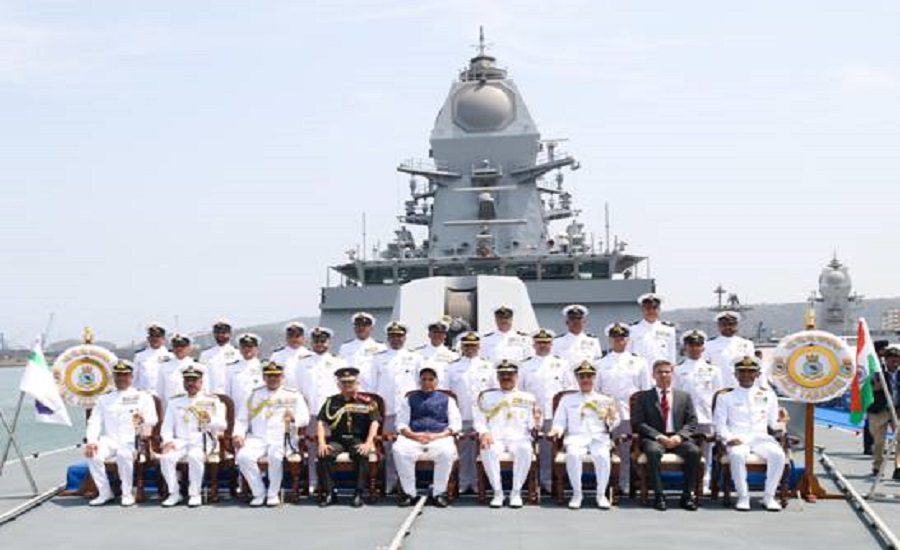
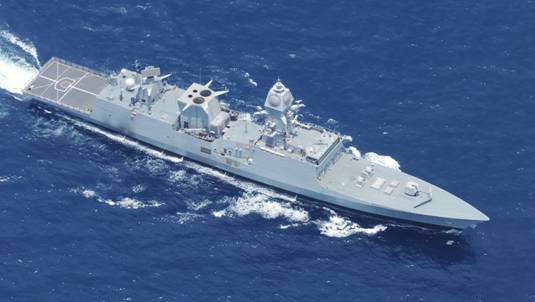
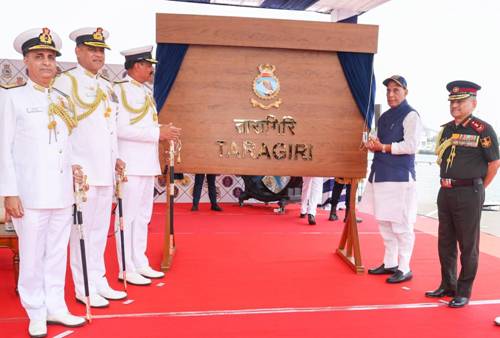
In a major boost to India’s maritime capability, the Indian Navy commissioned its latest stealth frigate, INS Taragiri, at Visakhapatnam on Thursday in the presence of Defence Minister Rajnath Singh.
The warship is the fourth vessel under Project 17A, a next-generation stealth frigate programme aimed at strengthening India’s blue-water naval capabilities through indigenous shipbuilding and advanced combat systems.
A New Generation Stealth Warship for Multi-Role Operations
With a displacement of approximately 6,670 tonnes, INS Taragiri has been designed by the Warship Design Bureauand built by Mazagon Dock Shipbuilders Limited with support from hundreds of domestic industries and MSMEs.
The frigate has been developed for:
- anti-air warfare
- anti-surface warfare
- anti-submarine warfare
- maritime security operations
- anti-piracy missions
- humanitarian assistance and disaster response
Its stealth architecture significantly reduces radar signature, making it harder to detect in contested maritime environments.
Read also: INS Agray Joins Indian Navy Fleet: Inside India’s Powerful New Shallow Water Anti-Submarine Warship
Equipped with BrahMos, Advanced Radar and Sonar Systems
Describing the vessel as a highly capable naval platform, Rajnath Singh said INS Taragiri combines speed, endurance and modern weapons.
The ship is equipped with:
- BrahMos supersonic surface-to-surface missiles
- medium-range surface-to-air missiles
- advanced radar systems
- sonar systems
- indigenous anti-submarine warfare suite
He said the warship can remain deployed at sea for long durations and is capable of delivering immediate response in hostile situations.
‘A Symbol of India’s Technological Prowess and Self-Reliance’
Addressing the commissioning ceremony, Rajnath Singh described INS Taragiri as not merely a warship but a symbol of India’s growing technological strength and strategic confidence.
He said:
“Building a strong and capable Navy is an absolute necessity in today’s times.”
The Defence Minister highlighted that India’s 11,000-km coastline, dependence on maritime trade and energy routes make naval strength critical for national security.
Nearly 95 percent of India’s trade by volume moves through maritime routes, making ocean security central to economic stability.
Indian Navy Guarding Sea Lanes, Choke Points and Digital Infrastructure
Rajnath Singh said the Indian Navy is maintaining round-the-clock deployment across the Indian Ocean amid global uncertainty.
He noted that India’s naval responsibilities now include protection of:
- critical sea lanes
- strategic choke points
- oil tanker routes
- undersea digital communication cables
He stressed that in the digital age, disruption of undersea internet cables could impact global systems, requiring a wider concept of maritime security.
Over 75% Indigenous Content, Major Push for Aatmanirbhar Defence
INS Taragiri carries over 75 percent indigenous content, involving more than 200 MSMEs, reflecting India’s growing defence manufacturing ecosystem.
The vessel demonstrates:
- public-private collaboration
- domestic ship design maturity
- advanced indigenous systems integration
Rajnath Singh said India is no longer only meeting domestic defence needs but entering the global supply chain in defence manufacturing.
Defence Exports Reach Record ₹38,424 Crore
The Defence Minister also highlighted India’s defence export growth, stating exports reached ₹38,424 crore in FY 2025-26, compared with about ₹1,200 crore over a decade ago.
He praised defence public sector undertakings and private industry for contributing to defence self-reliance.
Navy Chief Recalls Legacy of Earlier Taragiri
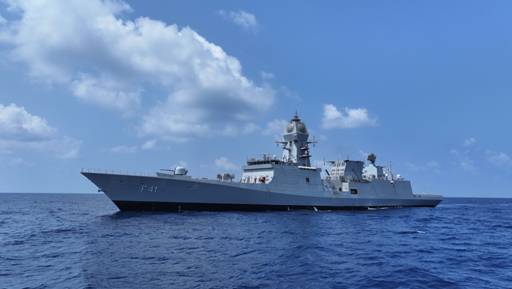
Dinesh K Tripathi recalled the legacy of the earlier INS Taragiri, a Leander-class frigate commissioned in 1980 that played a key role in anti-submarine warfare capability development.
He said the new vessel reflects the Navy’s goal of remaining:
• combat-ready
• credible
• cohesive
• future-ready
amid changing Indo-Pacific maritime security challenges.
Commissioning Ceremony Attended by Top Military Leadership
The commissioning ceremony included the ceremonial breaking of the commissioning pennant and hoisting of the national flag onboard.
Senior dignitaries present included:
• Anil Chauhan
• Sanjay Bhalla
• Jagmohan
INS Taragiri to Join Eastern Fleet
The warship will now join the Eastern Fleet on India’s eastern seaboard.
Its induction strengthens India’s maritime posture in the Indo-Pacific and sends a strategic message about indigenous warship-building capability.
About INS Taragiri
This Frigate represents a generational leap over earlier designs, offering a sleeker form and a significantly reduced Radar Cross-Section that allows it to operate with lethal stealth. With indigenous content exceeding 75 percent, the ship highlights the maturity of a domestic industrial ecosystem that now spans over 200 Micro, Small and Medium Enterprises (MSMEs), contributing to the Government’s Aatmanirbharta initiative, supporting thousands of Indian jobs.
Beneath its sleek, modular exterior lies a powerhouse driven by a Combined Diesel or Gas propulsion engine and managed by a state-of-the-art Integrated Platform Management System. This technological sophistication ensures the vessel remains a versatile asset, capable of carrying out any mission assigned to the ship, anywhere and at any time.
The ship’s combat punch is world class, featuring a lethal array of supersonic Surface-to-Surface missiles, Medium Range Surface-to-Air missiles, and an advanced indigenous Anti-Submarine suite. In an evolving Indo-Pacific security landscape, this commissioning sends an important geopolitical signal: India is now a premier builder of complex warships, capable of maintaining a credible posture to deter potential adversaries and contribute to collective regional stability under the vision of MAHASAGAR.
As INS Taragiri joins the Eastern Fleet on the Eastern seaboard, the ship carries forward the proud legacy of her predecessor, honouring a name that has served the nation for decades. The message delivered on the deck today was unmistakable: India’s oceans are guarded by ships designed by Indians, built by Indians, and operated by Indians.
Read also: Indian Navy 2035 Vision: Inside the 200 Warships Induction Under Atmanirbhar Bharat Plan