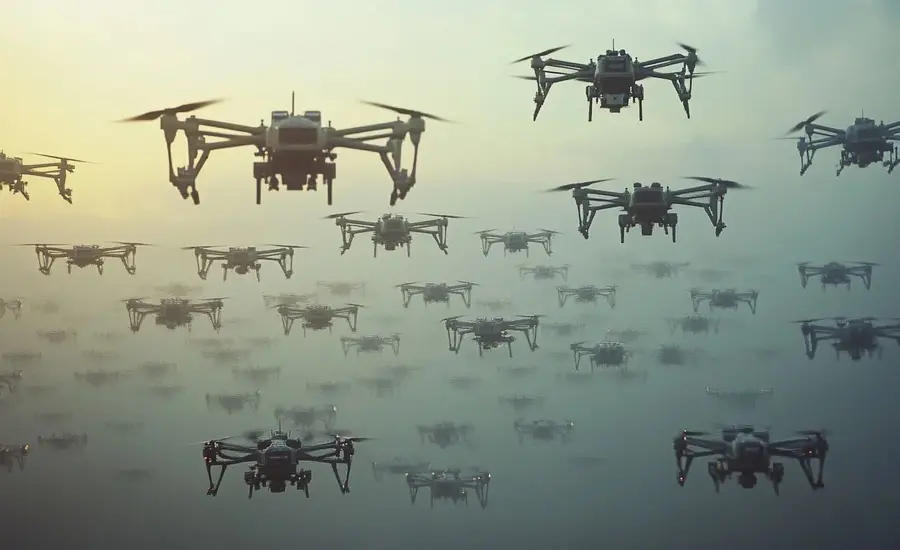
Amid escalating tensions in West Asia and the growing strategic role of drones in modern warfare, XTEND, an Israeli defence robotics company, has signed an $11 million manufacturing and distribution agreement with Indian defence technology firm Rayonix Tech to locally produce advanced AI-enabled Unmanned Aerial Vehicles (UAVs) in India.
The agreement marks a significant development in defence cooperation between Israel and India, especially at a time when autonomous aerial systems are becoming central to battlefield operations worldwide. The deal is expected to strengthen India’s indigenous drone manufacturing ecosystem while introducing advanced Israeli software-driven autonomy into the Indian defence market.
$11 Million Agreement to Manufacture AI-Powered Drones in India
Under the new agreement, Rayonix Tech will serve as XTEND’s exclusive partner in India for manufacturing, testing, and distribution of next-generation AI-powered drone systems.
The collaboration will establish local facilities in India where these UAVs will be assembled and integrated with XTEND’s proprietary autonomy software.
The partnership is being seen as a major boost to India’s push for self-reliance in defence production under the indigenous manufacturing framework, while also opening the door for advanced combat-ready drone technologies built within India.
XTEND’s XOS Platform to Power Indian-Built UAVs
At the centre of this defence partnership is XTEND’s proprietary XOS operating system, an advanced autonomy software architecture designed specifically for unmanned robotic systems.
The XOS platform enables:
• AI-based autonomous navigation
• Real-time mission planning
• Dynamic battlefield adaptation
• Remote operational control
• High-speed decision-making in contested environments
This software backbone allows drones to operate with limited human intervention while responding rapidly to changing combat conditions.
The architecture is designed to support multiple drone classes under a unified software ecosystem, allowing operational consistency across platforms.
Why These Drones Are Being Viewed as Highly Advanced
The UAV systems under this agreement are expected to combine:
• AI-guided targeting support
• Autonomous flight capability
• Precision tactical deployment
• Real-time obstacle avoidance
• Multi-mission adaptability
Defence experts note that such systems significantly improve combat survivability and operational effectiveness, especially in dense urban battle zones or contested border environments.
Because of their software-driven autonomy, these drones can continue operating even under disrupted communication conditions.
XTEND Previously Supplied 5,000 Assault Drones to Israeli Military
According to reports, XTEND is the same company that secured a major defence contract last year to supply 5,000 assault drones to the Israeli military.
That contract significantly elevated XTEND’s global defence profile, particularly in the domain of tactical assault drones and autonomous combat robotics.
Its systems are increasingly being deployed in military environments where rapid target acquisition and minimal operator exposure are critical.
India Chosen as Strategic Expansion Hub for AI Drone Ecosystem
XTEND says the India agreement is part of its broader international expansion strategy aimed at building regional manufacturing ecosystems while retaining a common software command architecture.
The goal is to allow partner nations to manufacture systems locally while continuing to operate under XTEND’s unified software framework.
This model offers:
• Local production capability
• Technology transfer
• Operational customization
• Scalable deployment potential
XTEND CEO Highlights India’s Fast-Growing Defence Technology Market
XTEND CEO Aviv Shapira stated that India has emerged as one of the fastest-growing defence technology markets globally.
According to him, India’s increasing focus on indigenous production and AI-enabled autonomous systems makes it a highly strategic market for XTEND’s future growth.
He also indicated that demand for advanced autonomous robotics in India is rising rapidly across both military and industrial sectors.
Technology Transfer Included in the Agreement
Reports suggest the agreement includes a strong technology transfer component, aimed at enhancing Indian expertise in:
• Advanced robotics
• Autonomous systems integration
• AI mission control
• UAV operational testing
This is expected to strengthen domestic capability development and create a deeper technological base for future indigenous drone projects.
India’s Drone Ecosystem Expanding Rapidly
According to the Press Information Bureau, India’s regulated drone ecosystem has expanded sharply.
As of February 2026, India has:
• 38,500+ registered drones
• 39,890 DGCA-certified remote pilots
• 244 approved drone training organisations
This rapid growth reflects how seriously India is investing in drone capability across civilian and defence sectors.
Why Drones Have Become Essential in Modern Warfare
Recent global conflicts have demonstrated how drones are reshaping warfare.
From the Russia–Ukraine War to current tensions involving Iran and Israel, drones have played decisive roles in:
• Surveillance
• Precision strikes
• Swarm attacks
• Reconnaissance
• Battlefield intelligence
Military analysts increasingly argue that future wars will be heavily shaped by autonomous drone fleets and coordinated drone swarms.
India’s Defence Focus Shifting Toward Drone Swarms
Indian defence planners are now placing greater emphasis on:
• Drone swarm capability
• AI-enabled autonomous strike systems
• Tactical battlefield UAV deployment
• Indigenous electronic warfare integration
Over the past two to three years, India has accelerated work in these sectors through both domestic innovation and foreign technology partnerships.
The XTEND–Rayonix agreement fits directly into that evolving strategic direction.
Broader Strategic Significance
The deal arrives at a time when India is actively diversifying defence technology partnerships while strengthening domestic manufacturing capability.
For Israel, India offers scale, industrial depth, and long-term market potential.
For India, the agreement offers immediate access to advanced AI-enabled combat drone architecture that can accelerate domestic defence readiness.