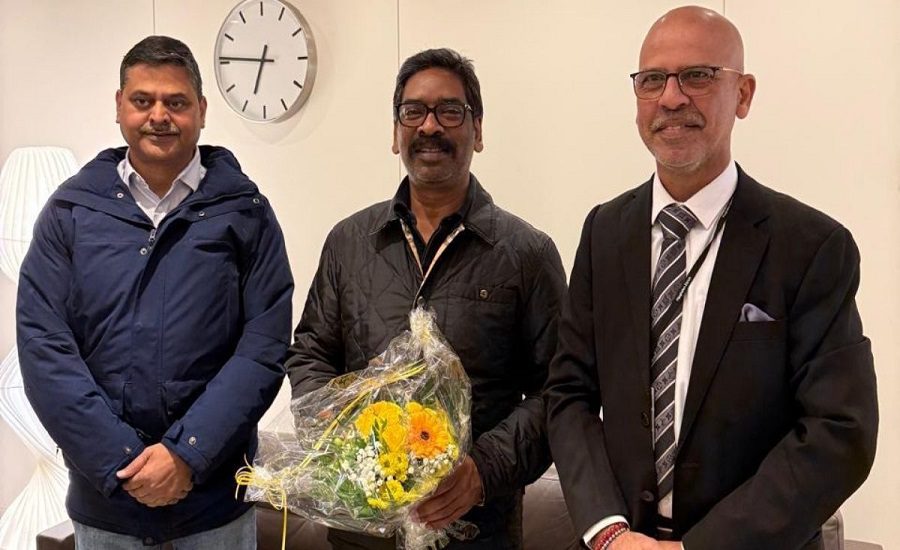
Ranchi: The Jharkhand government will present its energy transition model on global platforms during an upcoming delegation visit to Davos in Switzerland and the United Kingdom, officials said. The delegation will be led by Chief Minister Hemant Soren, who will attend the World Economic Forum (WEF) annual meeting in Davos this month and subsequently visit the UK to strengthen international partnerships.
“In Davos, Jharkhand will engage with global energy leaders, investors, technology providers, and policy institutions to highlight opportunities across renewable energy deployment, grid modernisation, energy storage, clean fuels, and industrial decarbonisation,” the Chief Minister’s Secretariat said in a statement on Friday.
Balancing Growth and Sustainability
Jharkhand’s energy transition strategy is built on responsible diversification, leveraging its existing energy infrastructure while accelerating investments in solar power, emerging clean technologies, and efficiency-driven systems. Central to this approach is the state’s development philosophy of “Growth in Harmony with Nature.”
Through its engagements at Davos and in the United Kingdom, the state aims to present an energy transition model that is credible, inclusive, and globally relevant, one that drives economic growth while respecting environmental limits and the aspirations of future generations.
Read also: Jharkhand CM Hemant Soren Launches Grassroots Innovation Internship, Boosts Education Initiatives
Ensuring a Just and Inclusive Transition
The state recognises that energy transitions must be socially inclusive, especially in regions where local economies and livelihoods have historically depended on conventional energy sectors. Jharkhand’s model emphasises worker transition, skill development, and community participation, ensuring that the shift toward cleaner energy strengthens social and economic foundations rather than disrupting them.
Building on a Legacy of Energy and Industrial Strength
For decades, Jharkhand has been central to India’s energy landscape. Its coal reserves, power plants, transmission networks, and industrial ecosystems have supported national growth, industrialisation, and infrastructure development. Cities such as Bokaro, Patratu, and Chandrapura have long been at the heart of India’s power and steel economy.
Today, Jharkhand is building on this legacy while adapting to a rapidly evolving global energy paradigm. The state is pursuing a balanced pathway that ensures energy security, economic stability, and employment, while steadily expanding the share of renewable and low-carbon solutions.
Leveraging Minerals for Global Energy Transition
Jharkhand’s mineral endowment, including materials critical for renewable energy systems, batteries, transmission infrastructure, and clean manufacturing, positions it as a strategic partner in the global energy transition. By integrating energy policy with a critical minerals strategy, the state aims to align extraction, processing, and energy use with environmental safeguards and long-term sustainability.
Strengthening International Collaboration
Following the WEF annual meeting, discussions in the United Kingdom will focus on collaboration in clean energy finance, technology transfer, institutional partnerships, and capacity building, reflecting the shared India–UK commitment to climate action and sustainable growth.
As Jharkhand marks 25 years of statehood, its energy vision demonstrates that regions built on traditional energy strengths can lead the transition by combining industrial experience, policy reforms, global partnerships, and ecological consciousness.
Historic Lecture at Oxford
After the Davos meeting scheduled for January 18-24, CM Hemant Soren will deliver a special lecture at the Blavatnik School of Government, University of Oxford. He will be the first Indian Chief Minister to address the prestigious institution, one of the world’s leading schools of public policy and governance, officials said.
Jharkhand’s global engagements signal the state’s ambition to emerge as a model for sustainable energy transition, balancing economic growth with environmental responsibility.