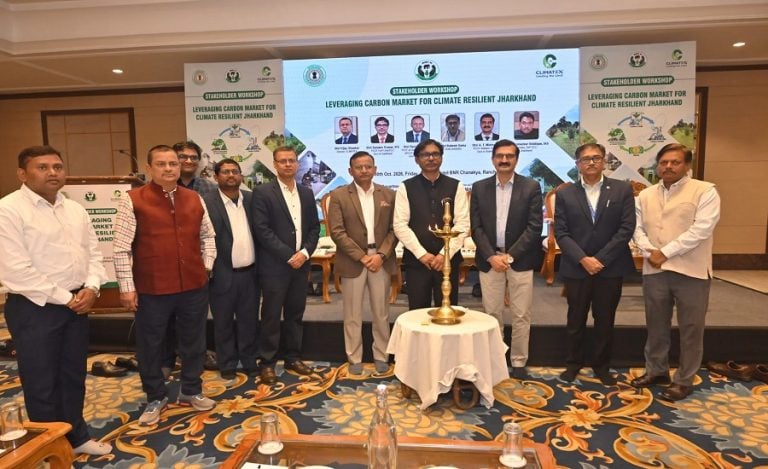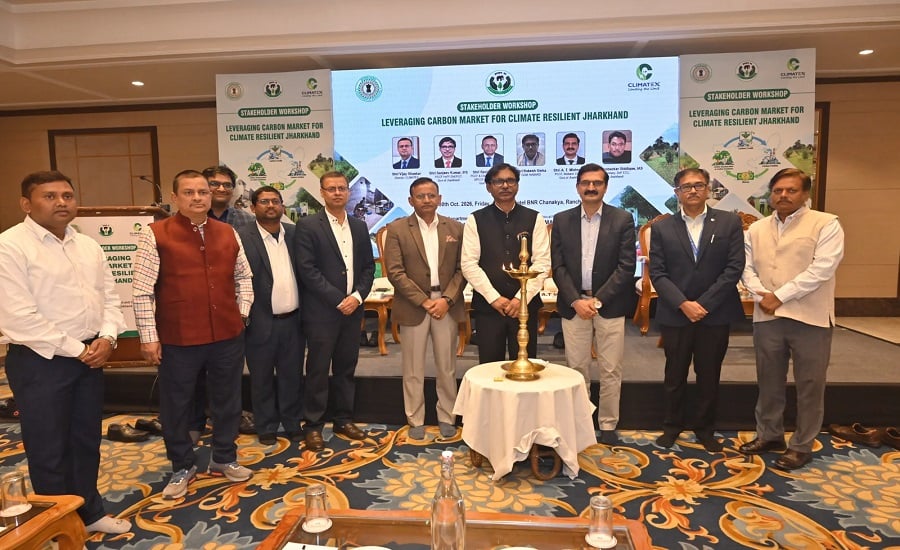
Ranchi: The Jharkhand Forest, Environment and Climate Change Department has organised a stakeholder workshop to discuss the implementation of five potential carbon credit projects across different government departments. The initiative aims to help the state monetise existing carbon-reduction programmes while generating additional income opportunities for rural communities.
The day-long workshop was held on Friday, following an initial workshop conducted in May to identify viable carbon finance opportunities in Jharkhand. During the latest meeting, government officials, financial institutions, climate experts and development organisations discussed strategies to implement the identified projects and generate verified carbon credits.
According to Ravi Ranjan, State Nodal Officer for Climate Change, five ongoing schemes from different departments and institutions have been selected for carbon monetisation.
Five Government Schemes Identified for Carbon Credit Projects
Following the initial stakeholder workshop in May, five existing schemes were identified as potential carbon credit projects. These initiatives cover forestry, rural development, urban infrastructure, renewable energy and agricultural livelihoods.
The selected projects are:
- Mukhyamantri Jan Van Yojana: An initiative of the Forest, Environment and Climate Change Department.
- Birsa Harit Gram Yojana: A scheme implemented by the Rural Development Department.
- Compressed Biogas Generation Initiative: An initiative under the Housing and Urban Development Department.
- Solar Mini and Micro Grid Systems: Projects supported by the Jharkhand Renewable Energy Development Agency (JREDA).
- WADI Schemes: Initiatives supported by the National Bank for Agriculture and Rural Development (NABARD).
These programmes have been identified for their potential to generate carbon credits through activities such as agroforestry, land restoration, renewable energy adoption and sustainable rural development.
Stakeholder Workshop Discusses Carbon Finance Opportunities
The workshop brought together representatives from government departments, financial institutions, climate experts and development organisations to discuss how existing schemes can be linked with carbon finance mechanisms.
Participants examined ways to generate verified carbon credits from ongoing initiatives and explore opportunities to mobilise additional funding for projects that contribute to carbon reduction.
The discussions also focused on strengthening rural livelihoods by enabling communities to benefit financially from activities such as tree plantation, land restoration and sustainable resource management.
Concept Notes to Be Developed for Five Projects
Following the suggestions and recommendations shared by experts during the workshop, concept notes will be prepared for the five identified projects.
Ravi Ranjan said the next step would be to develop these concept notes to explore how carbon credits can be leveraged alongside efforts to generate rural livelihoods in the state.
The proposed approach is expected to help government departments access carbon finance for existing programmes while creating additional economic opportunities for participating communities.
Climatex Presents Carbon Credit Feasibility Study
Climatex, a Jharkhand-based organisation, partnered with the Forest Department to identify and design potential carbon credit projects.
During Friday’s workshop, the organisation presented the findings of its feasibility study conducted for the department. The study formed part of the broader exercise to identify suitable government schemes that could be developed into carbon credit projects.
The initiative marks a step towards integrating carbon finance into Jharkhand’s ongoing development programmes, with a focus on environmental sustainability, renewable energy and rural income generation.
Read also: Jharkhand Plans to Turn Vacated Maoist Security Camps into Development Centres