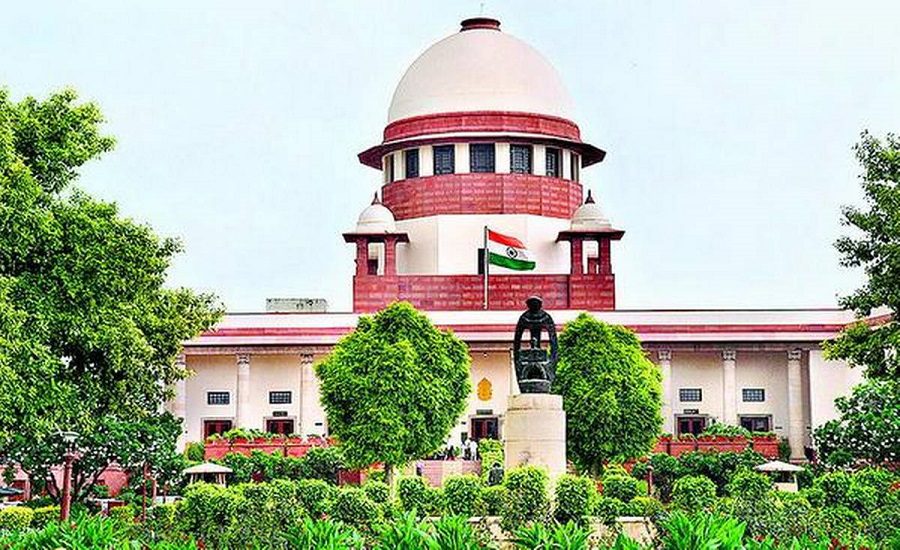
New Delhi: In a definitive judgment reinforcing service discipline and limited judicial interference in disciplinary actions, the Supreme Court of India on Friday upheld the dismissal of a Central Industrial Security Force (CISF) constable who contracted a second marriage while his first marriage was still legally subsisting.
The top court emphasized the restricted scope of judicial review in service matters and restored disciplinary findings of the CISF authorities, overturning the High Court’s attempt to moderate the punishment.
Background of the CISF Constable Bigamy Case
The case, titled Union of India v. Pranab Kumar Nath, arises from a disciplinary proceeding initiated against a CISF constable who joined the force in July 2006. In March 2016, the constable’s first wife filed a written complaint with CISF authorities alleging that he had entered into a second marriage during the subsistence of their first marriage and had also neglected her and their minor daughter.
Following the complaint, a departmental inquiry was ordered under Rule 18(b) of the CISF Rules, 2001, which deemed contracting a second marriage while having a living spouse as a serious violation of service conditions and grave misconduct.
The disciplinary officer found the charges proved, and on 1 July 2017, the Senior Commandant dismissed the constable from service. The decision was also upheld by the CISF appellate and revision authorities.
High Court’s Intervention on CISF Constable Bigamy Case
Dissatisfied with the punishment, the constable moved the Guwahati High Court challenging the dismissal order under Article 226 of the Constitution.
A Single Judge and later a Division Bench held that while the misconduct (second marriage) was established, the punishment of dismissal was “disproportionately harsh”, particularly given the personal hardship it might cause to the employee and his family.
The High Court remanded the matter to the disciplinary authority with directions to impose a lesser penalty.
Supreme Court’s Reasoning on CISF Constable Bigamy Case
1. Judicial Review Has Limits in Service Matters
A Constitution Bench of Justices Sanjay Karol and Vipul M. Pancholi allowed the appeal filed by the Union of India and held that the High Court exceeded its jurisdiction by acting as an appellate authority rather than a forum for judicial review.
The Supreme Court clarified that judicial review in service matters is confined to examining process irregularities, violation of natural justice, absence of evidence, or a punishment that is so disproportionate that it shocks the conscience of the court.
2. Application of “Dura Lex Sed Lex”
The bench invoked the legal maxim “Dura lex sed lex” — “the law is harsh, but it is the law” — stressing that unpleasant consequences of enforcing the law cannot dilute its mandate.
The Court noted the absence of procedural flaws, non-compliance, or ambiguity in the rules governing CISF service conditions, thus leaving no legal basis for interference.
3. Service Discipline and Public Confidence
The Court reaffirmed that rules like Rule 18(b) are not moral censures, but legitimate service conditions intended to uphold the highest standards of discipline, integrity, and public confidence in disciplined forces.
Even personal conduct, if it has the potential to affect discipline or organisational efficacy, can fall within the regulatory ambit.