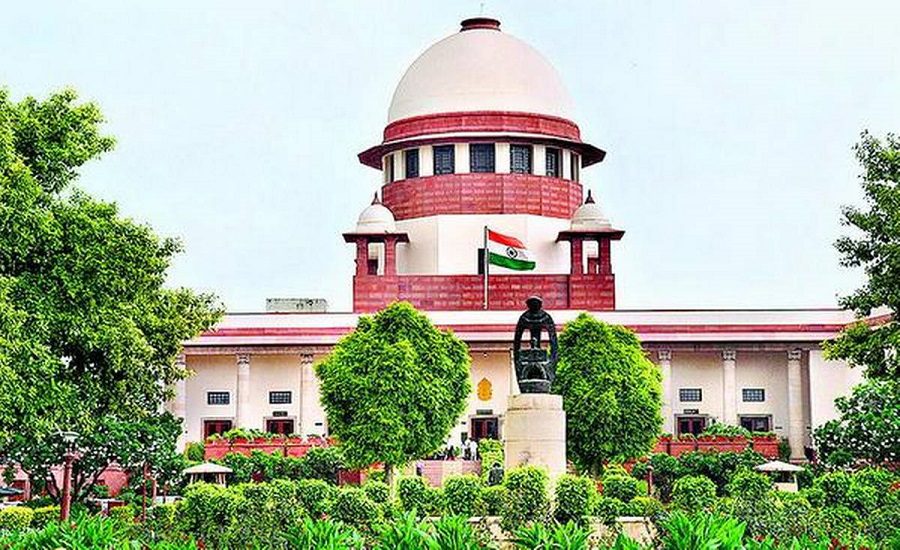
Jaipur / New Delhi: In a landmark administrative law and constitutional governance ruling, the Supreme Court of India has quashed the Rajasthan Government’s notification that named two revenue villages — Amargarh and Sagatsar — after private individuals, holding that the State cannot act in contravention of its own binding policy.
The judgment underscores the enforceability of executive policy decisions and affirms the fundamental right to equality under Article 14 of the Indian Constitution.
Background of Rajasthan Village Naming After Individuals Case
The dispute traces back to a December 31, 2020 notification issued under Section 16 of the Rajasthan Land Revenue Act, 1956, by which the state government carved out four new revenue villages from the existing settlement of Meghwalo Ki Dhani in Sohda, Barmer district.
Two of these — Amargarh and Sagatsar — were derived from the names of local land donors Amarram and Sagat Singh (through his wife).
Before issuing the notification, the Tehsildar certified compliance with statutory procedures, and affidavits were filed by the land donors. However, in 2025, during a subsequent reorganisation exercise of Gram Panchayats, villagers objected to the names, claiming that they violated a long-standing government policy that forbids naming new revenue villages after individuals.
Rajasthan Village Naming After Individuals Case: Supreme Court Restores Lower Court Order
A Bench comprising Justice Sanjay Kumar and Justice Alok Aradhe allowed an appeal filed by residents of Sohda village in Barmer district, setting aside an earlier Division Bench judgment of the Rajasthan High Court that had upheld the creation of the revenue villages.
The Supreme Court instead restored a Single Judge’s order quashing the notifications insofar as they named the villages after individuals.
The Core Legal Issue: Binding Nature of Government Policy
At the heart of the legal battle was the interpretation and applicability of a Revenue Department circular dated August 20, 2009, which clearly states that:
> “While deciding the name [of a revenue village], it shall be ensured that it is not based on any person, religion, caste, or sub-caste. As far as possible, the name of the village shall be proposed with general consensus.”
Rajasthan Village Naming After Individuals Case: Single Judge, High Court, and Division Bench
Initially, a Single Judge of the Rajasthan High Court quashed the notification for Amargarh and Sagatsar, holding that the naming clearly violated the 2009 policy and granting the State liberty to rename the villages in accordance with law.
However, a Division Bench of the same High Court later overturned that decision, accepting the State’s contention that the policy was “directory” and that earlier High Court judgments should not apply retrospectively.
Supreme Court Delivers a Decisive Verdict on Rajasthan Village Naming After Individuals Case
The Supreme Court found the Division Bench’s reasoning flawed and emphasised two core principles:
1. Executive Policy Is Binding Unless Lawfully Amended
The Court held that an executive policy decision, even if issued by way of a circular, is binding on the government unless it is lawfully amended or withdrawn.
Any action in derogation of such a policy, without valid justification, is not only unlawful but also arbitrary and discriminatory — violating Article 14 of the Constitution, which guarantees equality before the law.
2. Violation of Policy Amounts to Arbitrary State Action
By naming villages after individuals, the Rajasthan Government acted contrary to its own binding policy.
The Supreme Court observed that this contravention constituted arbitrariness, undermining the rule-of-law principle and the rationale behind having uniform criteria for naming revenue villages.
Constitutional and Administrative Law Implications
The judgment reinforces a settled legal doctrine: a government must not be permitted to act in contravention of its own policy. While executive powers allow the government to enact and enforce policies, these policies, once declared, are not merely aspirational or directory; they bind the executive unless properly amended.
The verdict also emphasizes that courts should adjudicate disputes on their merits, and procedural technicalities — such as reliance on earlier judgments or arguments about retrospectivity — cannot justify ignoring binding policies.
Impact of Rajasthan Village Naming After Individuals Case on Governance and Communal Harmony
The 2009 circular was originally framed to promote communal harmony and avoid arbitrary or subjective naming that could reflect individual, caste, religious, or community interests.
By enforcing this rule, the Supreme Court has reaffirmed the need for neutrality and broad public consensus in naming public entities like villages, towns, and civic bodies — a sensitive cultural and sociopolitical area in India.
What Happens Next?
With the Supreme Court’s order restored, the State Government will be required to rename the affected villages in accordance with its own policy and applicable legal principles.
The judgment may also set a precedent for future disputes involving policy enforcement and executive action, not only in Rajasthan but across other Indian states where similar issues could arise.