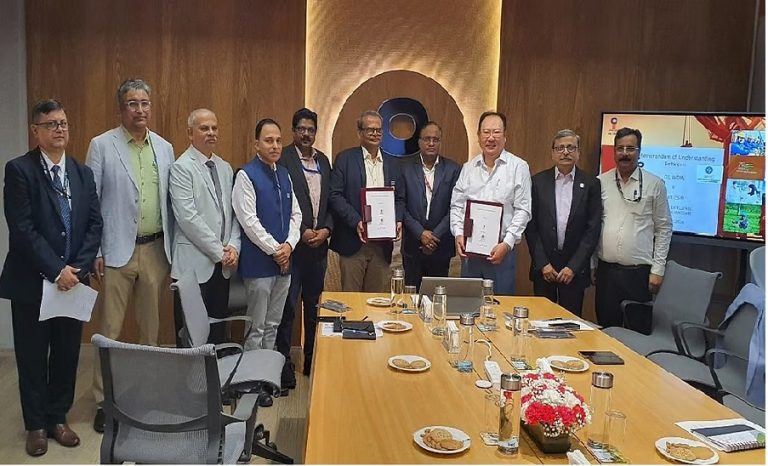
New Delhi: Defence Research and Development Organisation (DRDO) has taken a significant stride in advancing its indigenous defence software capabilities with the selection of MicroGenesis TechSoft Pvt. Ltd.’s INDIGIS geospatial platform for integration into the Pralay tactical quasi-ballistic missile system.
This development marks a pivotal moment in India’s push for self-reliance in critical defence technologies, especially in mission planning and battlefield geospatial visualization — a domain historically dominated by licensed foreign systems.
Background of INDIGIS Platform Pralay Missile Integration
The Pralay missile is an indigenously developed solid-propellant shore-to-surface quasi-ballistic missile, designed by DRDO, with a focus on tactical battlefield strike capabilities.
Capable of carrying a conventional warhead, the system boasts a range of approximately 150 to 500 kilometers, guided by advanced navigation systems to ensure high precision and target accuracy, with a Circular Error Probable (CEP) of less than 10 meters.
Pralay underwent two consecutive successful flight tests conducted by DRDO in July 2025 from the Dr APJ Abdul Kalam Missile Test Range in Odisha, validating its minimum and maximum range performance.
The missile is slated for induction into the Indian armed forces, enhancing India’s conventional strike capability.
What is INDIGIS? A Sovereign Geographic Information System (GIS)
INDIGIS, initially developed by DRDO’s Centre for Artificial Intelligence and Robotics (CAIR) in Bengaluru, is a 100% indigenous Geographic Information System (GIS) platform tailored for mission-critical spatial analytics and visualisation.
The platform is designed to operate offline and in secure environments, addressing concerns of cyber vulnerabilities and foreign-software dependencies in defence applications.
Comprising a robust kernel with more than 500 APIs, INDIGIS supports multiple operating systems, including Linux, Windows, and Android, and is used across various DRDO programs in real-time geospatial data processing and decision support.
Importance of INDIGIS Platform Pralay Missile Integration
The integration of INDIGIS into the Pralay missile system serves several strategic purposes:
1. Enhanced Operational Planning
INDIGIS offers missile battery commanders a secure, sovereign digital map environment that enables accurate visualisation of launcher positions, missile variants (including penetration-aided and sub-munition types), real-time range rings, and no-escape zones — key elements in planning precision missions.
2. Offline and Secure Computing
Since the system supports offline operations and is free from foreign software components, it eliminates cybersecurity risks and ensures data protection — a critical requirement for mission-critical defence systems.
3. Geospatial Decision Support
The platform provides real-time spatial analytics and terrain modelling, helping commanders simulate multiple scenarios, optimise launcher deployment, and make rapid battlefield decisions with unprecedented accuracy.
Strategic Significance of INDIGIS Platform Pralay Missile Integration
The selection of INDIGIS for Pralay demonstrates DRDO’s commitment to Atmanirbhar Bharat (self-reliant India) in defence technologies. This underscores a broader policy shift where indigenous solutions are prioritised over foreign-licensed software in security-sensitive areas.
Reducing Foreign Dependencies
Historically, many Indian defence systems relied on foreign GIS engines for mission planning and geospatial analytics.
Replacing these with INDIGIS significantly lowers risks associated with foreign dependencies, including backdoor vulnerabilities and supply chain disruptions.
Boosting Defence Tech Ecosystem
The partnership between DRDO and MicroGenesis sets an industry precedent for commercialisation of DRDO-innovated technologies through technology transfer agreements. It enhances the role of Indian private sector firms in defence R&D and digital innovation.