New Delhi: NITI Aayog has stated that India can achieve its ambitious vision of Viksit Bharat by 2047 while also reaching Net Zero emissions by 2070, according to a new set of scenario-based reports released on Tuesday.
The reports outline a balanced pathway that aligns economic growth with climate commitments, focusing on key sectors such as transport, industry, power, and critical minerals.
Multi-Sector Reports Unveiled in New Delhi
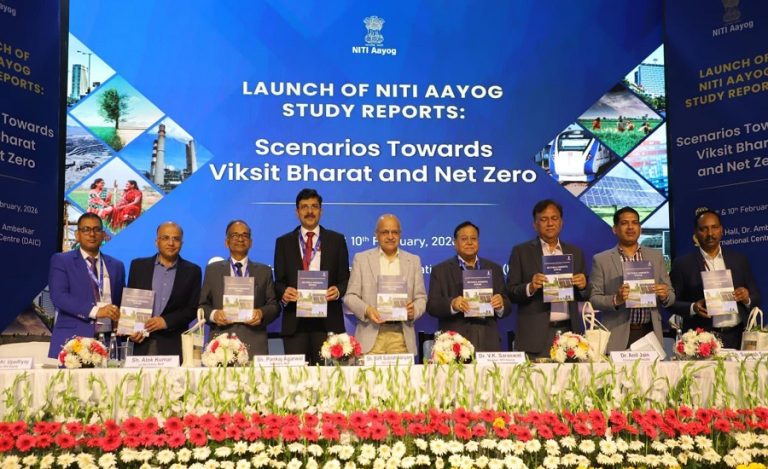
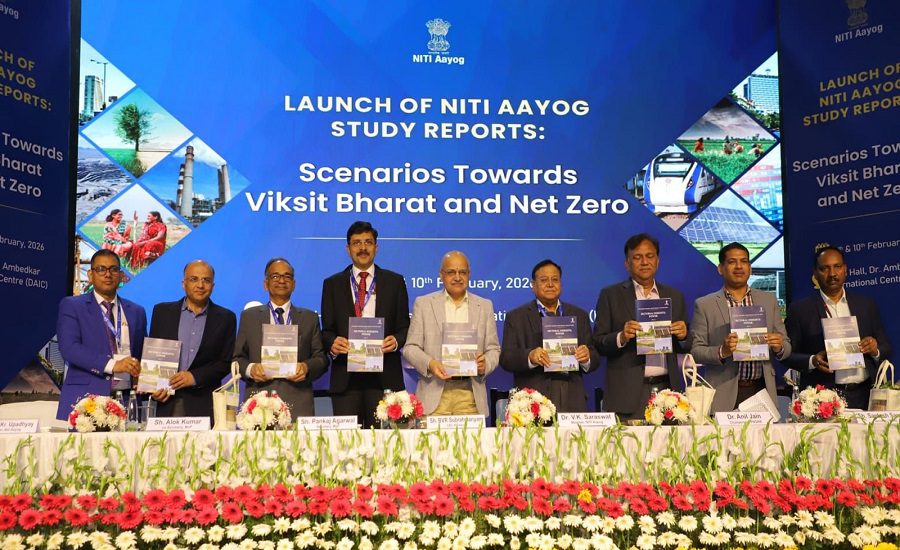
The four sectoral reports were unveiled at the Ambedkar International Centre in the presence of senior policymakers, including V. K. Saraswat and B. V. R. Subrahmanyam, along with officials from power, renewable energy, and petroleum ministries.
These studies are part of a broader series of 11 reports aimed at mapping India’s long-term development trajectory.
Key Drivers: Electrification, Clean Energy and Efficiency
The reports highlight that electrification, clean energy adoption, and behavioral change under Mission LiFE will be crucial to achieving Net Zero goals.
Key projections include:
- Final energy demand could reduce by 20% by 2070 through efficiency and circular economy practices.
- Electricity’s share in energy consumption may rise from 21% in 2025 to nearly 60% by 2070.
- Non-fossil fuel power generation could grow from 23% to 80–85% by 2070.
The transition will be driven by renewable energy expansion, energy storage, nuclear power, and green hydrogen.
Coal Demand to Rise Until 2047
Despite the clean energy push, the report notes that India’s coal consumption is expected to continue rising until 2047 due to growing energy needs, even as the country works toward Net Zero emissions.
Transport Sector to See Major Transformation
The transport sector is expected to undergo a significant shift, with electricity, biofuels, and hydrogen projected to meet nearly 90% of energy demand by 2070.
This transformation will be supported by:
- Expansion of railways and waterways
- Adoption of zero-emission vehicles
- Increased use of public and shared mobility
Industrial Growth and Decarbonisation
India’s industrial sector, especially hard-to-abate industries like steel, cement, and aluminium, is expected to grow four to six times by 2070.
Decarbonisation strategies will include:
- Electrification
- Green hydrogen usage
- Recycling and material efficiency
Focus on Critical Minerals and Supply Chains
The report emphasizes the importance of securing critical minerals for the energy transition. It estimates that 20–25% of copper and graphite demand could be met through recycling by mid-century.
Strategies include:
- Domestic resource development
- International sourcing
- Institutional reforms
- Circular economy practices
Leaders Highlight Opportunities and Challenges
Speaking at the event, V.K. Saraswat said the transition presents both challenges and opportunities, particularly in adopting clean fuels like green hydrogen.
B.V.R. Subrahmanyam noted that power, transport, and industry together account for nearly 80% of the energy transition challenge. He added that while critical mineral imports may increase, reduced fossil fuel imports could improve India’s energy security.
Integrated Planning Key to Energy Transition
Officials stressed the need for robust planning across power generation, transmission, storage, and demand management. Maintaining financially stable power distribution companies will also be critical during the transition.
A Roadmap for Sustainable Growth
According to NITI Aayog, these reports represent India’s first government-led, multi-sectoral integrated modelling exercise. The findings are expected to guide long-term policymaking as the country balances rapid economic development with climate responsibility.
Read also: NITI Aayog and UNICEF India Collaborate to Boost Nutrition and Health in Aspirational Districts