New Delhi: The National Research Development Corporation (NRDC) has transferred the technology for an Autonomous Underwater Profiling Drifter (AUPD), capable of measuring ocean parameters at depths of up to 2,000 metres, to Coratia Technologies Private Limited. The technology was developed by the National Institute of Ocean Technology (NIOT), Chennai, to support ocean observation, climate research and marine science.
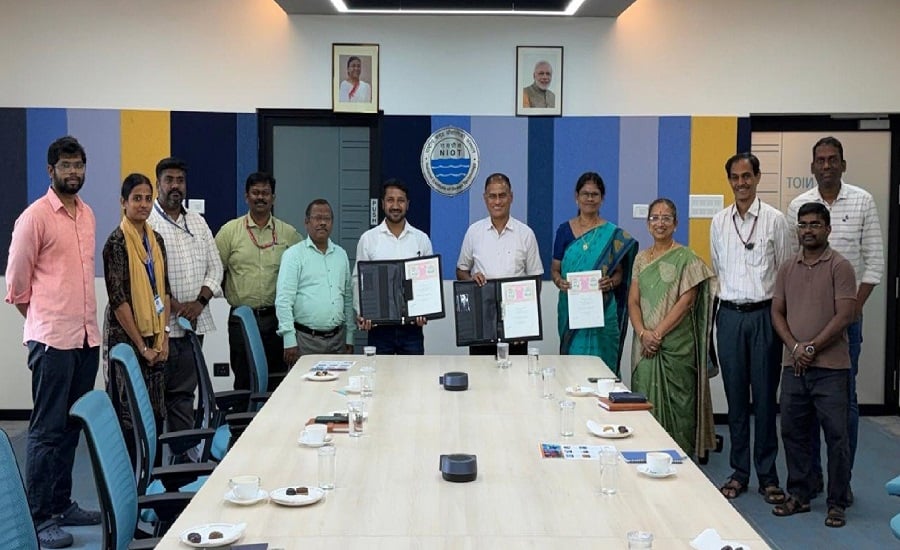
The technology transfer licence agreements were signed and exchanged on October 21, 2026, at the NIOT campus in Chennai. The transfer aims to support the application of the indigenous ocean-monitoring technology and strengthen capabilities in ocean observation and data collection.
NRDC Transfers Autonomous Underwater Profiling Drifter Technology
The technology transfer agreement involved NRDC, NIOT and Coratia Technologies. Prof. Balaji Ramakrishnan, Director of NIOT, and Debendra Pradhan, Chief Executive Officer of Coratia Technologies, signed and exchanged the tripartite technology transfer licence agreements.
Representing NRDC, Dr. B. K. Sahu, Head of Outreach, Dr. Bhavya Manjeera and Dr. Hareram participated in the event virtually.
NIOT officials attending the ceremony included Dr. Vijaya Ravichandran, Scientist-G and Deputy Director; Dr. Phani Kumar and Dr. Muthuvel Panayan, both Scientist-G and Group Directors; and K. Chithra, Scientist-F and Project Director, along with other scientists. The agreement provides for the transfer of NIOT-developed technology to Coratia Technologies, supporting its potential application beyond the research and development stage.
Read also: NRDC Appoints CEL CMD Shankar Narayan as Additional Chairman and Managing Director
What Is an Autonomous Underwater Profiling Drifter?
The Autonomous Underwater Profiling Drifter is a free-drifting, buoyancy-controlled device designed to collect information about ocean conditions. It can measure ocean parameters at depths of up to 2,000 metres and transmit the collected data in real time through satellite communication.
The system is equipped with a conductivity, temperature and depth (CTD) sensor, which measures key ocean parameters, including salinity, temperature and depth.
By collecting ocean profiles at different depths, the AUPD can help researchers better understand variations in ocean conditions and improve the availability of data for scientific analysis.
AUPD Technology to Support Ocean and Climate Research
The AUPD is designed to improve the understanding of ocean heat distribution and freshwater transport. The data collected by the device can be used in ocean forecasting models through data assimilation, a process in which observations are incorporated into models to improve their representation of actual ocean conditions.
The technology has several potential applications, including:
- Ocean monitoring: Measuring temperature, salinity and depth at different ocean levels.
- Climate research: Supporting studies of ocean heat distribution and climate variability.
- Ocean forecasting: Providing observational data for assimilation into ocean models.
- Marine ecosystem management: Supporting scientific assessments of ocean conditions and marine environments.
- Scientific infrastructure: Strengthening capabilities in ocean observation and data collection.
Real-time satellite transmission can help make the collected information available for research and monitoring, supporting improved ocean-related assessments.
Technology Transfer Supports Indigenous Ocean Technology
The transfer of the AUPD technology reflects collaboration between a government-supported technology transfer organisation, a national ocean research institute and a private-sector company.
NIOT developed the device, while NRDC facilitated the technology transfer to Coratia Technologies. Such collaborations can help bridge the gap between research and potential practical applications by enabling industry participation in the development and use of indigenous technologies.
AUPD Aligns with UN Sustainable Development Goals
The technology’s potential applications align with several United Nations Sustainable Development Goals (SDGs), particularly:
- SDG 7 – Affordable and Clean Energy: Supporting scientific knowledge that may contribute to assessments of ocean-based energy opportunities.
- SDG 9 – Industry, Innovation and Infrastructure: Promoting technological development and collaboration between research institutions and industry.
- SDG 13 – Climate Action: Supporting climate research through improved ocean observations.
- SDG 14 – Life Below Water: Contributing to ocean monitoring and scientific understanding of marine environments.
Through the technology transfer, NRDC, NIOT and Coratia Technologies aim to support the wider application of ocean-monitoring technology and strengthen India’s capabilities in marine research and innovation.
About National Research Development Corporation (NRDC)
The National Research Development Corporation (NRDC) is a Government of India enterprise under the Department of Scientific and Industrial Research (DSIR), Ministry of Science and Technology. It facilitates the transfer and commercialisation of technologies developed by research institutions, universities and laboratories, helping connect scientific innovation with industry and potential end users.
Read also: NRDC Signs MoA With CPPRI to Boost Technology Development, Transfer and Commercialisation