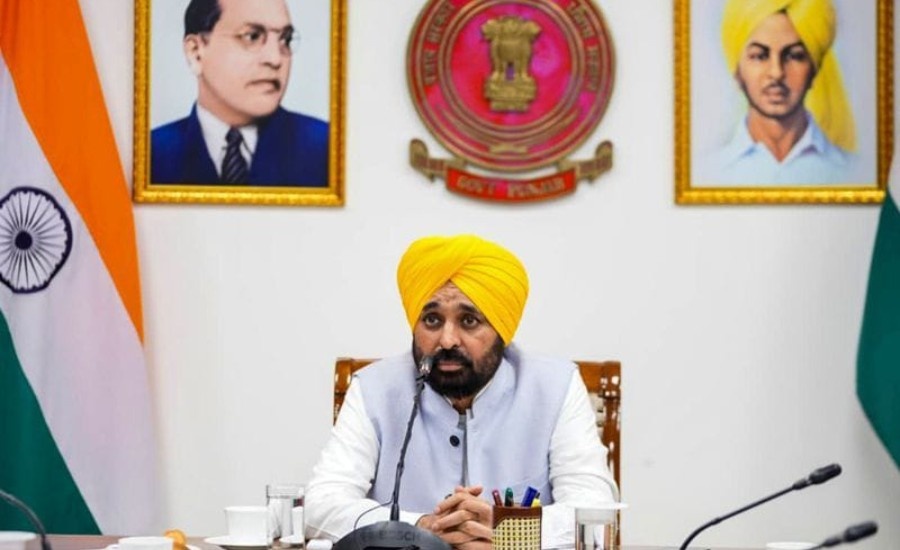
Chandigarh: Punjab Chief Minister Bhagwant Singh Mann has said he does not favour filing FIRs against farmers over stubble burning and called for financial incentives to encourage them to manage paddy residue without setting it on fire.
Mann made the remarks at the Punjab Agricultural University (PAU) Kisan Mela in Ludhiana, days before the paddy harvesting season begins. Farmers have been demanding a cash incentive of ₹3,000 per acre for managing stubble.
Mann Backs Incentives Over FIRs
The Chief Minister said farmers should receive financial support instead of facing criminal action for stubble burning. He argued that farmers themselves do not want to burn crop residue because the smoke affects their own fields and surroundings as well.
Mann also questioned the repeated focus on Punjab when discussing air pollution in Delhi-NCR. He referred to Punjab’s contribution of around 180 lakh metric tonnes of paddy to the central pool and said the amount of crop residue generated from it also needed to be considered.
He questioned whether emissions from Haryana and Uttar Pradesh were also being adequately considered while discussing the region’s air pollution.
Mann’s comments come as Punjab prepares for another paddy harvesting season, when the limited gap between harvesting and wheat sowing often creates pressure on farmers to clear their fields quickly.
Read Also: From Rehabilitation to Self-Reliance: Punjab Trains 48 Children in Job-Ready Skills
Farmers Seek ₹3,000 Per Acre
Farmer organisations have been seeking financial assistance for managing paddy straw. The demand is for a payment of ₹3,000 per acre to help farmers cover the cost of handling crop residue through alternative methods.
Farmer leaders have also called for the withdrawal of FIRs already registered in stubble-burning cases.
Bharatiya Kisan Union (Ekta Ugrahan) general secretary Sukhdev Singh Kokrikalan said the government should first cancel existing FIRs against farmers. He also linked Mann’s latest statement to the upcoming Punjab Assembly elections.
BKU Lakhowal leader Harinder Singh Lakhowal also reiterated the demand for cash incentives for farmers managing stubble without burning it.
Why Farmers Resort to Stubble Burning
Stubble burning remains a recurring challenge in Punjab and neighbouring states after the paddy harvest.
Farmers have only a short window between harvesting paddy and sowing the next crop, particularly wheat. Clearing the residue manually or through machinery can involve additional time and costs, making burning a quick method of field preparation.
The practice, however, contributes to seasonal air pollution across northern India and has become a major environmental and public-health concern during October and November.
FIRs, Fines and ‘Red Entries’
Farmers found burning crop residue can face legal and financial consequences.
According to recent reports, FIRs have been registered under Section 223 of the Bharatiya Nyaya Sanhita in stubble-burning cases. Environmental compensation can also be imposed, while a “red entry” may be recorded in revenue records. Such entries can affect access to loans and create difficulties in transactions involving agricultural land.
The enforcement system has therefore remained a contentious issue between authorities and farmer organisations, with unions arguing that financial assistance and practical alternatives should receive greater emphasis.
Stubble Burning Has Fallen Sharply
Punjab has recorded a substantial decline in farm-fire incidents over the past few years.
According to figures cited by the Punjab government, incidents fell from 36,663 in 2023 to 10,909 in 2024 and 5,114 in 2025, representing an 86% decline between 2023 and 2025.
The state had recorded higher numbers in earlier years, including 49,922 incidents in 2022, 71,304 in 2021 and 76,590 in 2020.
Districts such as Sangrur, Mansa, Bathinda and Amritsar have historically reported significant numbers of farm-fire incidents.
The government has said that the reduction has been supported by awareness campaigns, crop-residue management machinery and greater involvement of local institutions.
Subsidised Machines Offered to Farmers
Punjab has also promoted machinery-based alternatives to stubble burning through subsidies.
Farmers can access equipment such as super seeders, smart seeders, happy seeders, paddy straw choppers, shredders, mulchers, hydraulic reversible mould board ploughs and zero-till drills for managing residue in the field.
For collecting and using paddy straw outside the field, equipment such as balers and rakes is also available.
Individual farmers receive subsidies covering 50% of equipment costs, while cooperative societies and panchayats can receive subsidies of up to 80%.
The state has also been expanding village- and block-level awareness campaigns to encourage farmers to adopt these alternatives.
Focus Shifts Towards Incentives and Alternatives
Mann’s latest remarks bring the debate back to the balance between enforcement and financial support for farmers.
Punjab’s declining farm-fire numbers show that stubble management measures have produced measurable results, but the state continues to face the challenge of reducing incidents further during each harvest season.
With farmers seeking direct financial assistance and the government promoting machinery and awareness, the coming paddy season will again test how effectively Punjab can combine enforcement, incentives and practical crop-residue solutions.
Read Also: Japan Visit Ahead: Punjab CM Mann Invited to Asian Games Hockey Semis and Finals