New Delhi: India’s maritime and aerial defence posture is undergoing a significant strategic transformation as the Indian Navy strengthens its long-range strike capabilities through the induction of Rafale M fighter jets and the operationalisation of MH-60R multi-role helicopters.
Speaking at the commissioning ceremony of the second MH-60R squadron at INS Hansa, Chief of Naval Staff Admiral Dinesh K Tripathi underscored how these advancements will elevate the Navy’s strike reach, surveillance agility and maritime defence deterrence in an increasingly complex Indo-Pacific security environment.
Strategic Rationale of Second MH-60R Squadron
Amid shifting geopolitical dynamics in the Indian Ocean Region (IOR) and rising maritime security challenges, India’s emphasis on bolstering its naval aviation assets reflects a broader defence modernisation trajectory aligned with Aatmanir bharat by 2047.
Admiral Tripathi reiterated that strengthening both fixed-wing and rotary-wing aviation platforms enhances operational flexibility — from deep-strike missions to anti-submarine warfare (ASW).
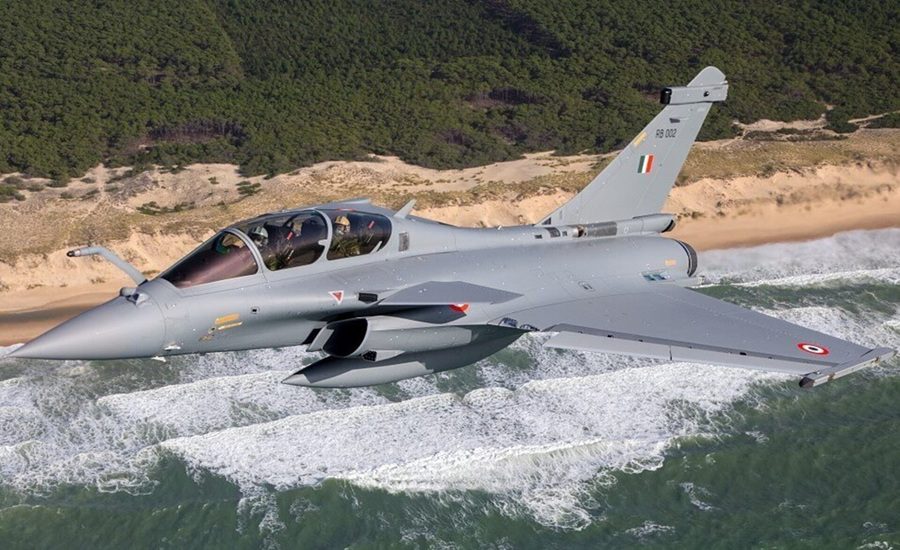
Rafale M Jet Acquisition: Strengthening Long-Range Strike Capability
In April 2025, India and France signed an Inter-Governmental Agreement (IGA) for the procurement of 26 Dassault Rafale M fighter jets specifically configured for carrier operations.
This fleet comprises 22 single-seat Rafale M aircraft and four twin-seat Rafale D trainers, alongside a comprehensive package that includes simulators, advanced weapon systems, training and a five-year Performance Based Logistics (PBL) support arrangement.
Strategic Significance
The Rafale M is designed for carrier-borne missions, enabling the Indian Navy to extend its long-range maritime strike and land attack capabilities — capabilities that are critical for asserting sea control and deterrence over vast maritime domains.
Equipped with advanced avionics, multi-role weaponry and superior sensor suites, these jets enhance India’s power projection in contested arenas and act as a strategic counterweight in an era of rising naval competition.
MH-60R Helicopter Induction: A Force Multiplier for Maritime Defence
Operational Commissioning
On 17 December 2025, the Indian Navy commissioned its second MH-60R squadron — INAS 335 “Ospreys” — at INS Hansa in Goa, affirming an important milestone in bolstering naval rotary-wing capacities.
The event was presided over by Admiral Tripathi and highlighted the Navy’s commitment to multi-domain maritime warfare synergy.
According to the Navy, this squadron operates Sikorsky MH-60R Seahawk helicopters, advanced multi-role platforms purpose-built for anti-submarine warfare (ASW), anti-surface warfare (ASuW), search and rescue (SAR), medical evacuation (MEDEVAC) and vertical replenishment (VERTREP) missions.
Combat and Surveillance Capabilities
The MH-60R is equipped with state-of-the-art sensors, radar and communication systems that significantly enhance maritime domain awareness (MDA) and enable rapid operational responses.
These aircraft can deploy torpedoes, depth charges and other mission-critical armaments, making them versatile tools for both peacetime surveillance and wartime contingencies.
Admiral Tripathi pointed out that the induction of these helicopters on the Western Seaboard reflects not only operational necessity but also India’s intent to maintain a robust deterrent across its strategic maritime approaches.
Indigenisation and Future Roadmap
While acquiring advanced foreign platforms remains essential to meet immediate operational requirements, the Indian Navy is simultaneously investing in indigenous development of multi-role helicopters and associated support systems, often in collaboration with Defence Public Sector Undertakings such as Hindustan Aeronautics Limited (HAL).
Admiral Tripathi has emphasised that while foreign procurements bridge current capability gaps, India’s long-term vision is to foster a sustainable defence industrial base that can supply sophisticated avionics, weaponry and combat platforms under the Make in India initiative.
Read also: TPCR 2025: Indian Navy Accelerates Deployment of Autonomous USV Swarms to Boost Maritime Security