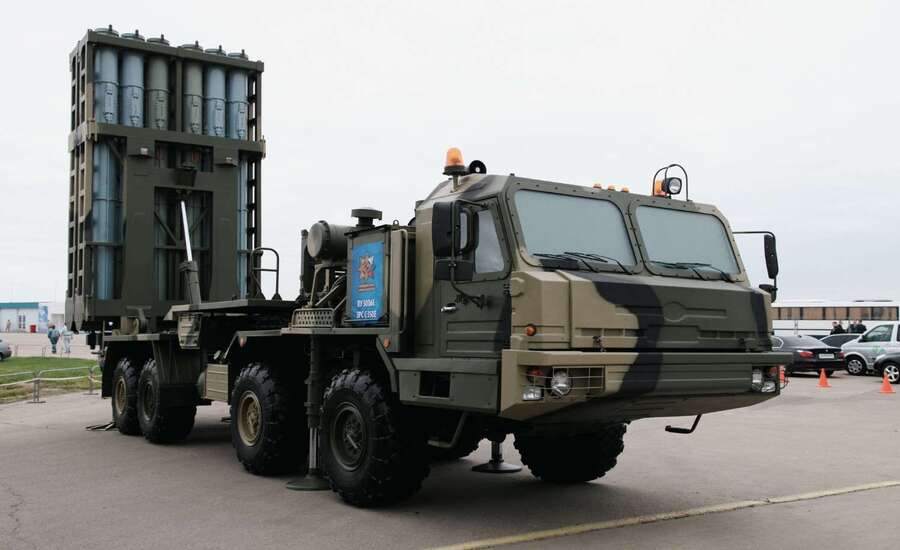
New Delhi: Russia has renewed a strategic defence proposal to supply India with the S-350 Vityaz medium-range air defence missile system — this time including full technology transfer, marking a potentially transformative step in India’s defence capabilities and defence manufacturing ecosystem.
The offer comes amid deepening India-Russia defence cooperation, persistent regional security challenges from Pakistan and China, and India’s unrelenting push towards Atmanirbhar Bharat (self-reliant defence production).
What Is the S-350 Vityaz System?
The S-350 Vityaz (designated 50R6A) is a Russian-made medium-range surface-to-air missile (SAM) system developed by Almaz-Antey to replace older Soviet-era systems like the S-300PS.
Key Features of S-350 Vityaz System
S-350 Vityaz System Range: Up to ~120 km against aircraft and aerodynamic targets.
Ballistic Intercept: 25–30 km against short-range ballistic threats.
Simultaneous Engagements: Tracks/engages up to 16 aerodynamic targets or 12 ballistic targets.
Missile
- Medium-range 9M96E / 9M96E2 actively guided missiles
- Short-range 9M100 interceptors for close-in defence
Radar: Advanced Active Electronically Scanned Array (AESA) multifunction radar
Mobility: Wheeled mobile launchers for rapid deployment
Interoperability: Designed to integrate with other systems (e.g., S-400, indigenous SAMs)
These features make the S-350 Vityaz air defence system a key bridging system between long-range and short-range SAMs in a layered integrated air defence network.
Full Technology Transfer: A Strategic Leap in India-Russia Defence Partnership
The renewed proposal distinguishes itself from previous offers by including full technology transfer (ToT) — a crucial point for India’s defence manufacturing ambitions.
Here is the following importance of full technology transfer of S-350 Vityaz System to india;
Local Production: India could manufacture components and subsystems domestically.
Maintenance Autonomy: Reduces dependence on foreign maintenance contracts.
Industrial Growth: Strengthens local defence MSMEs and supply chains.
Skill Development: Enhances technical know-how within Indian defence industries.
This aligns with Atmanirbhar Bharat Defence objectives, wherein India seeks to indigenise production, reduce import dependence, and nurture a resilient defence industrial base.
Importance of S-350 Vityaz Air Defence System
India currently operates S-400 Triumf long-range air defence systems, with three squadrons delivered and two pending, forming the backbone of its aerial shield against high-altitude, high-velocity threats.
The S-350 is not positioned as a replacement but as a complementary medium-range layer that strengthens coverage between:
- Long-range interceptors (S-400)
- Short-range systems (Akash, Barak-8)
This multi-tiered, networked approach enhances protection against aircraft, cruise missiles, drones, and advanced low-observable threats across critical border regions.
Implications of S-350 Vityaz System
Here are the implications of S-350 Vityaz System;
Against Pakistan
Pakistan has invested in air defence systems like the Chinese HQ-9B, which has faced operational challenges.
The deployment of S-350 systems would significantly strengthen India’s airspace denial capabilities and raise costs for any aerial incursions at low altitudes, especially along the Punjab and Rajasthan sectors.
Against China
China’s aerial assets — including stealth fighters such as the J-20 and advanced missile systems — pose more sophisticated threats along the Line of Actual Control (LAC).
The addition of S-350 provides faster reaction times and saturation attack handling, critical for high-altitude, contested environments like Ladakh and Arunachal Pradesh.
Operational Context & Real-World Performance
The S-350 has seen active usage in the field, including operations where it reportedly engaged hostile aircraft and drones autonomously.
Russian defence sources point to its performance against aerial threats, although at least one system was destroyed during combat in eastern Ukraine — underscoring both capability and tactical risk in contested airspaces.
India’s Integrated Air Defence Vision
India’s evolving air defence architecture aims to integrate multiple systems into a cohesive network:
- S-400 Triumf (long range)
- S-350 Vityaz (medium range)
- Akash & Barak-8 (short range)
- Project Kusha (indigenous future long-range SAMs)
Such a strategy will enhance redundancy, coverage, and response agility across all threat vectors.
Current Status & Future Prospects
Although the Russian proposal including technology transfer is under active discussion, no formal contract has been signed as of early 2026.
The debate now centers on pricing, localisation roadmaps, integration timelines, interoperability challenges, and India’s own indigenous programmes.
Regardless of the final outcome, the renewed offer underscores Russia’s intent to deepen defence ties with India and reinforces India’s drive toward defence self-reliance.