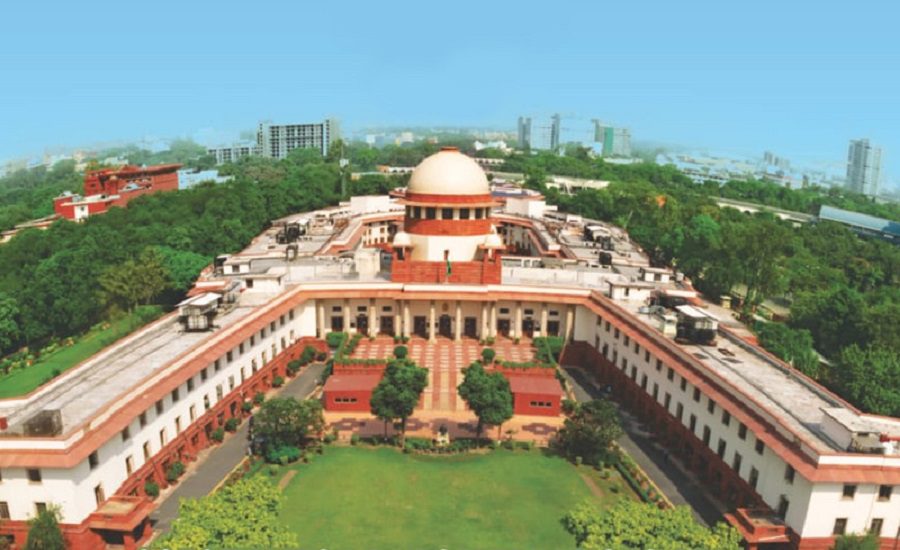
New Delhi: In a dramatic development sending ripples through India’s legal system, the Supreme Court on 14 November 2025 directed that a petition alleging judicial interference by a senior judge be treated as a representation to the Chief Justice of India.
The matter concerns a sitting member of the National Company Law Appellate Tribunal (NCLAT) who publicly disclosed that a “revered member of the higher judiciary” approached him to sway an insolvency appeal.
Background of NCLAT member disclosure probe
The core dispute arises from an appeal filed by the suspended director of KLSR Infratech Ltd before the Chennai bench of NCLAT. The matter pertained to the initiation of a Corporate Insolvency Resolution Process (CIRP) under the Insolvency and Bankruptcy Code, 2016 (IBC) via Section 9.
On 13 August 2025, the judicial member of the bench, Justice Sharad Kumar Sharma, recused himself after stating in open court that he had been approached by a senior member of the higher judiciary to favour a particular litigant in the pending appeal.
The petitioner – M/s A.S. Met Corp Pvt Ltd (the respondent in the NCLAT proceedings) – subsequently filed a writ petition (W.P.(Crl.) No. 440/2025) in the Supreme Court seeking a court-monitored investigation, registration of an FIR under relevant offences (including the Prevention of Corruption Act, 1988 and the Bharatiya Nyaya Sanhita), preservation and production of electronic evidence and neutral management of KLSR Infratech pending the probe.
Importance of the Case
- Judicial Integrity at Stake: The allegation that a higher court judge sought to influence a tribunal decision threatens the foundational principle of judicial independence. If true, it could undermine public confidence in the justice system.
- Insolvency Jurisprudence under Focus: As the matter concerns a high-stakes insolvency appeal under the IBC, the disclosure has potential knock-on effects on how corporate resolutions are handled in India’s economic restructuring ecosystem.
- Administrative Oversight vs. Criminal Inquiry: The Supreme Court’s decision to treat this as a representation to the Chief Justice of India – rather than immediately ordering a full criminal inquiry – raises important questions about accountability and procedure for investigating judges.
- Precedent for Fact-Finding Mechanisms: The petition invokes the court’s landmark rulings in Lalita Kumari and K. Veeraswami regarding mandatory registration of FIRs in corruption matters. Its resolution could chart the course for future allegations of judicial misconduct.
- The transfer of the insolvency appeal from NCLAT Chennai to the Principal Bench in Delhi indicates the seriousness with which the Supreme Court is treating this matter.
- The petitioner’s request for interim protective directions for the neutral management of KLSR Infratech underscores the practical consequences of this dispute for corporate governance and creditor rights.
- The case also raises international benchmarks: judicial systems in many jurisdictions have external oversight mechanisms for allegations of judicial bias or subversion, which India may look to emulate.
- If the matter results in a finding of undue influence, it could prompt wider reform of tribunal-court workflows, recusals norms and transparency of judicial conduct in India.
Major Challenges and Implications
- The disclosure does not name the higher judiciary member alleged to have influenced proceedings, making investigation and sanction complex. The petitioner itself says it cannot approach the CJI for sanction because it does not know the identity of the alleged judge.
- Though the NCLAT member says he preserved mobile messages, access to other crucial electronic records (video, audio of hearing) has reportedly been refused for lack of enabling rules. This delays transparent fact-finding.
- The Supreme Court’s approach of handling the matter on the “administrative side” raises concerns that matters of serious judicial influence may not be subjected to independent criminal probe, thereby setting a weaker standard for accountability.
- Given the large number of insolvency matters handled by NCLAT and its significance in India’s economy, a perception of compromised adjudication could dent investor confidence and prejudice corporate resolutions.
- A scandal of this nature can lead to broader questions about tribunal robustness, judicial appointments and the culture of deference within the higher judiciary.
Way Forward
- The Supreme Court or an independent agency should oversee a transparent investigation to preserve credibility of the judiciary. Depending on findings, an FIR or equivalent disciplinary action must be considered.
- Judiciary and tribunals should institute binding protocols for preservation of audio-video of hearings, mobile messages, and other electronic records to prevent obfuscation.
- A review of the “in-house” system of judicial accountability may be necessary, possibly introducing a hybrid oversight structure with involvement of retired judges, law-tow bodies and external experts.
- Steps may be taken to reassure stakeholders in the IBC ecosystem – such as improved transparency of tribunal compositions, justification of recusal orders and open disclosure policies.
- The judiciary might consider instituting regular ethics and integrity audits, training for judges on handling external overtures, and stricter norms around interaction with litigants and intermediaries.
- Given public interest, the judiciary should proactively communicate the progress of the investigation (within confidentiality bounds) to restore faith in the system and avoid perception of cover-up.
Read Also: Justice Ashok Bhushan to Continue as NCLAT Chief Till July 2026 — Key Highlights You Must Know