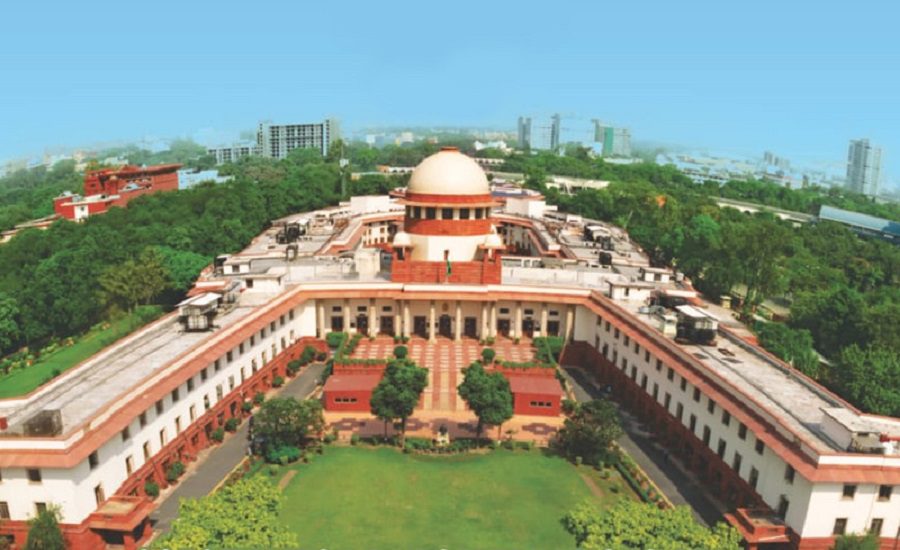
New Delhi: The Supreme Court of India has set aside the contempt of court sentence previously imposed by Bombay High Court on a woman who had referred to High Court and Supreme Court judges as part of a “dog mafia.”
On December 10, 2025, a Bench of Justices Vikram Nath and Sandeep Mehta held that the petitioner had shown genuine remorse and accordingly remitted her one-week simple imprisonment sentence.
This development brings to the fore complex issues surrounding contempt of court in India: the fine line between legitimate criticism and contempt, the discretionary power of courts to punish, and the role of remorse and context in deciding penalty.
Background of Dog Mafia Allegations Against Judges Case
The case arose from a dispute at a residential housing society in Navi Mumbai — Seawoods Estates Limited (SEL) — involving stray-dog feeding.
A resident had challenged the society’s attempt to prevent her domestic help from entering the premises on the ground that she fed stray dogs.
The Bombay High Court directed the society not to hinder the domestic help’s entry, recognizing that merely feeding stray dogs could not justify depriving someone of assistance.
In reaction, the cultural director of the society, the petitioner — Vineeta Srinandan — circulated a letter among residents. The letter described judges of the High Court and the Supreme Court as part of a “big dog mafia … having views similar to the dog feeders.”
The Bombay High Court treated the letter as contemptuous. It found that such “derogatory” remarks scandalized the judiciary and lowered public confidence in the administration of justice.
The court rejected the petitioner’s apology, calling it a “crocodile tears” exercise typical of contemporaries seeking to escape punishment. Consequently, it convicted her of criminal contempt, sentenced her to one week’s simple imprisonment and imposed a fine of ₹2,000.
The High Court’s order emphasised that the remarks constituted more than criticism — they were intended to ascribe malicious motives to judges, create distrust in the public mind, and prejudice the society’s faith in the institution of justice.
The Court held that this was not “fair criticism” but a deliberate attempt to tarnish the reputation of the courts.
Dog Mafia Allegations Against Judges: Intervention by the Supreme Court
In May 2025, the Supreme Court issued a stay on the Bombay High Court’s order, in response to the woman’s appeal challenging her contempt conviction.
On December 10, 2025, the Supreme Court finally adjudicated the appeal. The Bench of Justices Vikram Nath and Sandeep Mehta remitted the one-week simple imprisonment sentence. They observed that the petitioner had shown genuine remorse from the outset, and hence, the sentence was no longer warranted.
Further, the Court found that the reliance of the Bombay High Court on precedents such as Rajendra Sail v. M. P. High Court Bar Association & Ors. and D.C. Saxena (Dr.) v. Hon’ble the Chief Justice of India was misplaced in the present case.
By remitting the sentence, the Supreme Court has effectively delivered a reprieve to the petitioner — though it has not invalidated the finding of contempt per se.
Legal Context: Contempt of Court and Its Boundaries
Contempt of court in India is governed by the Contempt of Courts Act, 1971. Under the Act, courts may penalise civil or criminal contempt when actions or statements interfere with the administration of justice or scandalise the court.
Yet, the law also recognises the right to fair criticism — allowing for comments on court functioning or judgments, provided they do not cross the line into scurrilous or malicious attacks designed to lower the dignity of the courts. The key question often becomes: when does criticism transform into contempt?
In the present case, while the High Court believed the remarks “dog mafia” and association of judges with an alleged mafia constituted a deliberate attempt to undermine the judiciary, the Supreme Court’s decision suggests that context (remorse, perhaps absence of habitual misconduct) and proportionality of punishment matter.
Key Significance of the Supreme Court’s Decision
Perspective on Remorse and Proportionality
: By remitting the sentence, the Supreme Court has signalled that courts should exercise restraint before enforcing imprisonment for contempt — especially when the contemnor shows genuine remorse and the remarks were made in a particular context.
This hints at a more nuanced, flexible approach to contempt jurisprudence in India, rather than a strictly punitive mode.
Re-evaluating Precedents and Blanket Application: The Court’s observation that the High Court’s reliance on Rajendra Sail and D.C. Saxena was misplaced and demonstrates that blanket application of old precedents may not always fit new cases. Contempt must be assessed on facts and context, not on a rote formula.
Key Implications for Freedom of Speech and Institutional Accountability
Many legal analysts and civil society groups have long argued that contempt law in India works as a tool of chilling free speech, especially when used to penalise harsh criticism of the judiciary.
The Supreme Court’s decision may be seen as a small — but important — step toward balancing judicial dignity with freedom of expression.
It invites reflection on whether contempt powers should be exercised more sparingly or even reformed, to ensure courts do not become immune to legitimate public scrutiny.
What Comes Next? Broader Implications and Watchpoints
Although the sentence was remitted, whether the finding of contempt stays on record remains unclear. The presence of a contempt finding — even without punishment — could itself have consequences for the petitioner’s reputation.
The judgment may invite more appeals and challenges by other persons previously convicted for contempt, especially in cases where criticism of the judiciary was harsh but arguably not malicious.
Legal scholars may revisit whether the contours of “fair criticism” and “scandalising the court” — as envisioned under the Contempt Act — need clearer definitions or even statutory reform to avoid misuse.
The decision may spark debate about the right to dissent and free expression in India, especially in relation to the judiciary’s role, the public’s trust, and democratic accountability.