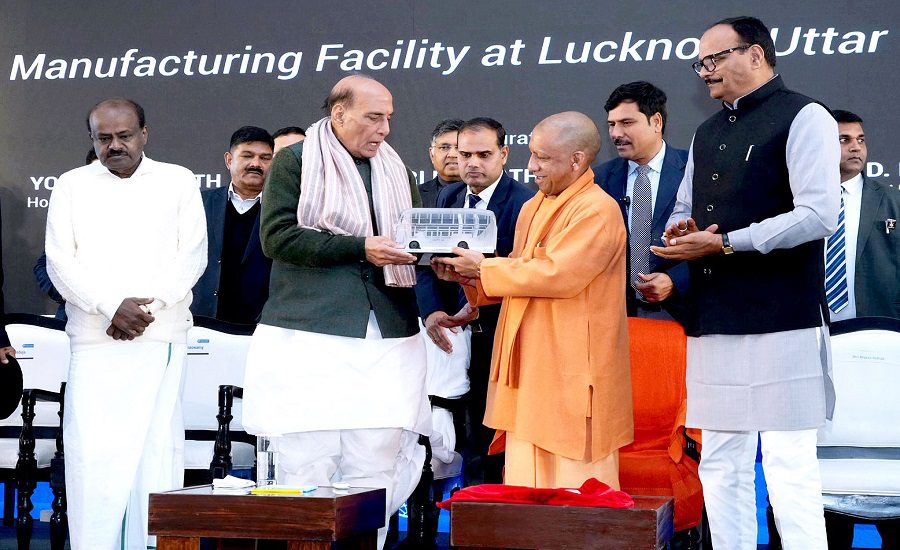
Lucknow: Uttar Pradesh Chief Minister Yogi Adityanath, along with Defence Minister Rajnath Singh, inaugurated Ashok Leyland’s new electric vehicle (EV) manufacturing plant, marking a major milestone in the state’s industrial growth and governance transformation. The state-of-the-art facility, commissioned in just 18 months, reflects the double-engine government’s fast-track approvals and robust governance framework.
During the event, the dignitaries also planted vermilion and Rudraksha saplings on the premises, symbolizing prosperity and sustainability. CM Yogi expressed his gratitude to the Hinduja Group for their investment and emphasized the project’s significance for job creation, industrial growth, and the Make in India initiative.
Turning Potential into Tangible Outcomes
Recalling the situation before 2017, CM Yogi said,
“Lawlessness in Uttar Pradesh was widely known, and investors were steadily withdrawing. After assuming office, our government reaffirmed that Uttar Pradesh is a land of unlimited potential. Today, the state has emerged as one that converts potential into tangible outcomes.”
He highlighted that Uttar Pradesh has transitioned from a state of unrest to a state of celebration, with a focus on Fearless Business, Ease of Doing Business, and Trust of Doing Business. The Chief Minister underlined the state’s 34 sector-specific policies, which allow investors to participate across multiple sectors, fostering rapid industrialization and economic growth.

Read also: CM Yogi Adityanath Reviews ‘Mission Karmayogi’ in UP, State Leads Nation on iGOT Training Platform
Ashok Leyland EV Plant: Capacity, Jobs, and Sustainability
The new EV manufacturing facility currently has an annual capacity of 2,500 units, which will be scaled up to 5,000 units in phases. CM Yogi stated,
“This project reflects PM Narendra Modi’s vision of industrial growth alongside environmental protection. It has already generated direct and indirect employment opportunities for thousands of youth in Uttar Pradesh.”
He added that the plant aligns with the government’s environmental goals, addressing challenges such as climate change and sustainable transportation. The 17–18 seater EV buses, priced at approximately ₹15 lakh, are intended for school transport and inter-city connectivity, contributing to both the public transport sector and clean mobility initiatives.
Statewide Investment and Infrastructure Boom
CM Yogi highlighted that investments are now spreading to all 75 districts of Uttar Pradesh. Key infrastructure developments include:
- 55% of India’s expressways located in UP
- Metro services in the highest number of cities
- The largest rail network in the country
- Two dedicated freight corridors
- Development of logistics terminals and transport hubs
- Operational rapid rail and inland waterways
“Uttar Pradesh has transformed from a state struggling with unrest to one of celebration,” said CM Yogi, emphasizing the state’s emergence as a revenue-surplus and investment-friendly region.

Investment Milestones and Economic Growth
CM Yogi announced that over the past 8–9 years, UP has received investment proposals worth ₹45 lakh crore, with:
- ₹15 lakh crore already under groundbreaking ceremonies
- ₹6 lakh crore scheduled for groundwork next month
- ₹5 lakh crore in the pipeline for future projects
He added that UP currently contributes 9.5% to India’s GDP, with the Gross State Domestic Product (GSDP) expected to reach ₹36 lakh crore by the end of the financial year. The state is targeting a $1 trillion economy by 2029–30, contributing to PM Modi’s vision of a $5 trillion Indian economy by 2027.
Electronics, IT, and Startup Ecosystem
Uttar Pradesh has rapidly emerged as a hub for electronics, IT, and innovation:
- 55% of India’s mobile phone manufacturing
- 60% of electronic goods production
- Over 18,000 startups supported by 76 incubators, 7 Centres of Excellence, and 8 unicorns
The Chief Minister emphasized sectors like MSMEs, AI, semiconductors, cybersecurity, robotics, EVs, agritech, fintech, deeptech, healthtech, tourism, hospitality, defence manufacturing, and sports as key drivers of UP’s industrial growth.

FDI, Fortune 500 Investments, and Governance Efficiency
The Ashok Leyland EV plant was established under UP’s FDI and Fortune 500 policy. CM Yogi recalled that prior to 2017, the state had negligible foreign investment, but proactive governance and investor facilitation platforms like Nivesh Mitra, Nivesh Sarathi, and Udyami Mitra have streamlined approvals and ensured continuous support for investors.
The MoU for the plant was signed in September 2023, with the Letter of Intent and land allotment completed by January 2024, highlighting the efficiency of the double-engine government.
Electric Vehicle Market and Skill Development Initiatives
CM Yogi highlighted that UP accounted for 19% of India’s total EV market in 2024 and is a key beneficiary of FAME I and FAME II schemes, with 700 electric buses operating across the state.
He announced that the Hinduja Group and the UP government will sign an MoU to provide skill development to 10,000 youth annually at the facility. The EV sector will help train youth in emerging technologies, preparing them for future-ready employment. Technical institutions such as ITIs, polytechnics, and engineering colleges are being strengthened to meet these demands.
A State Redefining Trust and Transformation
CM Yogi concluded,
“With the country’s largest workforce and proactive governance, Uttar Pradesh is poised to redefine itself as a state of trust and transformation.”
The event was attended by dignitaries including Ashok Leyland Chairman Dheeraj Hinduja, MD & CEO Shenu Agarwal, Union Minister H.D. Kumaraswamy, Deputy CM Brajesh Pathak, Cabinet Ministers Suresh Khanna and Nand Gopal Gupta, Transport Minister Dayashankar Singh, and other senior officials.