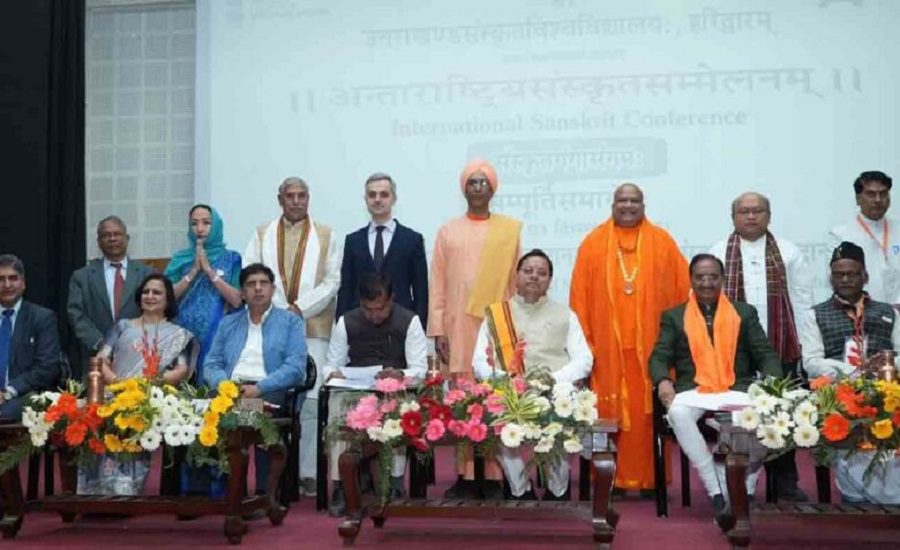
Dehradun: In a significant move to promote the Sanskrit language and preserve India’s rich cultural heritage, Chief Minister of Uttarakhand Pushkar Singh Dhami announced that the state government will establish model Sanskrit villages in every district. The announcement was made during the inaugural ceremony of the International Sanskrit Conclave held in Haridwar on Monday.
Sanskrit: More Than a Language
Addressing the gathering, CM Dhami emphasized that Sanskrit is not merely a language but the foundation of culture, tradition, knowledge, and scientific thought. “Sanskrit has played a crucial role in the development of ancient human civilizations,” he stated, recalling that he studied Sanskrit until grade IX in school. He added that many modern languages around the world trace their roots to Sanskrit, and that ancient texts, including the Vedas, Puranas, Upanishads, Ayurvedic treatises, works on Yoga, philosophy, mathematics, literature, science, and astronomy, were all composed in Sanskrit, enriching India’s ideological and intellectual heritage.
The CM highlighted that prominent ancient universities like Takshashila, Nalanda, Vikramshila, and Vallabhi disseminated Sanskrit-based knowledge globally, producing great scholars such as Charaka, Sushruta, Aryabhatta, Bhaskaracharya, Chanakya, Brahmagupta, and Panini. He added, “Sanskrit is not only a language of science but also a language that conveys ethics, human values, and global brotherhood.”
Government Initiatives to Revive Sanskrit
CM Dhami praised the central government, under Prime Minister Narendra Modi, for meaningful initiatives to promote Sanskrit across the country. He pointed out that the new education policy emphasizes Sanskrit as a modern and practical language. Efforts such as e-Sanskrit learning platforms, mobile applications, and online availability of Sanskrit literature are making the language more accessible to the younger generation. Citing the example of Mattur village in Karnataka, where Sanskrit is actively used in daily life, the CM remarked that Sanskrit can still become a living language in contemporary society. He also lauded the Central government’s recent initiative to translate Lok Sabha proceedings into Sanskrit, describing it as an important step in promoting the language.
Uttarakhand’s Sanskrit Legacy
Highlighting Uttarakhand’s historical role as a center of Sanskrit learning, CM Dhami stated that the state government has recognized Sanskrit as the second official language. The Uttarakhand Sanskrit Academy continues to organize a range of programs, including the All India Research Conference, Veda Conference, Astrology Conference, Sanskrit Teacher Skill Development workshops, and student competitions, to promote Sanskrit education and research.
The event was attended by several dignitaries, including former Chief Minister Ramesh Pokhriyal Nishank, MLA Aadesh Chauhan, Pradeep Batra, Swami Yatishwaranand, Union Foreign Secretary Meena Malhotra, Secretary of Sanskrit Education Uttarakhand Deepak Gairola, and Vice-Chancellor of Sanskrit University Dinesh Chandra Shastri.
Way Forward
The establishment of model Sanskrit villages in every district aims to strengthen grassroots-level efforts to preserve and propagate Sanskrit. These villages are expected to serve as centers of learning, cultural exchange, and community engagement, reinforcing Uttarakhand’s commitment to sustaining its centuries-old linguistic and cultural heritage.