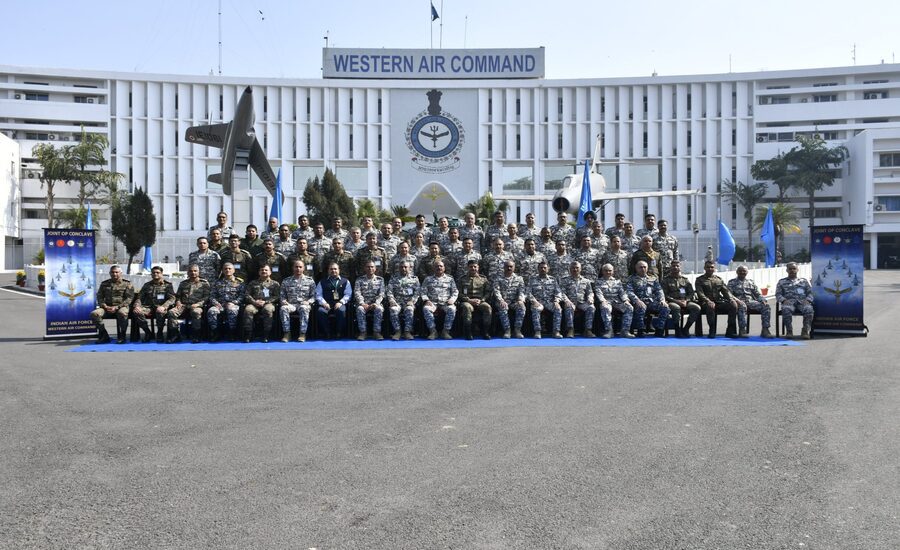
New Delhi: The Western Air Command Joint Operations Conclave marked a significant advancement in India’s defence integration efforts, focusing on strengthening joint operational capabilities across the Indian Armed Forces. Hosted under the All Domain Joint Operations (ADJO) Exercise 2026 framework from February 5–6, the conclave brought together top military leadership to discuss seamless cooperation across air, land, sea, space, and cyber domains.
Importance of the Western Air Command Joint Operations Conclave
The Western Air Command Joint Operations Conclave, organised at the Headquarters Western Air Command in New Delhi, aimed to deepen intra-service and inter-service coordination, particularly in a rapidly evolving multi-domain operational landscape.
The conclave’s objectives focused on enhancing joint warfighting readiness and improving interoperability among the Indian Army, Navy, Air Force, and other defence agencies.
With national security challenges becoming more complex, modern defence strategy increasingly requires cohesive responses across different military domains. This conclave reaffirmed India’s commitment to developing a unified operational architecture that ensures agile and decisive outcomes in future conflicts.
Inaugural Address: Focus on All-Domain Integration
In his inaugural address, Air Marshal J.S. Mann, Senior Air Staff Officer of Western Air Command, underlined the critical importance of jointness in modern warfighting. He emphasised that traditional service-centric strategies must evolve into all-domain frameworks that integrate air, land, sea, space, and cyber dimensions for operational success.
Air Marshal Mann highlighted:
- Enhancing interoperability among military services
- Promoting domain-agnostic decision-making
- Strengthening sensor-to-shooter networks
- Refining operational procedures for maximum efficiency
Chief of Integrated Defence Staff Calls for Institutionalised Integration
Addressing the conclave, Air Marshal Ashutosh Dixit, Chief of Integrated Defence Staff (CISC), stressed the need to institutionalise mechanisms that support coordinated defence planning. He underscored the importance of:
- Integrated operational planning
- Intelligence sharing across agencies
- Capability gap analysis and resource prioritisation
- Structured frameworks for unified responses
Air Marshal Dixit reiterated that joint mechanisms are essential to building a robust, future-ready defence force tuned to handle evolving strategic challenges.
Western Air Command Joint Operations Conclave: Insights from Air Marshal Jeetendra Mishra
Concluding the conclave, Air Marshal Jeetendra Mishra, Air Officer Commanding-in-Chief of the Western Air Command, shared insights from recent operational experiences, including Operation Sindoor — a major joint endeavour. He highlighted key lessons, such as the strategic role of air power and the need for synchronised ground and air manoeuvres.
Air Marshal Mishra also emphasised transitioning away from legacy attrition-based models to more agile, adaptive warfighting approaches that account for rapid technological and tactical shifts on the modern battlefield.
Western Air Command Joint Operations Conclave: Participation Across Services
The conclave saw active participation from senior officers representing:
- Headquarters Integrated Defence Staff (IDS)
- Indian Army
- Indian Navy
- Defence Space Agency (DSA)
- Defence Intelligence Agency (DIA)
- Indian Air Force leadership
This diverse representation reiterates India’s broader focus on tri-service and multi-domain integration, aligning strategic planning with real-time operational demands.