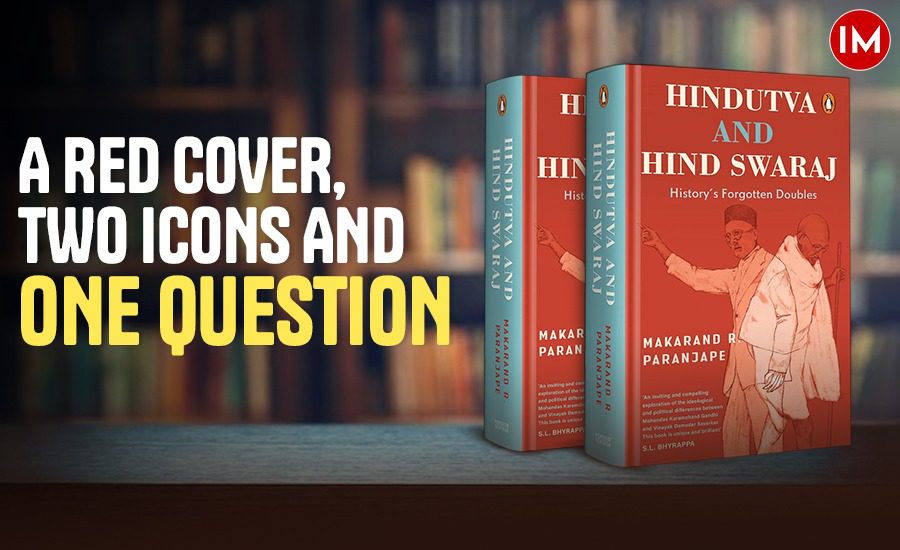
The cover page of Makarand Paranjape’s meditation on Hindutva and Hind Swaraj has a deep red background. Veer Savarkar in a shade of saffron points to the left, while Mahatma Gandhi in his trademark white homespun cotton is aligned to the right. It is important also to note, in the title, the “AND” instead of “OR”, for unlike UR Ananthamurthy who juxtaposed Rashtriya Swayamsevak Sangh founder V.D. Savarkar’s idea of Hindutva with M.K. Gandhi’s concept of Hind Swaraj, Paranjape argues that the two are not always entirely mutually exclusive. In his view, India-that-is-Bharat can invoke a dialogue with itself: ‘aatm-aamvad’. With the emphasis on ‘and’, Paranjape places on record that both were intensely patriotic and wanted India to exercise Swaraj. As he says in the Prastavana (Prologue), Swaraj subsumes Hindutva.
The book follows an interesting structure. The first part ‘Itihasa Mimamsa: Poetics of the Past’ is a meditation on history. If we do not engage with the past, we cannot understand what happened to us as a nation, as a people and as a civilization. ‘Daksinayana – India Lost and Found’ is Paranjape’s personal rediscovery of India within the Hindu-Muslim fault lines which flared up in murderous rage during the partition of 1947, and continue to erupt occasionally. The last part ‘Dharma – Samsthapanarthaya’ is a ‘Politics of the Present’. Its central point is that if we make the transition from politics to Dharma, then we may be able to heal the wound in the national psyche. And finally there is the ‘Svargarohana’, where the Mahatma seems to have made peace with himself as well as with the Veer, but the latter is still in a state of agitation.
The book’s history can be traced to a difficult conversation between the two protagonists on Vijay Dashami Day at London’s India House in 1909. This was the year Savarkar challenged the narrative of the “Sepoy Mutiny” by instead calling it the ‘Indian War of Independence 1857’ to inspire his people into waging a second, successful war to liberate their motherland. Savarkar was all of 25 when he wrote this 552 page narrative which was at complete odds with the Imperial narrative. More than historical accuracy and linear detail, he was interested in what Nietzsche called ‘monumentalism’ in his 1873 work ‘On the Use and Abuse of History for Life’. However one must not lose sight of the fact that the chosen symbol of the rebels was Bahadur Shah Zafar, then head of the Mughal empire, whose territorial writ was limited from the Red Fort to Palam. As such, the book’s great merit lies not so much in historical accuracy but rather in resurrecting the heroes of 1857. Writes Subbarao, “The greatest value of Savarkar’s book lies in its gift to the nation of the torch of freedom under whose light, a humble I, and a thousand other Indians have our dear daughters named after Laxmibai, the Rani of Jhansi. Even Netaji formed an army corps named after this valiant heroine.”
Dhananjay Keer, the biographer of both Mahatma and Veer, believes that Hind Swaraj was actually the former’s rebuttal to Savarkar’s advocacy for armed revolution. For the record, the Mahatma wrote in the Young Indian: ‘I came in contact with every known Indian anarchist in London. Their bravery impressed me, but I felt their zeal was misguided. I felt that violence was no remedy for India’s ills, and her civilization required the use of a different and higher weapon of self-protection.’ This then was the background to the 275 page manuscript, written in Gujarati on board the SS Koldonan Castle from 13-22 November 1909, on his way back from England to South Africa. The Mahatma had turned ambidextrous for this book – forty pages of the volume were written with the left hand.
Hind Swaraj is a conversation between an Editor (Gandhi himself) and a Reader, in which they cover a range of subjects from the critique of modern Western civilization (which he saw as materialistic and spiritually bankrupt) and his vision for true Indian self-rule (Swaraj, Satyagraha, Swadeshi, and a return to traditional self-reliant Indian values).
One way of looking at the two books is to suggest that the Mahatma and Veer represented two ideas of India. However, before their competing versions took the centre stage, for all of the nineteenth and the first few decades of the last century, dominant history taught in the schools of India was based on James Mill’s three volume ‘History of British India’ first published in 1817. It may be mentioned that Mill had never felt the need to visit India, but had no qualms about passing value judgements about Indians. Both Edward Said and Ranajit Guha have shown the nexus between knowledge and power, and how Mill sought to disparage the Hindus by statements like ‘In point of manners and character, the manliness and courage of our ancestors, compared with the slavish and dastardly spirit of the Hindus, place them in an elevated rank’. No wonder then that this was the dominant narrative which informed colonial administrators and others of their ilk.
As against this narrative, there was much more that Hind Swaraj and the First War of Independence had in common. Paranjape argues for an intermedial hermeneutics to re-read these texts, for both drew their inspiration from a Bhartiya version of Itihasa which is based more on collective memory than the linear arrangements of facts. Wilson’s first Sanskrit-English dictionary (1819) describes Itihasa as a tradition of reciting and performing the stories and legendary exploits of gods and heroes which flourished in the entire Indo-European region. As Ananda K Coomaraswamy notes, the quality of the oral literature is essentially poetical and its content essentially mythical in its preoccupation with the spiritual adventures of heroes. Thus the Muslim poet Jayasi celebrates not the pyrrhic victory of Allaudin Khilji, but the ‘Jauhar’ of Rani Padmavati and her companions. Death was preferred to dishonour.
There were other points of similarity as well between the Mahatma and Savarkar. Both were admirers of the Italian freedom fighter Mazzini. The Mahatma named Young Indian after his Young Italy, and Savarkar was in absolute agreement with him that revolution is complete rearrangement in the life of historic man. “A revolutionary movement cannot be based on a flimsy and momentary grievance”. Both the Mahatma and the Veer agreed that the grievances against the Empire were deep and well founded – but differed vehemently on the way ahead.
One must briefly mention their deaths: the Mahatma fell to the assassin’s bullet on January 30, 1948 at 5.15 pm– the time being recorded on his Swiss-made Zenith alarm clock, with ‘Hey Ram’ on his lips. The Veer fasted himself to death, and preferred the term ‘aatmarpan’ to aatmahatya. Both terms have entirely different connotations.
Can India do away without either of them? Paranjape is convinced that both are needed. The Swaraj needs a Samvad in which Hindutvavaadi viewpoint has to be factored in – for a nation needs both strategic insight as well as frank dialogue and civic engagement. India that is Bharat needs to face facts in the face, even as some old scores need purposeful forgetfulness.