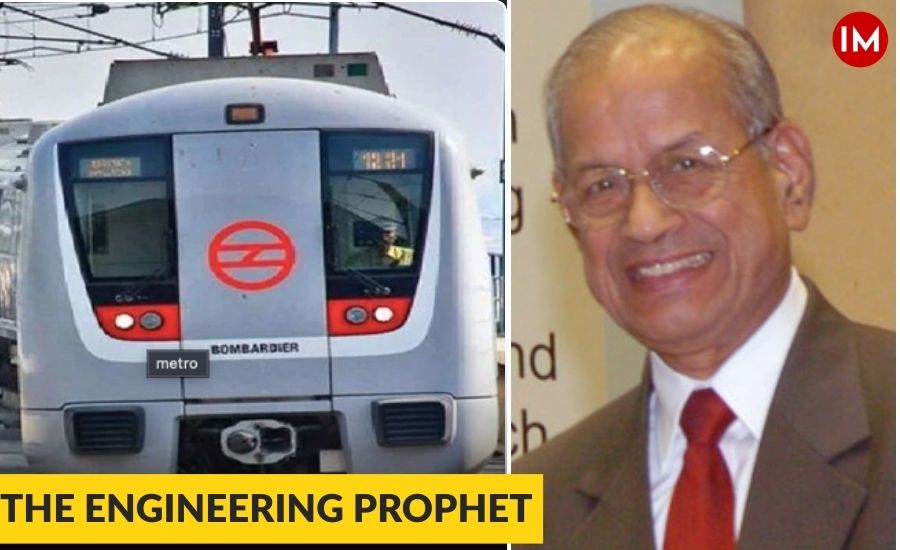
In an era where infrastructure projects often succumb to the Indian Stretchable Time, one man became a living legend by doing the impossible: delivering world-class results ahead of schedule and under budget. Elattuvalapil Sreedharan, better known as the Metro Man, did not just build railways; he built a new culture of accountability for a rising India.
Born on June 12, 1932 in Karukaputhur (Palakkad), Kerala, Sreedharan’s academic foundation was rooted in rigorous engineering training. He graduated in Civil Engineering from Government Engineering College, Kakinada (then in Andhra Pradesh), and later joined the prestigious Indian Engineering Services (IES) in 1955. His early exposure to large-scale public works shaped a professional philosophy that emphasised precision, accountability, and on-ground supervision—traits that would define his later achievements.
EARLY SIGNS
His career reads like a blueprint for how technical rigor, plain speaking and relentless discipline can remake public life. It was defined early on by a trial by fire. In 1964, a devastating cyclone washed away parts of the Pamban Bridge, the only link between mainland India and Rameswaram. The Railways gave a six-month deadline for restoration; Sreedharan’s superiors wanted it in three. In a display of the grit that would define his life, the young engineer completed the task in just forty-six days. It was the first sign of a leader who viewed a deadline not as a suggestion, but as a sacred vow.
KONKAN RAILWAY
Most people prepare for a quiet life as they approach sixty, but for Sreedharan, retirement in 1990 was merely the start of his second act. He was appointed to lead the Konkan Railway project, which confronted some of India’s most hostile terrain — a 760-kilometre coastal stretch with soft soils that frequently collapsed and dense Western Ghats. This was a feat many engineers deemed impossible.
Rather than allow the project to become a decade-long saga, he assembled a compact, empowered management team, adopted innovative tunnelling and bridge techniques, and executed the line on a Build-Operate-Transfer (BOT) model that was novel for Indian public works at the time. He divided the project into zones, giving chief engineers the autonomy to make on-the-spot decisions. He famously installed reverse clocks in offices that counted down the days to the deadline, keeping the pressure visible.
The result: a technically audacious corridor bridging 146 rivers, and boring 93 tunnels, completed in seven years with comparatively modest overruns. The project fundamentally changed the economy of India’s western coast. The Konkan Railway became a case study in how strong engineering leadership can tame complex geography.
DELHI METRO
In 1995, Sreedharan took on his most iconic role as the Managing Director of the Delhi Metro Rail Corporation. Building a metro in a congested, chaotic capital like Delhi was an administrative nightmare. Yet, Sreedharan managed to create an island of efficiency. He operated with a zero-interference policy, keeping the project insulated from the political tug-of-war. His management was built on three pillars of punctuality, integrity, and professional competence.
He insisted on modern contracting practices, international standards for safety and quality, and a zero-tolerance culture for corruption. Under his stewardship, Phase I of the Delhi Metro was completed three years ahead of schedule and subsequent early expansions of the Delhi Metro were delivered on or before schedule and within budget — a rarity for large Indian infrastructure projects at the time.
More than a transport program, the Metro became a template for indigenous institutional capacity: project structuring, transparent bidding, integrated design and disciplined execution that other Indian cities would copy. The network transformed daily life in Delhi, cutting travel times, improving air quality and creating a visible public asset people trusted
His commitment to ethics was so absolute that in 2009, following a bridge collapse at a construction site, he immediately resigned, taking full moral responsibility. Though the government persuaded him to stay, the gesture cemented his status as a man of rare character in public service.
MORE METROS
Sreedharan’s influence extends far beyond the tracks. He has been a guiding light for the Kochi Metro, Lucknow Metro, and several other urban rail projects across the country. His philosophy is deeply rooted in the Bhagavad Gita, which he views not as a religious text but as a handbook for Karma Yoga, the yoga of action.
Throughout his career, he held pivotal roles including Deputy Chief Engineer of the Kolkata Metro, CMD of Cochin Shipyard where he launched India’s first indigenous ship, and leader of the Konkan and Delhi rail networks.
A CATALOGUE OF HONOURS
Recognition followed. The Government of India awarded him the Padma Shri (2001) and later the Padma Vibhushan (2008); France made him a Chevalier de la Légion d’honneur, and Time magazine listed him among Asia’s heroes. These awards acknowledged both technical mastery and a rare public credibility: Sreedharan could speak plainly to ministers, bureaucrats and the public without losing authority. He also authored memoirs and gave public lectures that turned infrastructure into a topic citizens could grasp.
BEYOND RAILS
After Delhi Metro, Sreedharan didn’t retire into obscurity. He advised other metro projects across India and abroad (including Kochi and Dhaka), served on international transport groups and remained an outspoken voice on urban policy. In 2021 he briefly entered electoral politics with the BJP in Kerala, an episode that ended when he stepped away from active politics later that year — a reminder that his strengths remained engineering and administration rather than party organisation.
HIS LEGACY
Sreedharan’s legacy is visible in the steel, concrete and timetables of India’s metros: faster procurement norms, better contractual disciplines and a culture that treats public transport as an engineering problem to be solved rather than a political give. He proved that in a country often paralyzed by red tape, a single person with unshakeable integrity and a clear vision can move mountains, or in his case, move millions of people every single day.