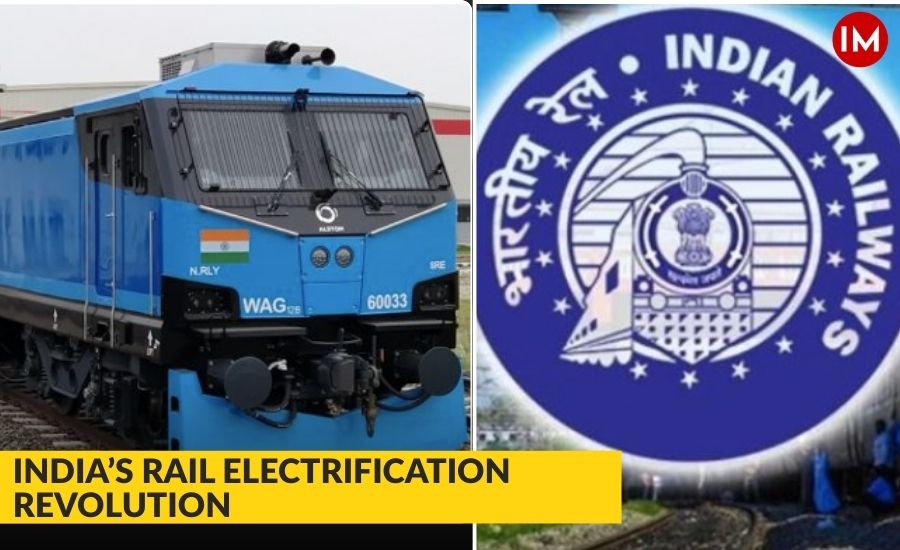
For more than a century India’s railways have been the iron spine of the subcontinent. What started with a handful of electric suburban lines a hundred years ago has, over the past decade, become a full-scale national transformation: between 2014 and 2025 India electrified tens of thousands of route-kilometres, driving the share of electrified broad-gauge to almost 100% by January 2026. That is not just engineering: it is a climate and operational revolution — no diesel locos, zero fuel import bills, faster acceleration for passenger trains, simpler maintenance and big cuts in greenhouse-gas emissions.
India’s pace has been extraordinary. Where earlier decades saw only a few kilometres of overhead wiring a day, the railways ramped up to double-digit kilometres per day during the recent push, finishing entire states and multiple zones to 99.2% by the end of November 2025 while leaving a small number of difficult ghat sections and branch lines to be completed. The passenger and freight benefits are immediate: electrified trains can be quicker, more reliable and far cheaper to run when powered by an expanding mix of renewable electricity.
Read More : How Dr. Anirudh Pamar is Driving Innovation Across Hyderabad Division
A COMPARISON
A clear picture emerges when we compare India’s achievement vis a vis rail electrification in other major countries:
Switzerland long ago electrified its entire networks and already operates at or extremely close to 100% electrification for main lines. These are physically smaller networks, but fully electrified.
China has massively electrified its system in recent decades; by end of 2025 China’s electrified route share was around 82%, with very high electrification on its high-speed and trunk routes. China’s scale is huge, which makes its absolute electrified kilometres the largest in the world. Japan has a long tradition of electrified mainlines, with a high national share — around 64%.
Britain, Germany, Spain and France have significant electrified networks. Germany has electrified over 50 per cent of its rail track but expansion has slowed in places. France has historically electrified its busiest trunk lines including TGV corridors; about 60 per cent of its active network is electrified. Spain has electrified 67 per cent of its tracks. United Kingdom has electrified merely 39% of its rail routes – significantly less than many continental networks
United States: by contrast, has very little mainline electrification outside a few corridors; mainline freight is overwhelmingly diesel and national route electrification is below a few percent.
So is India the first major country to be 100% electrified? Yes, India has achieved the feat in January 2026. India’s milestone is remarkable because of scale — being the largest national system to achieve complete electrification in so short a time. No network of India’s size has been electrified so comprehensively so quickly.
Electrification is more than wires and poles: it is an enabler for cleaner transport, greater energy security, and higher-speed services. India’s complete electrification is a policy and engineering story—mobilising funding, rolling stock, power agreements, and crews to rewire a living, operating network.
Read More : Corruption, Black Money and Broken Promises: Why India’s Political Landscape Must Change