October 2010. Alwar, Rajasthan.
Two little girls, six and nine years old, were abducted and sexually assaulted. The brutality shook the city, but the investigation soon hit a wall. No eyewitnesses. No usable CCTV footage. No immediate leads.
The girls were alive, but emotionally shattered. One of them spent days in Jaipur’s SMS Hospital. When police officers asked questions, they stared at the floor. Not a word. Fear had sealed their voices.
Inside the police system, the case quietly slipped into a dangerous category: blind. A file that risked being remembered only by its number.
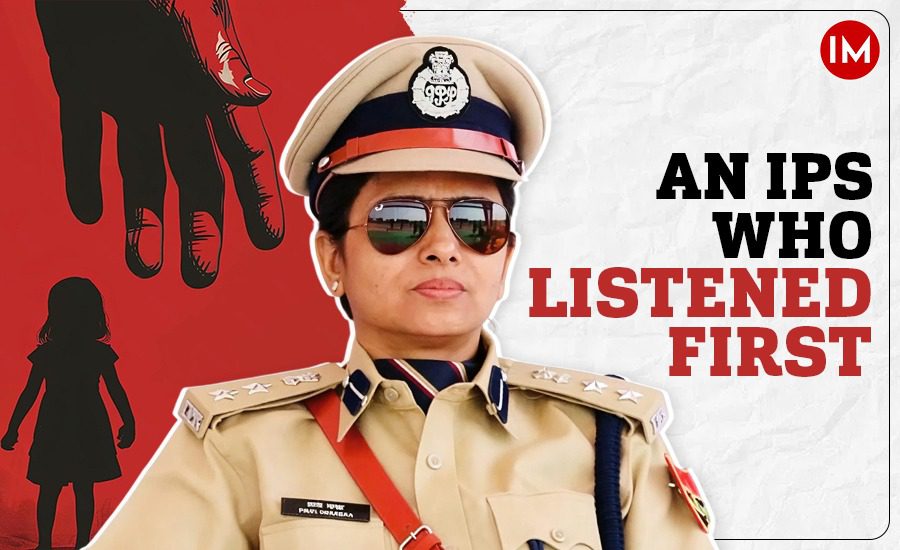
That was when 2008 batch IPS Preeti Chandra arrived in Alwar as the Additional Superintendent of Police.
“FROM DAY ONE, THIS WAS MY RESPONSIBILITY”
The Superintendent of Police handed her the case immediately. There was no dramatic announcement, no press conference. Just a clear message: find the truth.
She began the way any officer would: multiple angles, area combing, sketches, and local intelligence. Every possible route was explored. Nothing worked.
The problem wasn’t effort. The problem was silence.
BECOMING “AUNTY,” NOT AN OFFICER
Preeti Chandra understood something crucial: these children were not hiding information; they were protecting themselves. So, she changed the rules. No uniforms. No notebooks. No pressure.
Along with ASI Snehlata, she began visiting the girls’ home every single day. Not to interrogate, but to sit. Biscuits. Chocolates. New clothes. Gentle conversations. Ordinary moments.
Slowly, the girls stopped shrinking when they saw her.
They started calling her “Aunty.”
Trust took weeks. Then months.
WHEN A WHISPER FINALLY SPOKE
About six weeks later, during a casual conversation, Preeti softly asked about that day. There was no command in her voice.
This time, the younger girl spoke.
“Aunty… he ate gutkha.”
“He had an earring.”
“Dark complexion… pimples on his face.”
It wasn’t a full description. But it was life returning to a frozen memory. A sketch was prepared. The police moved again.
Still, no arrest.
The case hovered between hope and frustration.
A STREET FIGHT THAT CHANGED EVERYTHING
Two months after the crime, police picked up a young man and woman arguing violently in the middle of a road. They were brought in for questioning.
During interrogation, it emerged they belonged to the Nat community. The man had been living in Bhiwadi with the woman’s sister. The argument was personal, but something else caught Preeti Chandra’s attention.
His appearance.
The earring.
The face.
The match was too close to ignore.
A TRAP BUILT WITH MEMORY
Under sustained questioning, the man casually mentioned “other incidents” that had been quietly settled within community councils.
Preeti Chandra didn’t confront him directly. Instead, she mentioned one incident near a Mataji temple.
His response was instant and careless: “Oh, that girl? She was wearing a ghaghra. She wasn’t from our community, so nothing happened.”
Then she mentioned another place, near a pond. He laughed.
“She was scared… very weak.”
That laugh ended the case’s darkness.
FIVE MINUTES TO THE TRUTH
Within minutes, the man broke. He confessed and admitted to raping both girls.
The same case that had been nearly written off was suddenly alive, solved not by force, but by patience, psychology, and empathy.
JUSTICE, GENTLY EARNED
The accused was arrested. The investigation was completed. The file was no longer “blind.”
What cracked the case was not technology or chance, but a woman officer who understood that for some victims, justice begins with safety, not questions.
Years later, Preeti Chandra would go on to serve as IG, Rajasthan Police. But in Alwar, she would always be remembered as the officer who became “Aunty” and gave two children their voice back.