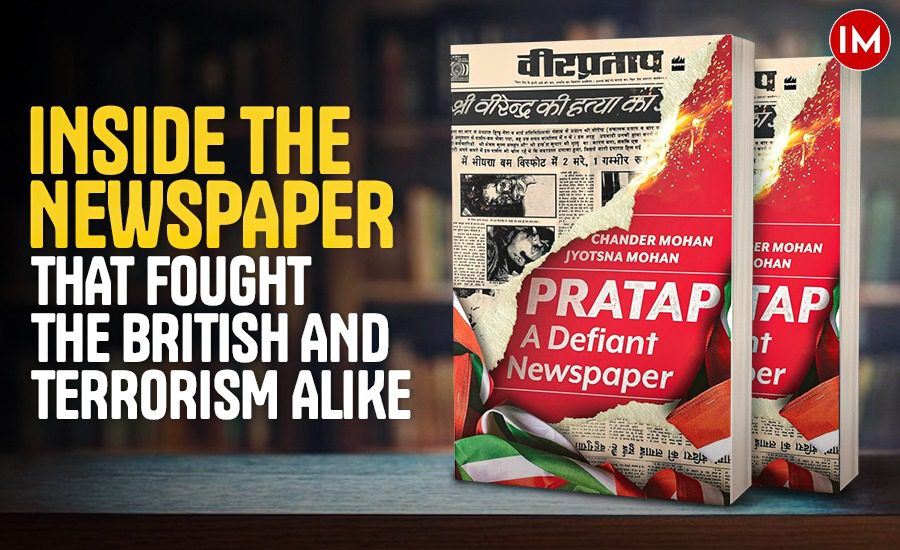
‘Pratap: A Defiant Newspaper’ by the father daughter duo of Chander Mohan and Jyotsna Mohan is a riveting story of the five decades of the freedom struggle, and the five decades thereafter. Liberally interspersed with Urdu quotes, it takes one back to the times when India was engaged in a ‘do or die’ struggle against her colonial masters. Punjab and Bengal were in the forefront of the protest, and the newspapers of that period reflected the broad patterns of the ownership, intent and interests of the proprietors. The editorials were as important as the news coverage, and the owner’s personality was writ large in the production of the papers.
The reader’s view and opinion mattered, for they were the primary source of revenue and as news occupied the prime space in the paper, it was legitimately a newspaper. As the Mohans point out: now that 90 percent of revenues comes from advertisements – including those from government departments – is it wrong of owners to assert that they are the business of advertising, not news. Which raises the fundamental question: why call it a newspaper at all?
Let me add here that I grew up in Jalandhar, or Jullundur as it was then called. I did my eleventh standard from the Government Junior Model school – the only English medium co-education school affiliated to the Punjab board, and later the Lyallpur Khalsa College, both in close proximity to the many newspaper offices that dotted this part of the town. The Punjab of the eighties was a very different place. Chandigarh was the (contested) capital, but every district town had a personality of its own. Thus Amritsar was the pilgrim city with its Golden Temple, the Jallianwala Bagh and famed eateries, Ludhiana was a manufacturing hub for bicycles and garments, Batala had agro industries, Khanna had all the foundries, Patiala had a rich cultural heritage and Jalandhar had the AIR, Doordarshan and more than a dozen independent publications in Urdu, Hindi and Punjabi.
The four prominent groups (Pratap, Milap, Hind Samachar-Punjab Kesari and Ajeet) had Urdu and Hindi/Punjabi editions to begin with. Both the CPI and CPI M had their own newspapers – Nawan Zamana and Lok Lehar in Punjabi. Then of course, there were correspondents of The Tribune, Statesman, Times of India, HT and Indian Express,among others. The District Library, the Press Information Bureau’s reading room, the study centre of the Guru Nanak Dev University and the Desh Bhagat Yadgar Hall (memorial) were all ‘open access’, and located within a two to three kilometer ‘cycling radius’ of the Circuit House and the Skylark hotel where most press conferences were held by visiting leaders. Legendary editors like Virender (Pratap), Jagat Narain, and later Ramesh and Vijay Chopra (Punjab Kesari), Yash (Milap) and Sadhu Singh Hamdard (Ajeet) were on the social circuit, and most school and college functions had one or the other of them as a Chief Guest – which also ensured some press coverage on the next day!
All this has changed forever: Urdu disappeared from of Punjab, terrorism took its toll, and pan India newspaper chains – Aaj Tak, Dainik Jagran and Bhaskar started their editions in Hindi and Punjabi which made it well-nigh impossible for independent papers like Milap and Pratap to continue their Urdu and Hindi editions. The nineties saw the advent of TV, but after two decades, the idiot box has lost its sheen to FB, podcasts, Insta and X.
An Editor called Virender
The book is a tribute to the life of the legendary editor, Virender, a contemporary of Bhagat Singh, Rajguru, Sukhdev and Chandrashekhar Azad,who suffered many incarcerations in the British jails. It is also the story of the newspaper which preferred to shut shop rather than succumb to government or commercial pressure.
The narrative structure is interesting – it moves back and forth. It starts with a parcel bomb attack on June 24 1983 on the newspaper office of Pratap (Urdu) and Vir Pratap (Hindi) intended for its feisty editor Virender, but ends up killing two staff members – Krishan Alang and Indresh Kumar. More devastating than the attack was the silence of the prominent Punjabi language papers to condemn the attack and offer even a token of support for their media brethren. Punjabi brotherhood had become a casualty. This has to be seen in the context of murders of the editors of Punjab Kesari and Hind Samachar, Lala Jagat Narain in 1981 and, later his son Ramesh Chander in broad daylight at the bustling Namdev Chowk in Jalandhar in 1984.
Instances of Hindus being pulled out of buses and trains and being shot dead had become commonplace, the disconnect between the Hindus and Sikhs had reached alarming proportions, and the infighting between the three leaders of the Congress – Zail Singh, Darbara Singh and Buta Singh was not helping anyone. The trio of Akali leaders (Longowal, Badal and Tohra) too were complicit in letting Bhindranwale take over the precincts of the Golden Temple. The genie unleashed by R&AW to weaken the traditional Akali leadership was now gobbling its own creators. Punjab had indeed become a Terroristan.
In the next 29 chapters, the Mohans take us to Lahore of 1919 to the mayhem which accompanied the partition. Just a fortnight before the massacre at Jallianwala Bagh in Amritsar, Mahashaya Krishan had launched Pratap (Urdu ) , an evening newspaper in the twin city of Lahore. While there was a profusion of spoken dialects in North India – Seraiki, Punjabi, Dogri, Multani and Jhangi (among many others), Urdu was the language of the court, education, culture and erudition. This was the language of Shaheed-e-Azam Bhagat Singh and Sher-e-Panchnaad (Panjab) Lala Lajpat Rai. As Mohans write ‘in pre-independent India, Urdu was a distinctly inclusive language – uniting Hindus, Muslims and Sikhs under its umbrella. Subhash Chandra Bose’s Azad Hind Fauj had ‘Ittehad, Itmad and Qurbani’ (Unity, Faith and Sacrifice) inscribed on its colours. In a blend reflective of the times – the Urdu paper started by Lala Lajpat Rai was called ‘Vande Mataram’.
Running a newspaper like Pratap which was bold, independent and anti-British was not an easy task at all. The paper was often confiscated, its securities invoked and editors threatened with imprisonment. As the Tribune (a nationalist English newspaper) wrote in an editorial on August 5, 1922 ‘the press act was so conceived that it was impossible even for a body of angels to work it without causing grave offence from time to time’. But Mahashaya Krishan was not one to give up, and his fiery patriotic spirit was inherited by his son Virender who chose to join the Forman Christian College run by an American missionary society which never found it necessary to toe the official line. On the contrary, their Principal, Dr Lucas stood behind his students.
It was from this college that young Virender went to invite Lajpat Rai to preside over the conference of the Punjab Students Union, to which most young men, including Bhagat Singh were affiliated. When Lala Lajpat Rai died after an assault by the cops during a protest against the Simon Commission, Bhagat Singh and his comrades decided that ‘enough was enough’ (khoon ka badla khoon), and in this, they were drawing their inspiration from the IRA as well as the revolutionary movements of France, Russia and Italy. Thus it was that Rajguru, Bhagat Singh and Chandrashekar Azas lined up to shoot James A Scott, the policeman who had charged on Rai. The attempt went terribly wrong, for they ended up shooting John P Saunders, a new recruit to the IP who was on probation and not connected with the firing.
Soon thereafter, Bhagat Singh changed his appearance, donned a western suite and overcoat and left for Calcutta with Durga Bhabhi as a ‘family man’ in the First Class with Rajguru dressed as a servant in the third, where they took shelter in the house of Sir Chajju Ram. However, in the police raids that followed Saunders’s killings, the eighteen year old Virender faced his first arrest, and his first taste of the British third degree investigation and it was only after a month that he was released on bail of Rs 50,000/ a fortune in 1929.
(The Second Part Of This Review Will Follow Soon)