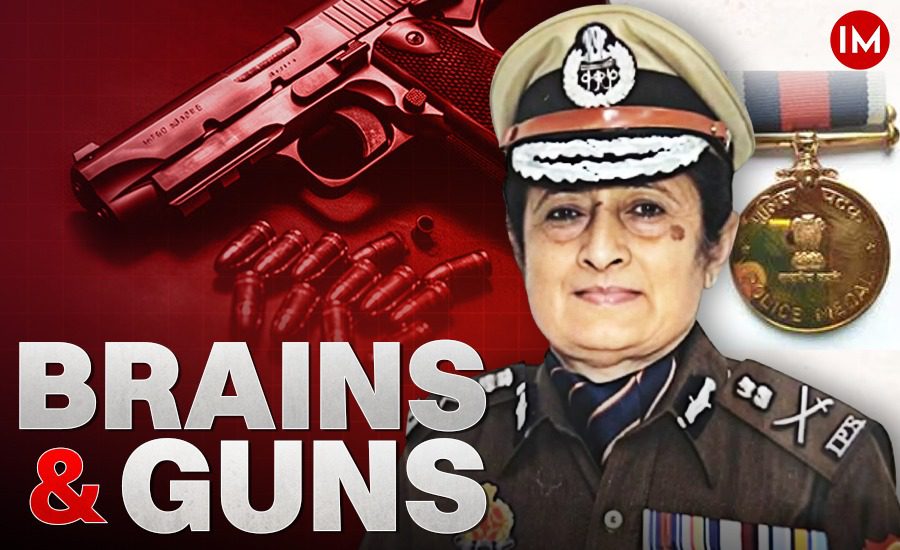
Growing up in the home of a senior police officer, discipline and courage were part of everyday life for the 1990-batch IPS officer of U.P. cadre, Ms. Tilotama Varma. Years later, she would enter the Indian Police Service and go on to become the first woman IPS officer from Uttar Pradesh to receive the President’s Police Medal for Gallantry. In a candid conversation with Indian Masterminds, the former DG of UP Police reflects on her childhood, her academic brilliance, the challenges of policing as a woman, and the support system that helped her rise to the top.
Childhood Lessons
For Tilotama Varma, the idea of public service was shaped early at home. Her father, an IPS officer who later became the DGP of Himachal Pradesh, lived a life defined by discipline and duty. Watching him leave early every morning and return late at night left a deep impression on her.
“Subah 9–10 baje nikalte the aur raat ko 8–9 baje se pehle ghar nahi aate the,” she recalls. She and her sister often wondered what they could do that would make their parents proud. “Hum do behne hain… humein lagta tha ki humein bhi kuch na kuch karna hai.” That thought would eventually guide her towards the uniform.
A Brilliant Mind
Before she ever thought seriously about joining the civil services, Varma had already established herself as a brilliant student.
While studying law, she achieved a rare academic distinction. The exposure to global legal thought opened new possibilities. A career in international law seemed within reach.
But life had another plan waiting.
Life Changing Exam
Interestingly, her entry into the civil services was part of a carefully designed strategy. She appeared for the UPSC examination after preparing for the exam at home only. .
She cleared the exam and joined the Indian Police Service, beginning a journey that would take her through some of the toughest postings in Uttar Pradesh. One attempt was enough. She didn’t appear again because she never aspired to be an IAS.
Equality In Training
When Varma entered police training, men and women were expected to undergo exactly the same drills. But the reality of field training brought challenges that were rarely discussed.
Long marches, harsh field conditions and the absence of basic facilities often created silent hardships for women officers.
“Jab 30 kilometre march karte hain… nature’s call bhi ek challenge ban jaata hai,” she explains.
Even years later, when she joined the CBI as DIG after nearly two decades of service, some basic infrastructure for women officers was still missing.
It is a reminder that institutional systems sometimes take longer to adapt.
The Family
Behind every demanding police career lies a strong support system. For Varma, that support came from her husband and extended family.
Whenever she opted for field postings, her husband adjusted his career to ensure the family remained stable. “Mere husband meri career mein bahut bada support rahe,” she says.
At times, he even requested non-field postings so he could stay with their children while she handled difficult assignments. Her in-laws also stepped in whenever needed. “Akele na aadmi bachcha paal sakta hai, na aurat… support system bahut zaroori hota hai.”
Winning Respect At Work
In her early years, Varma often faced skepticism from senior officers who wondered whether a woman could handle the pressures of policing. “Senior officers poochte the – aap lady hain, kar paayengi?”
Yet she found unwavering acceptance where it mattered the most—among her subordinate staff. “Hamare staff ne kabhi nahi poocha ki aap lady hain ya officer. Unke liye hum sirf officer the.” That trust helped her build confidence and authority on the ground.
Lonely At The Top?
After rising to the highest ranks of the police service, she was once asked whether leadership felt lonely.
Verma’s answer reflects the relentless nature of police work. “Police force mein loneliness ka time hi nahi hota,” she says. The constant flow of responsibilities, crises and decisions leaves little time for self-reflection. “Yeh ek aisi service hai jahan 24 ghante kaam hota hai… akela mehsoos karne ka waqt hi nahi milta.”
Earning Recognition
Throughout her career, Varma handled several difficult investigations, solving some of them with remarkable speed and precision. Her courage and professionalism eventually earned her the President’s Police Medal for Gallantry, making her the first woman IPS officer from Uttar Pradesh to receive the honour.
For her, however, the award represents the spirit of the police service rather than individual glory.
Brains and Guns
Tilotama Varma’s journey reflects a rare combination of intellectual brilliance and fearless policing—brains and guns in the truest sense.
From presenting a paper at the International Court of Justice to commanding respect in one of the country’s toughest police forces, she has walked a path few have travelled. Her story is not just about breaking barriers. It is about quietly redefining what leadership in uniform can look like.
And as she candidly admits, even today some gaps remain. “Progress hui hai… lekin kuch cheezein abhi bhi lacking hain.” Perhaps acknowledging that truth is what keeps the journey of reform alive.