We are closer to a civilizational inflection point than we realize. For centuries, progress was constrained by the limits of human intelligence—how much we could know, compute, design, and decide. That constraint is now dissolving. With the rapid emergence of Generative AI and the approaching horizon of AGI, intelligence itself is becoming abundant.
This is not just another technological shift. It is a reversal. For the first time in history, the primary risk is no longer insufficient intelligence. It is misdirected intelligence at scale. And that changes everything.
The Core Gap: Intelligence Without Direction
AI systems can already generate strategies, code, policies, scientific hypotheses, and persuasive narratives—often better and faster than humans. As these systems scale, they will not just assist decision-making; they will increasingly shape it.
But intelligence, by itself, does not contain a compass: it optimizes, it extrapolates, it executes. It does not inherently ask: Should this be done? For whom? At what cost? With what long-term consequences?
That function—call it judgment, discernment, or in the Indian philosophical tradition, Vivek—has always been human. The emerging danger is not that AI will become too intelligent. It is that humanity may fail to embed wisdom into systems that amplify intelligence beyond human control.
Why This Is Existential
Much of the current discourse on AI risk focuses on alignment, control, and safety. These are necessary—but not sufficient. Alignment asks: Does AI follow our instructions? Control asks: Can we constrain its actions? But a deeper question precedes both: Are our instructions themselves wise?
A perfectly aligned system, pursuing poorly framed goals, can still produce catastrophic outcomes—efficiently, irreversibly, and at scale. History offers a sobering pattern: human systems often optimize for what is measurable, immediate, and incentivized—while neglecting what is meaningful, long-term, and difficult to quantify.
AGI will not correct this tendency. It will amplify it. Which means the central challenge of the AI age is not just technical alignment. It is the Wisdom Gap—the gap between what we can do and what we should do.
From Individual Judgment to Collective Wisdom
Traditionally, wisdom has been treated as an individual trait—associated with experience, leadership, or moral authority. That model is inadequate for the scale and speed of decisions we now face. No single individual, however expert, can fully grasp the multidimensional consequences of deploying powerful AI systems across societies, economies, and ecosystems.
What becomes necessary is a shift: From individual intelligence to collective wisdom. But collective processes today are deeply flawed. They are shaped by hierarchy, bias, noise, and polarization. They either collapse into forced consensus or fragment into unproductive disagreement. In an era where AI can generate an abundance of ideas, the bottleneck is no longer ideation. It is discernment at scale.
A Different Paradigm: From Consensus to Resonance
We need to move beyond traditional models of decision-making. Consensus is often shallow—driven by compromise or pressure. Majority is often misleading—driven by incomplete understanding. What we need instead is resonance.
Resonance is not agreement. It is deeper alignment—where diverse perspectives, when independently examined, converge toward what is robust across contexts, consequences, and values. This requires systems that can i) bring to the surface diverse insights without distortion by status or authority, ii) allow independent evaluation rather than groupthink, iii) identify patterns of convergence that signal depth, not popularity, and iv) integrate these patterns into coherent, actionable direction.
In essence, a shift from debate to something closer to a symphony—where differences are not eliminated, but harmonized.
The Case for Wisdom–AI
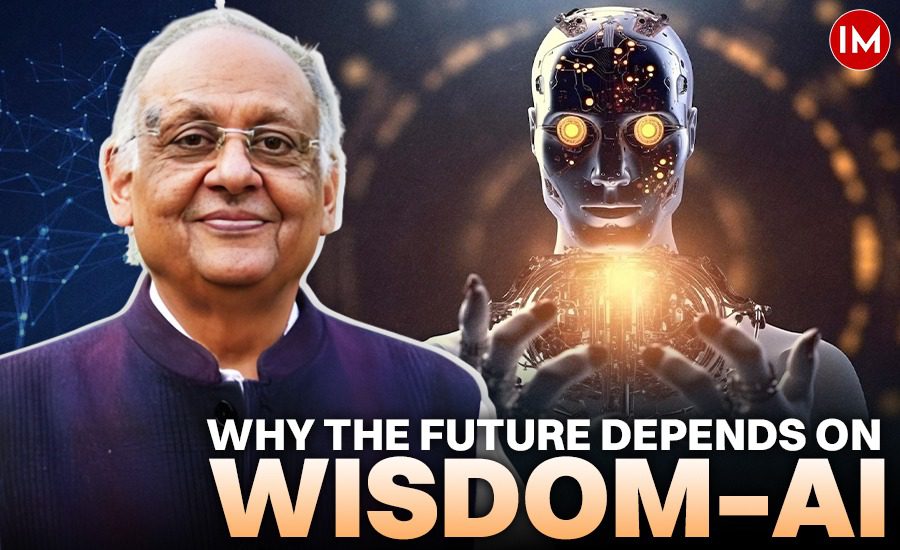
This is where a new layer becomes essential: Wisdom–AI. Not AI that merely generates or optimizes. But AI that helps human systems become wiser. Such a system would not replace human judgment. It would augment and structure it, enabling i) aggregation of distributed human insight without hierarchy-induced distortion, ii) detection of deeper patterns of alignment across diverse expertise, iii) integration of ethical, contextual, and long-term considerations into decision flows, and iv) continuous refinement of decisions through reflective feedback loops.
In this architecture, AI becomes less of an “actor” and more of an orchestrator of human wisdom.
The Inner Constraint
However, no system design can substitute for a fundamental requirement: the quality of human participation. If individuals engage with fixed positions, ego, or narrow incentives, even the most advanced systems will produce noise. Wisdom requires a minimal inner condition—openness, intellectual humility, and the willingness to revise one’s own assumptions.
This insight is not new. Philosophical traditions across cultures—from the Upanishads and Vedanta to Western philosophical inquiry—have emphasized that discernment is as much an inner discipline as an external capability. What is new is the possibility of operationalizing this at scale, through carefully designed socio-technical systems.
A Civilizational Choice
We are, in effect, making a choice—implicitly, if not explicitly. We can continue to scale intelligence without a corresponding evolution in wisdom. Or we can recognize that wisdom is now a first-order requirement, not a philosophical luxury.
The stakes are clear. Without wisdom, AGI can magnify errors, biases, and short-termism—threatening not just efficiency, but freedom, stability, and human agency. With wisdom, the same technologies can enable a level of coordination, foresight, and collective flourishing previously unimaginable.
The Way Forward
The next phase of AI development must therefore include three parallel efforts, viz. i) advancing capabilities of AI systems, ii) strengthening alignment and safety frameworks, and critically iii) developing infrastructures for collective wisdom
This is not a peripheral agenda. It is central to ensuring that intelligence—now unbounded—remains directed toward human well-being.
In the age of AGI, the defining question is no longer how intelligent our systems become. It is whether we can guide that intelligence with sufficient wisdom.
Because in the end, the future will not be determined by what AI can do. It will be determined by what humanity chooses to do—with AI. Our survival, freedom and happiness depends on the choices we make today, the actions that we take today, individually and collectively.
(Mr. Anurag Goel is a Career Civil Servant (IAS 1972) turned Futurist & Governance Architect)