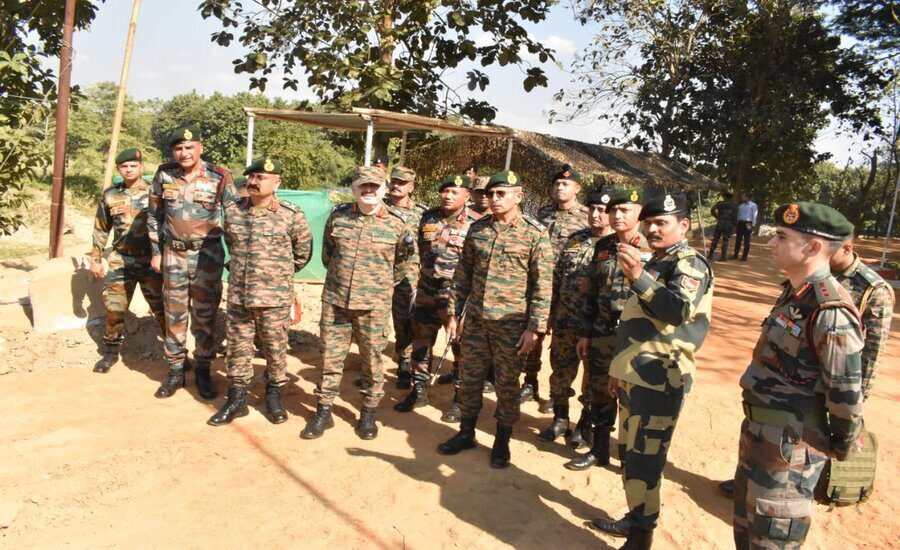
New Delhi: In a decisive move to strengthen India’s defensive posture on its eastern front, the Indian Army is actively exploring the establishment of a fourth Army base near the India-Bangladesh border in Mizoram, aimed at bolstering security around the vulnerable Siliguri Corridor — also known famously as “Chicken’s Neck.”
The consideration for this new military station follows a strategic effort earlier this year to create three new Army bases spanning West Bengal, Bihar, and Assam.
These installations form a protective arc around the Siliguri Corridor — the narrow land bridge connecting India’s northeastern states with the mainland — to counter emerging geopolitical dynamics and potential threats in the region.
Understanding the Strategic Importance of Chicken’s Neck
The Siliguri Corridor, stretching roughly 22 km at its narrowest point, is not just a geographical flashpoint — it is a critical lifeline anchoring India’s integration with its seven northeastern states. Bordered by Nepal, Bhutan, and Bangladesh, any compromise in this region can isolate the entire northeast from the rest of the country.
Read also: Garuda 25: A Milestone in India–France Defence Partnership and Air Force Interoperability
This vulnerability isn’t new but has gained renewed attention amid evolving defence postures by neighbouring countries and broader regional shifts.
In response, New Delhi has intensified infrastructural and military preparedness, including troop deployments, advanced frontline stations, and joint force coordination.
Army fourth base Mizoram: Mizoram Under Consideration
High-Level Military Assessment
According to defence sources, the Army’s Eastern Command GOC, Lieutenant General R C Tiwari, visited Thuampui near Aizawl, Mizoram on December 19, 2025 to evaluate the terrain for a possible new station.
Accompanying him were senior commanders including:
- Lt Gen Abhijit S Pendharkar, GOC Dimapur-based 3 Corps
- Lt Gen Yash Ahlawat, GOC, 17th Mountain Strike Corps
The assessment included field inspections of key border outposts — Parva Border Outpost (BOP) in Lawngtlai district and Silsuri in West Phaileng block of Mamit district — both strategically significant given their proximity to Bangladesh and, in Parva’s case, the tri-junction with Myanmar.
Strategic and Security Imperatives of Army fourth base Mizoram
1. Multi-Layered Border Threat Mitigation
Officials say the new base is envisioned as a first line of defence to deter or respond to threats — both state and non-state — appearing near the India-Bangladesh frontier.
Plans include deploying an Army battalion drawn from a brigade under the 3 Corps to serve as a forward force presence in the region.
This move complements earlier defensive expansions that have improved troop mobility, surveillance coverage, and rapid response capabilities in high-sensitivity zones.
BSF’s Parallel Infrastructure Drive
2. Inland Defensive Fortifications
In tandem with the Army’s evaluative study, the Border Security Force (BSF) has launched a vigorous infrastructure strengthening programme along the Mizoram-Bangladesh border.
Ministry of Home Affairs sources state that across three battalion command areas (including Cachar and Mizoram frontiers):
- Bunkers
- Ring bundhs
- Blast-proof shelters
- Underground armouries
These will be built over the next five years based on operational sensitivity and vulnerability assessments. Each battalion area is slated to include about 45 defensive structures.
Mizoram has 85 BSF outposts along its border with Bangladesh, many of which are being upgraded into future-ready composite hubs.
Around 40 defensive structures are already completed in Lunglei and Lawngtlai districts, and 19 more projects have been sanctioned. The long-term plan is to fully equip about 26 outposts with the four critical defensive infrastructure types.
Geopolitical & Security Context of Army fourth base Mizoram
The proposed fourth base, in conjunction with newly created stations in West Bengal, Bihar, and Assam, underscores a broader strategy to:
- Create a robust defensive network around the Chicken’s Neck
- Enhance rapid mobilization capabilities
- Deter unconventional or external threats across eastern borders
- Ensure the security of critical land corridors connecting northeast India to the mainland
Defense analysts view these developments as a calibrated response to shifting regional dynamics, including increased military infrastructure near Indian borders and potential vulnerabilities posed by terrain and proximity to foreign installations.