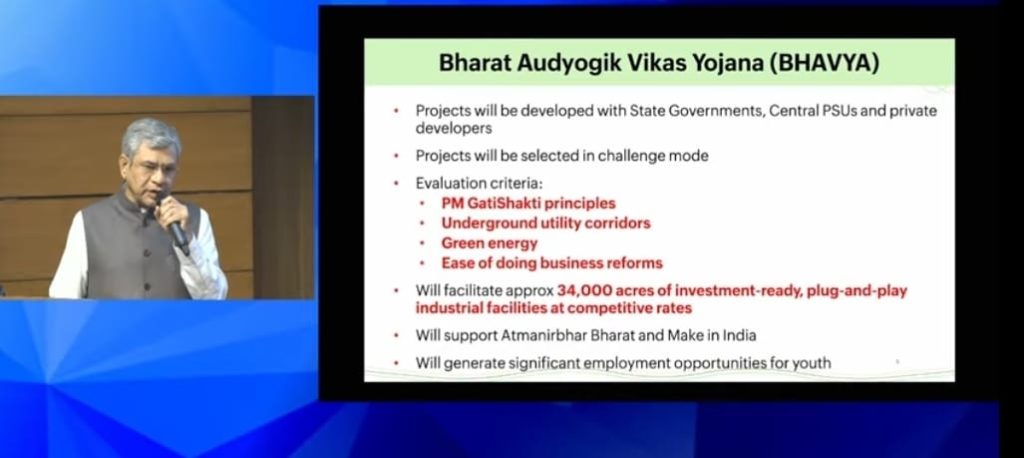
New Delhi: In a major policy push aimed at accelerating manufacturing-led growth and strengthening India’s industrial backbone, the Union Cabinet chaired by Narendra Modi has approved the Bharat Audyogik Vikas Yojna (BHAVYA), a ₹33,660-crore scheme to establish 100 world-class plug-and-play industrial parks across the country. The ambitious programme seeks to create investment-ready industrial ecosystems that reduce project delays, attract global capital, strengthen domestic supply chains, and generate large-scale employment.
The scheme marks one of the most significant industrial infrastructure interventions in recent years and is designed to position India as a globally competitive manufacturing destination by combining ready land, modern infrastructure, policy support, and integrated logistics.
Government Targets Faster Industrialisation Through Plug-and-Play Ecosystems
Addressing the Cabinet briefing, Union Minister Ashwini Vaishnaw said manufacturing activity in India is expanding rapidly and the country is increasingly being seen as a preferred destination for global investment because of policy certainty, talent availability, strong design capabilities, and sectoral growth in electronics, electric vehicles, and technical textiles.
He said the newly approved scheme aims to take this momentum further by creating industrial parks where investors can begin operations quickly without facing the conventional delays associated with land acquisition, approvals, and infrastructure creation.
According to the minister, the parks will be developed near nearly 100 cities with either existing industrial ecosystems or strong industrial potential, enabling industries to leverage local supply chains and regional economic strengths.
Read also: Over 1 Lakh Women-Led Startups in India Signal Strong Growth in Gender-Inclusive Entrepreneurship
₹1 Crore Per Acre Support for Core Infrastructure
A major financial feature of the scheme is the Centre’s support for infrastructure development.
The government will provide financial assistance of approximately ₹1 crore per acre, with a minimum land requirement of 100 acres for general regions. For North Eastern and hilly states, the minimum project size has been relaxed to 25 acres, recognising geographical and developmental constraints.
Industrial parks under BHAVYA will range between 100 and 1,000 acres, depending on local requirements and industrial demand.
The financial assistance will primarily support:
• Internal road networks
• Water supply systems
• Power infrastructure
• Drainage and sewerage systems
• ICT-enabled utilities
• Common industrial facilities
This funding structure is expected to significantly reduce entry costs for state governments and private developers participating in the scheme.
Built on Industrial Smart City Experience
The BHAVYA scheme builds upon the implementation experience gained under the National Industrial Corridor Development Programme, led by National Industrial Corridor Development Corporation.
Over the past several years, industrial smart cities developed under this framework have demonstrated how integrated industrial infrastructure can accelerate project execution and attract private investment.
The new scheme aims to replicate and expand that model on a much larger scale through coordinated implementation involving:
• Central government support
• State government facilitation
• Private sector participation
Officials believe this collaborative model will help ensure faster project rollout and stronger local ownership.
Ease of Doing Business Central to BHAVYA Framework
A defining pillar of BHAVYA is its focus on making industrial investment easier and faster.
The scheme proposes to eliminate procedural bottlenecks through:
• Streamlined approval systems
• Single-window clearances
• Faster state-level approvals
• Investor-friendly regulatory mechanisms
The plug-and-play format means industries will receive pre-approved land parcels with ready infrastructure, allowing companies to move quickly from investment decision to production.
This model is expected to particularly benefit sectors where project delays often increase capital costs and reduce competitiveness.
Value-Added Infrastructure Beyond Basic Industrial Facilities
Unlike conventional industrial estates, BHAVYA parks will include not only core infrastructure but also value-added facilities required for modern manufacturing ecosystems.
These include:
• Factory sheds
• Testing laboratories
• Warehousing facilities
• Logistics support systems
• Common industrial services
In addition, social infrastructure will also be integrated into park planning, especially for workforce support.
This includes:
• Worker housing
• Basic social amenities
• Support infrastructure for industrial labour communities
Such integrated planning is intended to improve productivity and support long-term industrial sustainability.
PM GatiShakti Principles to Guide Connectivity and Logistics
The scheme has been designed in alignment with PM GatiShakti principles to ensure seamless multimodal connectivity.
Industrial parks will be planned with direct access to:
• Highways
• Rail links
• Ports where feasible
• Freight corridors
• Logistics nodes
This connectivity strategy aims to reduce logistics costs, improve supply-chain efficiency, and strengthen export competitiveness.
Integrated underground utility systems are also planned to ensure uninterrupted industrial operations and reduce future maintenance disruptions.
Green Energy and Sustainable Industrial Design Prioritised
The government has indicated that sustainability will be a core design principle of these new-generation industrial parks.
Planned features include:
• Green energy integration
• Efficient resource management
• Sustainable water systems
• Environment-friendly utility design
The emphasis on future-ready infrastructure reflects India’s attempt to align industrial expansion with sustainability commitments while remaining globally competitive.
Expected to Generate Large-Scale Employment and Investment
Officials expect BHAVYA to trigger substantial economic activity across multiple sectors.
The scheme is projected to:
• Attract large domestic and foreign investments
• Generate lakhs of direct jobs
• Create indirect employment in logistics, services, and support sectors
• Strengthen regional industrial clusters
By promoting cluster-based development, the parks will allow manufacturers, suppliers, and service providers to operate in close
proximity, reducing supply-chain costs and improving production efficiency.
This is expected to particularly benefit:
• MSMEs
• Startups
• Export-oriented manufacturers
• Component suppliers
• Logistics firms
Boost to Regional Economies Across States and Union Territories
The geographical spread of nearly 100 industrial parks is expected to support balanced industrial development across India.
States and Union Territories that currently have emerging industrial ecosystems may benefit significantly through:
• New industrial investments
• Employment opportunities
• Urban expansion around manufacturing nodes
• Increased local economic activity
The inclusion of smaller land thresholds for difficult terrain regions is also expected to help expand industrialisation into previously under-served geographies.
NICDC to Lead National Implementation
Implementation responsibility will largely rest with National Industrial Corridor Development Corporation, which currently oversees 20 industrial projects across 13 states.
Its experience in developing industrial smart cities using plug-and-play infrastructure is expected to play a crucial role in timely rollout under BHAVYA.
With institutional capacity already established, officials believe implementation can move faster compared to entirely new project structures.
A Major Step Toward Viksit Bharat and Atmanirbhar Bharat
The approval of BHAVYA is being seen as a strategic step toward strengthening the goals of Viksit Bharat and Atmanirbhar Bharat.
By creating globally competitive industrial infrastructure, the government aims to improve India’s position as a preferred manufacturing destination while deepening domestic industrial capacity.
As global supply chains continue to diversify, the scheme may help India capture a larger share of manufacturing investment seeking stable, scalable, and policy-backed destinations.
Read also: I&B Ministry Proposes 40 IIS Posts in Foreign Missions to Boost India’s Global Media Outreach