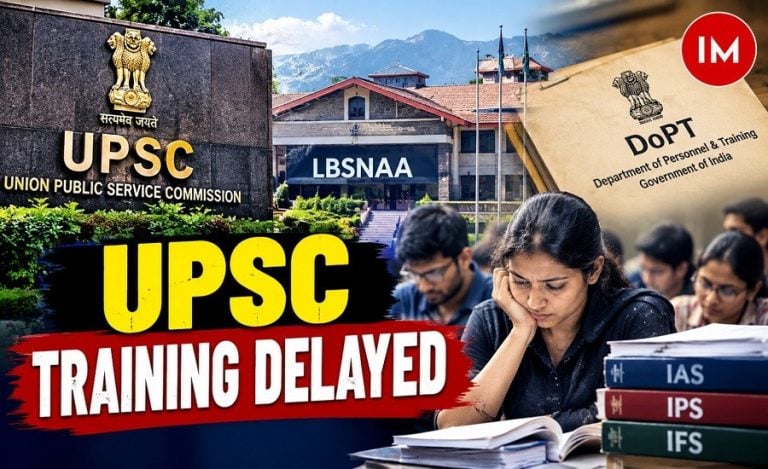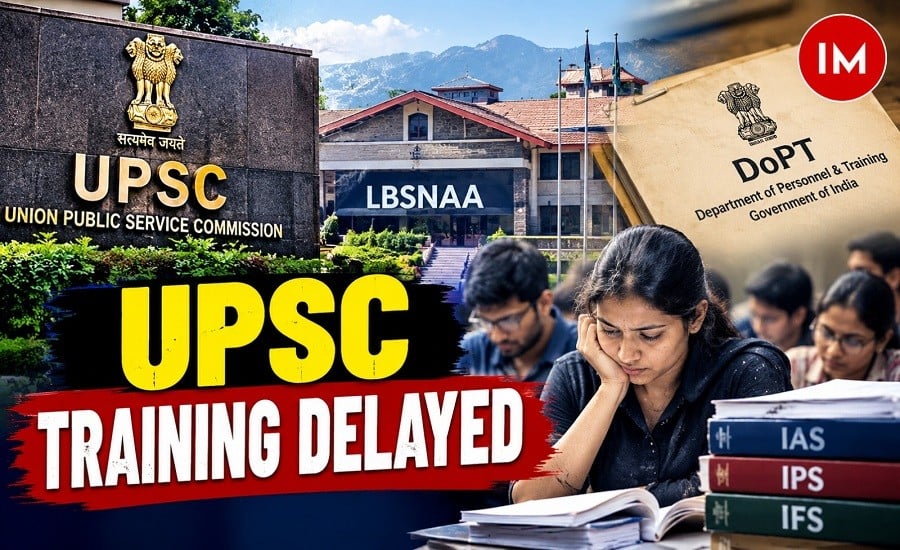
New Delhi: The careers of 958 candidates selected through the Union Public Service Commission‘s Civil Services Examination (UPSC CSE) 2025 are facing an unusual delay, with service allocation and the mandatory Foundation Course yet to begin because of an ongoing legal dispute over the Other Backward Classes (OBC) creamy layer criteria.
The Foundation Course, generally conducted between August or September and December at the Lal Bahadur Shastri National Academy of Administration (LBSNAA), Mussoorie, and other designated training institutions, was originally expected to commence in the last week of August 2026.
However, more than two months after its scheduled commencement, candidates are still awaiting confirmation of their allotted services and training dates.
The delay has been described by officials familiar with civil services training as unprecedented in independent India’s administrative history.
Amid concerns about the consequences for the careers of newly recruited officers, officials associated with the Department of Personnel and Training (DoPT) have clarified that the delay will not adversely affect the seniority, gradation or other service conditions of the successful candidates.
DoPT Clarifies: Delay Will Not Affect Seniority of UPSC 2025 Candidates
The most significant reassurance for the selected candidates has come from official sources, who have indicated that the pending Supreme Court proceedings will not affect the seniority of the CSE 2025 batch.
According to the officials, the DoPT and the concerned training institutions are prepared to complete service allocation expeditiously and begin the Foundation Course at the earliest possible date.
They have also maintained that the delay in commencing training will not adversely affect the seniority, gradation or other service conditions of the candidates.
This clarification is particularly important because the Foundation Course and the subsequent appointment process are closely connected with the career progression of civil servants.
Candidates had expressed concerns that a prolonged delay could affect their joining schedules, batch placement and future service benefits.
The official assurance seeks to address these concerns, although the precise date for commencement of training has not yet been announced.
Read also: UPSC CRT 2026 Postponed: New Exam Date Announced for 24 Principal, 704 Vice-Principal Posts
Why Has the UPSC CSE 2025 Foundation Course Been Delayed?
The uncertainty originates from a Supreme Court judgment delivered on March 11, 2026, concerning the criteria used to determine whether candidates belonging to the OBC category fall within the creamy layer.
The judgment, delivered in the Union of India versus Rohith Nathan and connected cases, addressed the treatment of parental salary income and the equivalence of employment positions in public sector undertakings, banks and private organisations with government service posts.
The Supreme Court held that candidates could not be excluded from OBC reservation benefits solely on the basis of their parents’ salary income without considering the applicable service-status criteria.
The ruling raised questions about how OBC non-creamy layer eligibility should be assessed in cases where the equivalence of non-government employment positions with government posts has not been established.
The issue became particularly significant for the UPSC CSE 2025 batch because its final results were declared on March 6, 2026, just five days before the Supreme Court delivered its judgment.
Although the results had been announced, service allocation had not been completed when the judgment was pronounced.
This created uncertainty over the criteria to be applied while finalising category-wise allocation of successful candidates to the IAS, IPS, IFS, IRS and other civil services.
Centre Approached Supreme Court on August 24
To resolve the implementation difficulties, the Central Government approached the Supreme Court on August 24, 2026, seeking clarifications regarding the March 11 judgment.
The application was filed shortly before the expiry of the six-month period associated with implementation of the court’s directions.
The Centre requested that the judgment should not be applied retrospectively in a manner that could disturb completed recruitment processes, admissions, academic sessions, degrees already awarded or other settled rights.
It also sought a two-year period to undertake the exercise of determining equivalence between government posts and positions in public sector undertakings, private organisations and other institutions.
The government argued that reopening previously completed selections could create substantial administrative complications.
It also raised concerns that delays in finalising category-wise merit lists and service allocations could have consequences for training schedules, seniority and pay fixation.
On September 24, the Supreme Court reserved its order on the Centre’s application. The continuing wait for clarification has contributed to the delay in finalising service allocation for the 2025 batch.
What Did the Supreme Court Say About OBC Creamy Layer?
The March 11 judgment was delivered by a Division Bench comprising Justices P. S. Narasimha and R. Mahadevan.
The central issue was whether the salary income of parents employed in public sector undertakings or private organisations could independently determine the creamy layer status of their children.
The dispute arose from the interpretation of a September 8, 1993 Office Memorandum and a subsequent DoPT clarification issued on October 14, 2004.
Under the 1993 framework, creamy layer determination involves different criteria relating to parental service status, occupational position and income or wealth.
The 2004 clarification created controversy over how salary income should be treated when the equivalence of positions in public sector undertakings and other organisations with government posts had not been established.
The Supreme Court found that applying different standards to similarly placed candidates merely because of the nature of their parents’ employment could result in discriminatory treatment.
The judgment emphasised that the creamy layer framework must be implemented consistently with the constitutional principles of equality and non-discrimination.
It rejected the approach of treating parental salary income as the sole determining factor in the disputed category of cases without properly considering the relevant status and equivalence criteria.
How the OBC Creamy Layer Income Limit Evolved
The creamy layer concept was introduced to ensure that OBC reservation benefits reach socially and educationally disadvantaged sections rather than those considered relatively advanced under the prescribed criteria.
The original annual income ceiling under the income and wealth test was fixed at Rs 1 lakh in 1993.
It was subsequently revised in 2004, 2008 and 2013.
In 2017, the ceiling was increased to Rs 8 lakh per annum, a level that has remained unchanged.
However, the creamy layer determination is not based on the income ceiling alone.
The framework also covers the status of parents occupying constitutional positions, Group A and Group B government posts, positions in public sector undertakings and the armed forces, as well as specified professional, business, property and income-related categories.
Questions surrounding the equivalence of positions in different sectors have remained a persistent source of litigation.
While equivalence issues concerning certain central public sector undertakings were addressed in 2017, similar questions involving private employment, universities, educational institutions and several state government organisations have continued to create difficulties.
Nearly 100 Candidates from Previous UPSC Batches Also Affected
The dispute is not limited to candidates selected through the 2025 Civil Services Examination.
It also concerns the future of approximately 100 candidates who cleared the Civil Services Examination in different years since 2016 but were denied OBC non-creamy layer status under the criteria then applied.
Some of these candidates had challenged the treatment of their parents’ salary income while determining eligibility for reservation benefits.
The Supreme Court’s March 11 judgment has implications for such disputes, particularly where candidates were excluded from reservation benefits without an appropriate assessment of parental employment status.
The Centre’s request for prospective application of the judgment is therefore significant for both previously completed recruitment processes and selections awaiting final allocation.
UPSC Candidates Continue Waiting for Service Allocation
The prolonged uncertainty has left successful candidates unable to make definite plans for the beginning of their civil services careers.
According to a report by The Indian Express, one candidate whose rank indicates the possibility of allocation to the IAS said that they were still waiting for communication regarding the Foundation Course.
Another candidate expecting possible allocation to the IRS described repeatedly checking the LBSNAA website for updates.
The uncertainty has also affected candidates who appeared again in the Civil Services Main Examination this year in an attempt to improve their ranks.
A separate Foundation Course arrangement for such candidates was expected at the National Communications Academy-Finance in Delhi, approximately a week after the commencement of the main LBSNAA programme.
That programme has also been postponed.
LBSNAA Prepared, But Training Date Yet to Be Announced
The Lal Bahadur Shastri National Academy of Administration remains the principal institution responsible for the common Foundation Course for newly recruited civil servants.
The programme brings together officer trainees from the All India Services and various Central Civil Services.
It introduces them to the Constitution, public administration, government functioning, public policy, ethics and the responsibilities of public service.
The course also encourages interaction among officers belonging to different services, helping establish professional relationships that can support coordination throughout their administrative careers.
A senior LBSNAA official told The Indian Express that preparations were continuing, but the starting date had not been finalised because further instructions were awaited from the competent authorities.
The postponement therefore affects not only the training calendar but also the initial professional orientation of an entire batch of future administrators.
Why the Delay Has Raised Concerns About Career Progression
For candidates selected through the UPSC examination, service allocation determines whether they will join the IAS, IPS, Indian Foreign Service, IRS or another participating service.
Once allocation is completed, candidates begin their training and enter the administrative system according to the applicable service rules.
The delay has consequently generated concerns about the timing of appointments, subsequent professional training, seniority and long-term career progression.
Although official sources have assured candidates that their seniority and service conditions will remain protected, the absence of a confirmed training schedule continues to create uncertainty.
The government has indicated that it wants to avoid any cascading impact on the recruitment and training system while ensuring compliance with the Supreme Court’s directions.
What Happens Next for the UPSC CSE 2025 Batch?
The immediate focus is now on the Supreme Court’s pending clarification and the DoPT’s subsequent decision on service allocation.
Official sources have indicated that the department and training institutions are ready to proceed once the necessary legal and administrative issues are addressed.
For the 958 successful candidates, the assurance regarding seniority provides some relief, but the most important development will be the announcement of service allocations and a confirmed date for the Foundation Course.
The case has also brought renewed attention to the need for clear and consistent OBC creamy layer criteria, particularly for families whose employment falls outside conventional government service classifications.
Until the remaining issues are resolved, the UPSC CSE 2025 batch will continue to wait for the formal beginning of its civil services training.
Read also: UPSC Declares NDA, Naval Academy II Written Results; SSB Interviews Next for July 2027 Courses