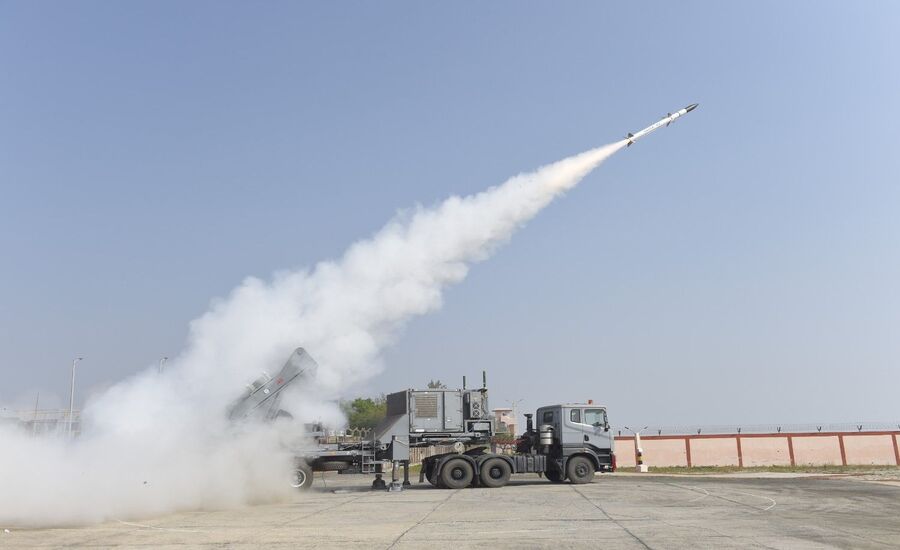
New Delhi: India’s Akash missile exports could help the country become a bigger player in the global defence market. However, difficult financing procedures, high production costs and delays in payments remain major challenges for Indian defence manufacturers, especially small businesses.
India has reportedly exported its indigenous Akash air defence system to Armenia, Tajikistan and Turkmenistan. The growing demand for Indian military equipment offers new opportunities, but better financial support will be important for sustaining this growth.
Akash Missile Exports Strengthen India’s Defence Ambitions
The Akash surface-to-air missile system is developed by the Defence Research and Development Organisation (DRDO). Bharat Dynamics Limited (BDL) and Bharat Electronics Limited (BEL) are involved in its production.
Read also: Why These Three Countries Chose India’s Akash Missile System For Air Defence
The system is designed to protect important locations against aerial threats, including aircraft and other high-speed targets. Its export success highlights India’s growing ability to develop and manufacture advanced military equipment.
Armenia became the first foreign customer for the Akash system, followed by reported exports to Tajikistan and Turkmenistan. These developments could help India expand its defence presence in Central Asia and other international markets.
India’s Defence Production And Exports Reach New Heights
India’s defence industry has recorded strong growth in recent years. According to figures cited in the report, defence production increased from ₹46,429 crore in 2014–15 to approximately ₹1.78 lakh crore in 2025–26.
Defence exports also reached a record ₹38,424 crore in 2025–26, compared with ₹686 crore in 2013–14. Indian defence products now reach more than 80 countries.
The government aims to increase annual defence production to ₹3 lakh crore and defence exports to ₹50,000 crore by 2029. Achieving these targets will require stronger manufacturing capacity, new technologies and better support for exporters.
Financing Remains A Major Challenge For Defence Exports
Despite rising international demand, securing finance remains a serious problem for Indian defence manufacturers. Companies may win overseas contracts but still struggle to arrange enough money to manufacture and deliver the equipment.
Defence exports often involve lengthy testing, technical evaluations, security clearances and approval procedures. Manufacturers may need to spend large amounts of money before receiving payments from overseas customers.
These challenges can delay production, increase costs and place pressure on companies’ cash flow. As a result, winning an international contract does not always mean that a company can execute it easily.
Small Defence Businesses Face Greater Difficulties
Micro, Small and Medium Enterprises (MSMEs) play an important role in India’s defence manufacturing industry. They supply components, specialised equipment and technical services to larger defence companies.
However, smaller businesses often have fewer financial resources than major manufacturers. They may find it difficult to manage the high upfront costs and long waiting periods associated with defence export contracts.
Although financing facilities are available through institutions such as the Export-Import Bank of India, industry representatives believe that defence exporters need financial support designed specifically for their requirements.
Industry Seeks A Dedicated Defence Export Financing System
Defence manufacturers are calling for a dedicated financing framework to support overseas contracts. Such a system could provide working capital, contract-linked loans and suitable financial guarantees.
Industry representatives have also suggested a single-window system to simplify export approvals, financing, insurance and other procedures.
Under this approach, exporters could manage several requirements through a coordinated process instead of dealing with multiple agencies separately. This could reduce delays and make it easier for companies to fulfil international orders.
The government could also examine these proposals in consultation with the Reserve Bank of India, the Ministry of Finance and the Export-Import Bank of India.
Private Companies Could Help Expand India’s Defence Exports
India’s defence export growth depends on both public-sector manufacturers and private companies. While large government-backed contracts can support the industry, wider private-sector participation could increase production capacity and encourage innovation.
Smaller companies can contribute specialised components, advanced materials, electronics, sensors and communication systems. Better access to finance could help these businesses participate in more international projects.
A stronger supply chain would also help major manufacturers meet delivery deadlines and compete with established international defence suppliers.
Akash Missile Exports Success Could Open New Markets
The Akash missile system represents India’s wider effort to move from dependence on imported weapons towards domestic manufacturing and international sales.
Other Indian defence products, including the BrahMos missile system, radar equipment, artillery platforms and naval systems, could also benefit from growing international interest.
Countries looking to diversify their military suppliers may consider Indian equipment because of its capabilities and potential cost advantages. However, long-term export growth will depend on reliable production, after-sales support, timely delivery and competitive financing.
Read also: MIDHANI Signs MoU with HWB and BARC to Recover Nickel and Cobalt from Plant Reverts
FAQs
India’s Defence Secretary has stated that the Akash system has been exported to Armenia, Tajikistan and Turkmenistan. The system’s international reach reflects India’s growing defence export capabilities.
The Akash missile system is an indigenous Indian surface-to-air missile system developed by DRDO. It is designed to defend important locations against aerial threats, including aircraft and other high-speed targets.
Defence export financing helps manufacturers pay for production, testing, materials and delivery before overseas customers make their payments. Better financing can help companies, especially MSMEs, complete contracts on time and expand their international business.