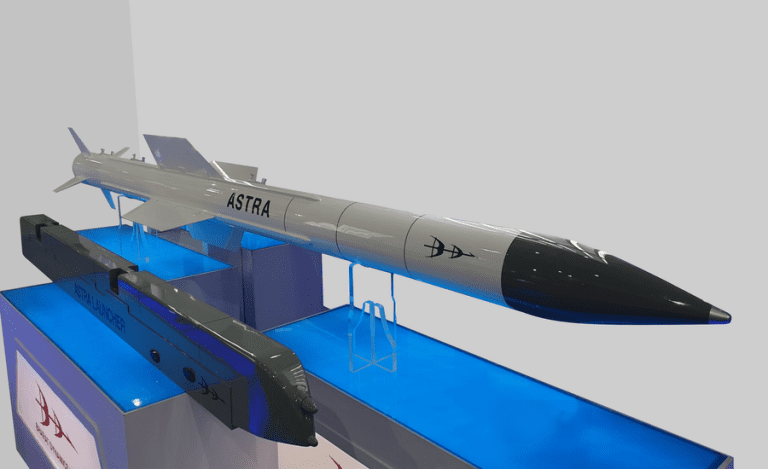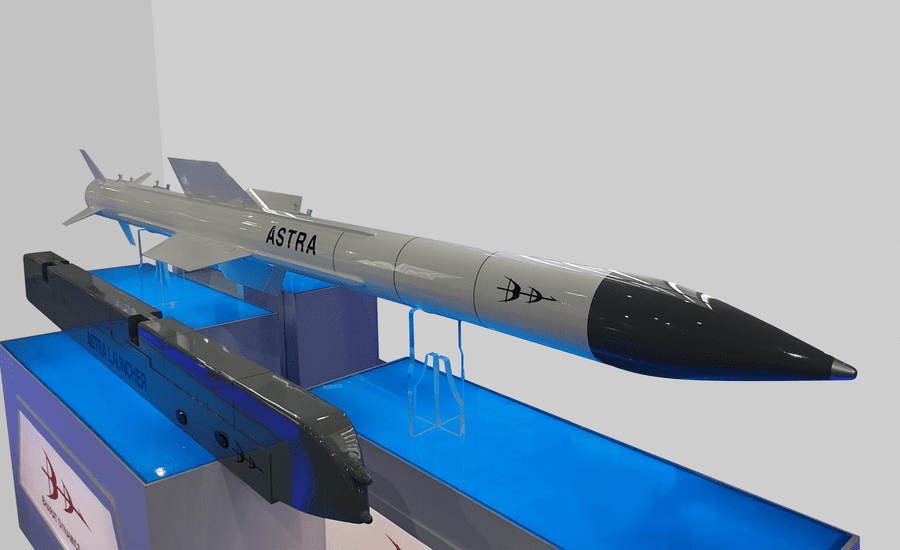
New Delhi: India is upgrading its Astra MK Missile programme to strengthen its air combat capabilities. Developed by the Defence Research and Development Organisation (DRDO), the Astra family of missiles is designed to help Indian fighter jets attack enemy aircraft from long distances.
According to recent reports, upgraded versions of these missiles are moving towards further evaluation by the Indian Air Force (IAF). However, official government sources have confirmed successful Astra missile tests, while the reported completion of development trials for both upgraded versions still needs official confirmation.
Astra Missile Programme: What Makes It Important
The Astra is an indigenous Beyond Visual Range Air-to-Air Missile (BVRAAM). This means it can attack enemy aircraft without requiring the pilot to see the target directly.
Read also: Inside India’s Bold Strategy To Mass Produce Astra Missiles And Boost Exports
The missile uses advanced guidance and navigation systems to track and engage targets. Its development also supports India’s goal of reducing dependence on foreign defence equipment.
The DRDO has developed the weapon system with support from the Indian Air Force, Hindustan Aeronautics Limited (HAL), Bharat Dynamics Limited (BDL), and other Indian industries. According to the Ministry of Defence, more than 50 public and private sector industries contributed to the Astra Missile programme.
Astra Mk1 Missile: Range And Latest Test Results
The Astra Mk1 is the established version of India’s indigenous air-to-air missile. It has already been inducted into the Indian Air Force and tested on Indian fighter aircraft.
Astra Mk1 Range And Capabilities
The Government of India’s Department of Defence Production lists the Astra weapon system with a range of 80–110 kilometres. The Ministry of Defence has also stated that the Astra missile has a range exceeding 100 kilometres.
The missile is designed to engage enemy aircraft at long distances. Its guidance system helps it track targets and improve the chances of a successful interception.
The missile can be launched from the Sukhoi Su-30MKI fighter aircraft. It has also been test-fired from the indigenous Light Combat Aircraft (LCA) Tejas.
DRDO And IAF Successfully Test Astra In July 2025
On July 11, 2025, the DRDO and the Indian Air Force successfully tested the Astra missile equipped with an indigenous Radio Frequency (RF) seeker.
The test was conducted from a Su-30MKI fighter aircraft off the coast of Odisha. Two missiles were launched against high-speed unmanned aerial targets at different ranges and under different conditions.
According to the Ministry of Defence, both missiles destroyed their targets with high accuracy. The test also confirmed the performance of the missile’s indigenous RF seeker. The successful test was an important step towards strengthening India’s ability to develop advanced air-to-air missile technology.
Is The Astra Mk1 Range Now More Than 160 Kilometres?
Recent media reports claim that an upgraded Astra Mk1 configuration could offer a range of more than 160 kilometres. However, the official government announcement about the July 2025 tests does not confirm this upgraded range. It confirms successful missile tests and a range exceeding 100 kilometres.
Therefore, the reported 160-kilometre-plus range should not be treated as an officially confirmed operational specification without further information from the DRDO or the Ministry of Defence.
Astra Mk2 Missile: Aiming For Greater Range
The Astra Mk2 is intended to provide a longer engagement range than the established Astra Mk1. A longer range could allow Indian fighter aircraft to threaten enemy aircraft from farther away.
This capability is important in modern air combat, where pilots need to detect, track, and engage targets while managing the risks posed by enemy aircraft and air defence systems.
Astra Mk2 Range: What Is Known?
The report published by Defence News India states that the Astra Mk2 is designed to engage targets at distances exceeding 200 kilometres. However, this figure should be understood as a reported or intended capability rather than a confirmed operational range. The actual performance of an air-to-air missile depends on several factors, including launch altitude, aircraft speed, target movement, and flight conditions.
The official sources cited here do not establish that the Astra Mk2 has completed all developmental trials or achieved a verified range beyond 200 kilometres.
Astra Missile Programme: How Could A Dual-Pulse Rocket Motor Help?
The report also describes a dual-pulse solid rocket motor as a key feature of the Astra Mk2.
A dual-pulse motor can deliver propulsion in two separate stages. Instead of using all its propellant in one continuous burn, the motor can provide an initial boost and a later burst of thrust.
The second pulse can help the missile retain energy during the later part of its flight. This may improve its ability to manoeuvre and engage a moving target at a longer distance. However, the exact propulsion configuration and performance of the Astra Mk2 should be confirmed through official technical information from the DRDO or the Ministry of Defence.
Why Are Longer-Range Air-To-Air Missiles Important?
Long-range air-to-air missiles can give fighter pilots more options during aerial combat. They can help aircraft engage threats from farther away and potentially reduce the need to approach an enemy aircraft closely.
Their effectiveness depends on more than maximum range. The missile must also receive accurate target information, maintain sufficient energy, and successfully guide itself towards the target. For this reason, the maximum advertised range of a missile is not always the same as its effective engagement range in real combat.
Which Indian Fighter Jets Can Use The Astra Missile?
The Astra missile programme supports India’s effort to equip its fighter aircraft with indigenous weapons.
Sukhoi Su-30MKI
The Su-30MKI is one of the main aircraft associated with the Astra programme. The Ministry of Defence confirmed the successful July 2025 test of the Astra missile with an indigenous RF seeker from this aircraft.
LCA Tejas
The Astra missile has also been test-fired from the LCA Tejas. On March 12, 2025, a successful test launch from an LCA AF Mk1 prototype demonstrated a direct hit on a flying target.
The Ministry of Defence described the test as an important step towards the integration of the weapon with the LCA AF Mk1A variant. It also stated that further trials were planned for performance evaluation.
The integration of indigenous missiles with Indian-built fighter aircraft can help strengthen the country’s defence manufacturing ecosystem.
Read also: IAF Eyes 700 Astra Mk2 Missiles in Major Push for Indigenous Air Combat Strength
FAQs
The supplied report claims that the Astra Mk2 is designed to engage targets at distances exceeding 200 kilometres. However, this range has not been confirmed by the official sources cited in this article.
The Department of Defence Production lists the Astra weapon system with a range of 80–110 kilometres. The Ministry of Defence has confirmed that its range exceeds 100 kilometres. Claims of an upgraded range above 160 kilometres require further official confirmation.
The Astra missile has been tested on the Sukhoi Su-30MKI and the indigenous LCA Tejas. The Ministry of Defence has also reported successful testing from an LCA AF Mk1 prototype as part of work towards integration with the LCA AF Mk1A variant.