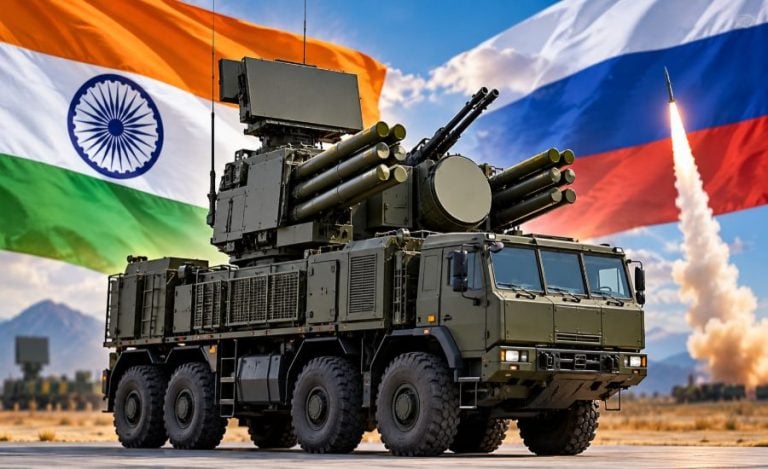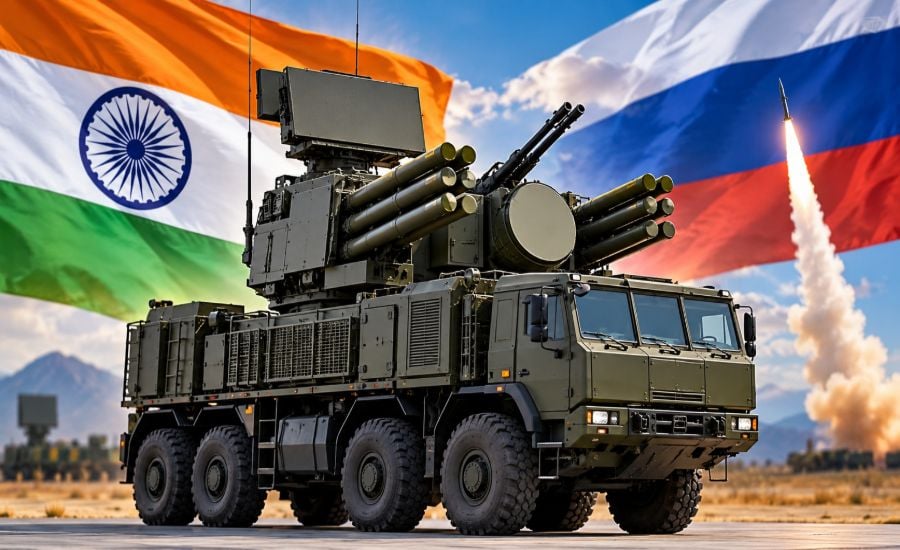
New Delhi: India is reportedly considering the purchase of 13 Russian Pantsir-S1 air defence systems to protect its important military assets, including the S-400 missile defence batteries. The proposed Pantsir-S1 air defence systems for India could provide an additional layer of protection against drones, cruise missiles and other low-flying aerial threats.
The reported plan includes 10 systems for the Indian Air Force (IAF) and three for the Indian Army. However, the proposal should not be treated as a confirmed purchase, as an official government announcement confirming the deal has not been identified.
What is the Reason of India Russia Pantsir-S1 Air Defence System Deal
India is working to strengthen its air defence network against different types of aerial threats. While the S-400 is designed to engage threats at long distances, smaller and low-flying targets can create different operational and cost challenges.
Read also: Explained: How Pantsir-S1M Can Protect S-400 from Modern Drone Warfare Threats
The Pantsir-S1 could help fill this gap by providing short-range protection around important military installations. This would allow India to use its more expensive, long-range interceptors for threats that require their advanced capabilities.
What Is The Pantsir-S1 Air Defence System
The Pantsir-S1 is a Russian-made, mobile air defence system that combines surface-to-air missiles with automatic guns. It is designed to protect military bases, radar stations and other important sites from aerial attacks.
According to published technical information, the system can engage several types of targets, including aircraft, cruise missiles, precision-guided weapons and unmanned aerial vehicles (UAVs).
Its combination of missiles and guns allows it to respond to threats at different distances. However, its actual performance depends on the target, operating conditions and system configuration.
How Pantsir-S1 Could Protect India’s S-400 Systems
The S-400 is a long-range air defence system designed to intercept important aerial threats. Its radar equipment, missile launchers and other supporting components are also valuable military assets that need protection.
Under the reported proposal, the Pantsir-S1 could operate as a close-range protective layer around these assets. It could help defend against drones and other threats that approach the S-400 batteries.
This layered approach would combine long-range interception with shorter-range defence. It could also help reduce the need to use expensive long-range missiles against relatively inexpensive targets.
Lessons From Operation Sindoor
Operation Sindoor, launched by India in May 2025, highlighted the importance of air defence and protection against aerial threats. Modern conflicts have shown how drones, missiles and other weapons can challenge military installations.
A layered defence network can help address these different threats by combining systems with different ranges and capabilities. However, claims about individual combat results should be assessed using reliable, independently verified information.
For India, protecting air defence installations is an important part of maintaining their readiness during a conflict.
India Russia Pantsir-S1 Air Defence System Deal: Reported Plan For The Indian Air Force And Army
According to the report, the proposed 13 Pantsir-S1 systems could be divided between the two services.
- Indian Air Force: 10 systems could be used to protect S-400 batteries and other important air defence assets.
- Indian Army: Three systems could provide additional protection to sensitive military formations and installations near the borders.
This allocation remains a reported proposal, not a confirmed final deployment plan.
Could India Manufacture Pantsir Systems Locally
India has been seeking greater domestic participation in defence manufacturing under the Make In India initiative. Cooperation between Indian and Russian defence companies could potentially support local production or other forms of industrial collaboration.
Bharat Dynamics Limited (BDL) and Russia’s Rosoboronexport signed a memorandum of understanding in November 2024 concerning cooperation on Pantsir variants.
However, this cooperation alone does not confirm that India has approved domestic production of the systems discussed in the current proposal. Any future manufacturing arrangement would depend on the terms of an official agreement.
FAQs
The Pantsir-S1 could provide close-range protection against drones, cruise missiles and other aerial threats. It would complement the S-400, which is designed for long-range air defence.
India is reportedly considering 13 Pantsir-S1 systems for the Air Force and Army. However, a confirmed government announcement approving this specific purchase has not been identified.
Domestic manufacturing may be possible through India-Russia defence cooperation. However, no confirmed production agreement for the systems covered by this reported proposal has been identified.