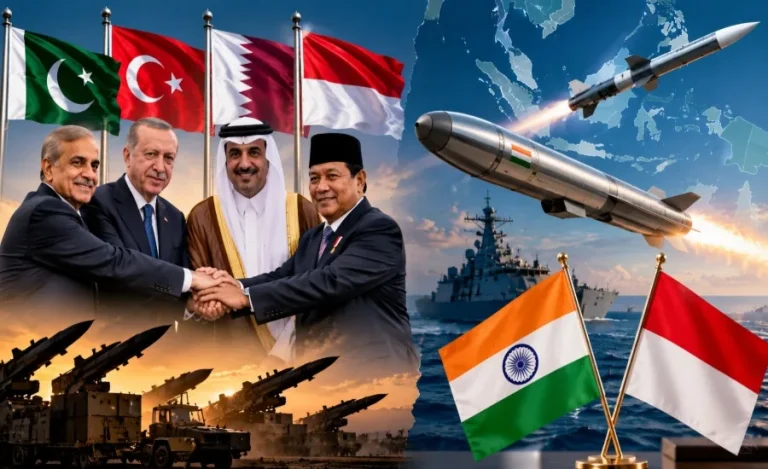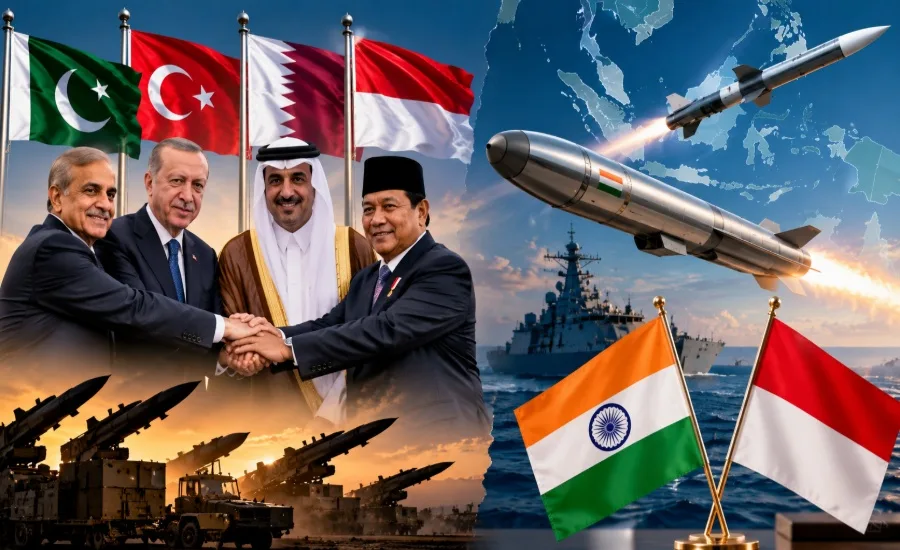
New Delhi: Indonesia’s Badr MoU with Pakistan, Turkey, and Qatar has raised questions about India’s defence exports, especially the BrahMos cruise missile and Astra air-to-air missile. The four countries signed the agreement in Doha on October 21, 2026, to strengthen defence research, technology cooperation, and joint weapons production.
However, Indonesia’s participation does not automatically mean that Indian missile technology will be shared with Pakistan or other members. The real impact will depend on the projects undertaken, the terms of the agreement, and the safeguards protecting sensitive defence technology.
What Is The Badr MoU
The Badr Memorandum of Understanding is a defence-industrial cooperation agreement between Indonesia, Pakistan, Turkey, and Qatar. It aims to help the four countries work together on defence manufacturing, research, technology development, and military industrial capacity.
Indonesia’s Defence Ministry confirmed that the agreement was signed in Doha on October 21, 2026. The participating countries want to strengthen their defence industries and develop closer cooperation in areas such as engineering, investment, and manufacturing.
The agreement also aims to improve defence supply chains and increase the participating countries’ ability to meet their military equipment needs.
What Are The Main Objectives Of The Badr MoU
The Badr MoU focuses on three major areas:
- Research And Development: Supporting joint research and the development of defence technologies.
- Defence Manufacturing: Exploring opportunities to manufacture military equipment through industrial cooperation.
- Technology And Skills Development: Improving technical knowledge, training, and industrial capabilities.
However, signing an MoU does not guarantee that every country will receive advanced weapons technology. Its practical impact will depend on future projects, funding, and the specific terms agreed upon by the participants.
Why Is Indonesia’s Badr MoU Important For India
Indonesia has an important defence partnership with India. Both countries have been working to expand cooperation in maritime security, military technology, defence manufacturing, and regional stability.
During Prime Minister Narendra Modi’s visit to Indonesia in July 2026, both governments reaffirmed their commitment to stronger defence cooperation. Their discussions included cooperation on the BrahMos missile system and an air-to-air missile cooperation agreement.
Indonesia’s participation in the Badr MoU has therefore attracted attention because it is now involved in a defence-industrial framework that also includes Pakistan and Turkey. However, joining this framework does not automatically cancel Indonesia’s existing defence partnerships or prove that it intends to share Indian military technology.
Will The Badr MoU Affect India’s BrahMos Missile Exports
The BrahMos supersonic cruise missile is one of India’s important defence export products. Developed through cooperation between India’s DRDO and Russia’s NPO Mashinostroyeniya, the missile is designed to strike land and sea targets.
India’s defence cooperation with Indonesia includes the BrahMos missile system. This makes the protection of sensitive technical information an important issue for New Delhi.
The main concern is whether Indonesia’s participation in joint defence projects with Pakistan and Turkey could create risks for information related to Indian weapons systems. However, there is an important difference between buying a weapon and gaining the ability to manufacture it independently.
Does Buying BrahMos Give Indonesia Access To Its Secret Technology
No. Purchasing a missile system does not automatically give a country access to all the technical information needed to reproduce it.
Operational documents, maintenance instructions, manufacturing designs, and sensitive engineering information are different categories of information. The level of access depends on the export contract and the permissions granted by the original equipment manufacturer.
According to the report, former BrahMos Aerospace chief Sudhir Kumar Mishra expressed confidence in the safeguards protecting India’s defence technology.
The report also states that the arrangements include protections for intellectual property and sensitive data. However, the full contractual details are not publicly available, so the exact scope of those safeguards cannot be independently assessed from public information alone.
Could Pakistan Gain Access To India’s Astra Missile Technology
The Astra is an Indian-developed air-to-air missile designed to engage aerial targets. It is an important part of India’s indigenous defence technology programme.
The concern surrounding the Badr MoU is whether Indonesia’s defence cooperation with Pakistan and Turkey could create a route for sensitive Indian technology to reach other countries.
At present, Indonesia’s participation in the agreement does not establish that such a transfer will happen. No publicly available evidence cited in the report demonstrates that Indonesia plans to transfer Astra technology to Pakistan.
Why Are Technology Protection Rules Important
Defence export agreements normally need clear rules covering the use, maintenance, storage, and protection of sensitive equipment and information.
These safeguards help protect a supplier’s intellectual property and prevent unauthorised access to restricted technology. Their effectiveness depends on the contract terms, monitoring, compliance, and enforcement.
India will therefore have a strong reason to monitor developments under the Badr framework while ensuring that its existing defence export arrangements remain protected.
What Do Defence Experts Say About India’s Concerns
The report cites defence experts who argue that India should not treat the Badr MoU as an immediate threat to its missile exports.
Group Captain Ajay Ahlawat (Retd), a senior fellow at the Centre for Aerospace Power and Strategic Studies, reportedly described the agreement as an industrial cooperation arrangement rather than a formal collective military alliance.
His argument is that an agreement for joint production and research does not automatically create a military alliance or require members to share every defence technology they possess.
The report also cites Sudhir Kumar Mishra, who expressed confidence in the protection of sensitive Indian missile technology.
These views suggest that the agreement should be judged by its actual implementation rather than by the names of the participating countries alone.
How Could The Badr MoU Help Pakistan’s Defence Industry
The Badr MoU could create opportunities for Pakistan to expand its defence manufacturing partnerships and cooperate more closely with Turkey, Qatar, and Indonesia.
Turkey has developed defence manufacturing capabilities in areas such as drones, aerospace, and military electronics. Qatar can potentially contribute investment, while Pakistan and Indonesia may offer manufacturing capacity and domestic demand.
If the countries agree on specific projects and provide sufficient funding, the partnership could help them develop production capabilities and diversify some defence supply chains. However, these are potential outcomes, not guaranteed results. The agreement’s value will depend on actual investments, technology-sharing arrangements, industrial projects, and the ability of the participating countries to work together.
What Does The Badr MoU Mean For India’s Defence Export Strategy
India has been working to strengthen its position as a defence equipment supplier to international markets. Its partnerships with countries in Southeast Asia are an important part of this effort.
India and Indonesia have publicly committed to expanding defence and maritime cooperation. Their July 2026 joint statement welcomed cooperation on the BrahMos missile system and an air-to-air missile agreement.
The Badr MoU introduces a new factor that Indian policymakers will need to consider. However, it does not by itself prove that India’s existing agreements are at risk.
New Delhi’s key priorities will be to protect sensitive technology, enforce export safeguards, maintain communication with Jakarta, and assess how the four-country framework develops.
Read also: Meet This Next Generation Indigenous Missile Which Can Destroy Whole Lahore From India
FAQs
Indonesia’s participation does not automatically give Pakistan access to BrahMos technology. Any transfer would depend on the applicable agreements, permissions, and safeguards. No publicly available evidence cited in the report establishes that such a transfer is planned.
The Badr MoU is a defence-industrial cooperation agreement signed on October 21, 2026. It aims to strengthen joint defence research, technology development, manufacturing, and cooperation among the four countries.
There is no established evidence that the Badr MoU will stop India’s BrahMos and Astra missile exports. The agreement may create new defence-industrial cooperation among its members, but its impact on India will depend on future projects and the protection of sensitive technology.