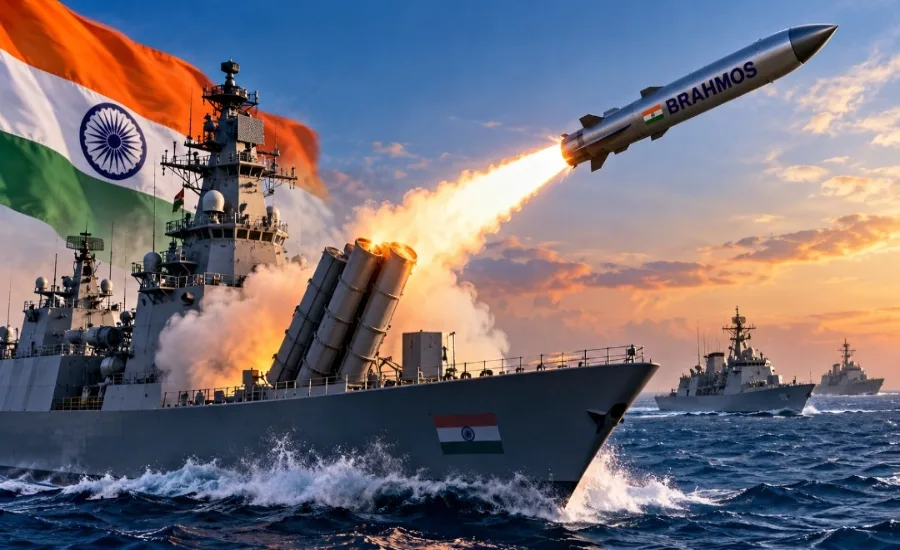
New Delhi: India is strengthening its naval firepower as the Indian Navy plans to upgrade its ageing Kashin-class destroyers and Veer-class corvettes with BrahMos missiles. The Ministry of Defence has signed a ₹661.5 crore (approximately $68 million) contract with BrahMos Aerospace for the procurement of Fire Control Systems (FCS) and launchers.
The project aims to improve the combat capabilities of older warships while supporting India’s defence indigenisation efforts. According to the reported details, the contract covers two Veer-class and two Ranvir-class ships, with more than 68% indigenous content.
Key Highlights Of Indian Navy BrahMos Deal
- Project Cost: ₹661.5 Crore (Approximately $68 Million).
- Main Equipment: BrahMos Fire Control Systems And Missile Launchers.
- Warships Covered: Two Ranvir-Class Destroyers And Two Veer-Class Corvettes.
- Indigenous Content: More Than 68%, According To The Reported Details.
- Main Objective: Improve The Strike Capabilities Of Older Indian Navy Warships.
Read also: Indian Navy BrahMos Missile Deployment: Key Plans, Benefits and 2030 Roadmap
Why Is The Indian Navy Upgrading Its Older Warships
The Indian Navy operates several older warships that continue to play an important role in national maritime security. Upgrading these vessels can help extend their operational usefulness and improve their ability to respond to modern threats.
BrahMos is a supersonic cruise missile developed through cooperation between India and Russia. It is designed to engage land and sea targets at high speed, giving naval forces an important long-range strike capability.
By installing modern launchers and fire control equipment, the Navy aims to improve how selected ships prepare, control and launch their missiles. The upgrade also supports India’s broader goal of strengthening its domestic defence industry.
Indian Navy BrahMos Deal: Ranvir-Class Destroyers To Receive Upgrades
The Indian Navy originally acquired five Kashin-class destroyers from the Soviet Union between 1980 and 1987. Three ships from this group remain in service: INS Rana, INS Ranvir and INS Ranvijay.
INS Ranvir and INS Ranvijay were among the early Indian Navy vessels equipped with BrahMos missiles. They also retain four inclined launchers for older Styx anti-ship missiles at the bow.
The reported contract is expected to support BrahMos-related upgrades on INS Ranvir and INS Ranvijay. The ships could receive new launchers to improve their missile capabilities.
INS Rajput, the first Indian Navy ship equipped with BrahMos, previously featured four twin-cell inclined launchers. The ship was decommissioned in 2021, and its equipment has since served as a reference for subsequent naval missile integration efforts.
INS Rana has also supported the development and testing of India’s naval air-defence capabilities. In 2025, its older Styx launchers were removed during a refit, and the ship was used as a test platform for the DRDO-developed VL-SRSAM missile system.
Indian Navy BrahMos Deal: Veer-Class Corvettes To Receive Upgrades
The Veer-class is an Indian variant of the Soviet Tarantul-class missile corvettes. The Indian Navy initially imported five vessels between 1987 and 1990, while Mazagon Dock Shipbuilders and Goa Shipyard later built additional ships under licence.
Seven Indian-built vessels of this class, featuring combined gas turbine and gas turbine (COGAG) propulsion, were reported to remain in service.
INS Vidyut was seen carrying two twin-tube inclined BrahMos launchers during Navy Day events in December 2025. The launchers had been transferred from the decommissioned INS Rajput.
INS Vibhuti was also reported to retain its older Styx missile launchers in December 2025. INS Nashak is another Veer-class vessel that could be considered for future launcher integration, depending on the Navy’s plans.
The upgrade programme could improve the strike capabilities of these ageing corvettes. However, the final configuration and the number of BrahMos missiles to be carried by each vessel will depend on the approved integration plan.
INS Prabal And INS Pralaya: Another Important Part Of The Veer-Class Fleet
INS Prabal and INS Pralaya are among the youngest Veer-class ships. Both entered service in 2002 and are equipped with 16 Kh-35E anti-ship missiles in four quad launchers.
These ships represent a different configuration within the class. Their existing missile systems and the physical limitations of small corvette hulls are important considerations when assessing any future BrahMos installation.
BrahMos missiles are larger than many older anti-ship missiles. As a result, fitting them to smaller vessels requires careful planning, including launcher placement, stability, weight distribution and integration with the ship’s combat management systems.
The Navy must balance improved striking power with the operational limits of its older ships. The programme’s final design will determine how many missiles can be safely and effectively carried.
How Indian Navy BrahMos Deal Can Improve Naval Strike Capability
BrahMos can engage selected land and sea targets at supersonic speed. Its high speed can reduce the time available for an opponent to detect, track and respond to an incoming missile.
Equipping additional warships with BrahMos could give the Indian Navy more platforms capable of conducting long-range precision strikes. It could also help distribute missile capability across different classes of vessels rather than concentrating it on a smaller number of modern ships.
The upgrade is particularly relevant as India continues to modernise its fleet with newer destroyers, frigates and corvettes. Older ships can remain useful when their combat systems are updated and their condition supports continued operations. However, a missile upgrade alone does not make an older warship equivalent to a new one.
Sensors, electronic warfare systems, air defence, propulsion, maintenance and the ship’s remaining service life also affect its overall combat value.
Additional Varunastra Heavyweight Torpedo Procurement
In a separate development, the Ministry of Defence reportedly signed a ₹1,543 crore contract with Bharat Dynamics Limited for Varunastra heavyweight torpedoes for the Indian Navy. The order follows an earlier procurement of 73 torpedoes in July 2016. The newer contract is expected to cover approximately 40 additional units.
Varunastra is an Indian-developed heavyweight torpedo designed to engage underwater threats. The DRDO has also developed an electric heavyweight torpedo for submarine applications, intended for integration with Kalvari-class submarines.
These programmes address different areas of naval warfare. BrahMos strengthens surface-based strike capabilities, while heavyweight torpedoes support underwater combat operations.
Read also: Why ASEAN Nations Are Closely Watching India’s BrahMos Missile Program
FAQs
The reported contract is worth ₹661.5 crore, approximately $68 million. It covers BrahMos Fire Control Systems and launchers for selected Indian Navy warships, with more than 68% indigenous content reported.
BrahMos missiles provide high-speed precision-strike capability against selected land and sea targets. Their integration can increase the number of Indian Navy ships equipped for advanced missile operations and strengthen India’s maritime strike capability.
The Indian Navy is upgrading selected Kashin-class destroyers and Veer-class corvettes to improve their missile strike capabilities. The programme involves BrahMos Fire Control Systems and launchers, helping modernise older vessels.