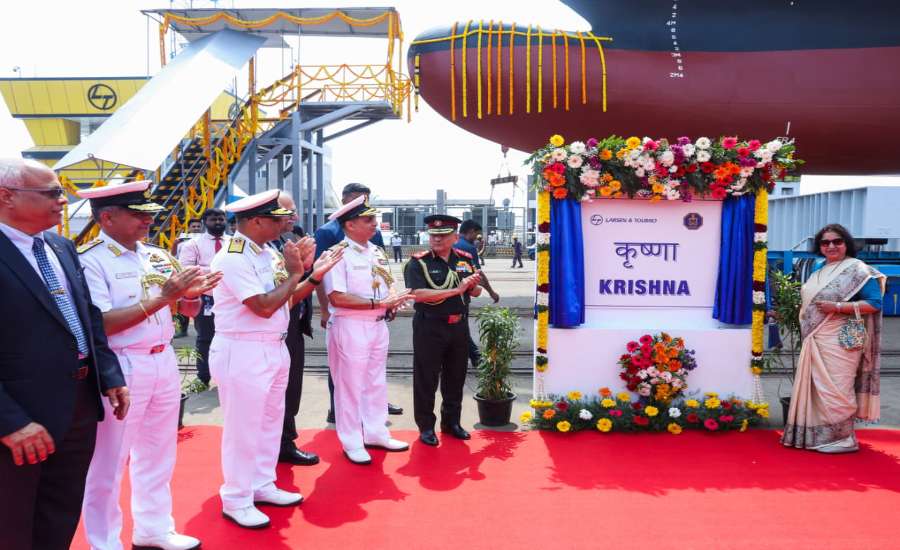
New Delhi: India’s shipbuilding legacy reached a significant milestone on 16 February 2026 with the launch of the first of three Indian Navy Cadet Training Ships Krishna. Built indigenously at Larsen & Toubro (L&T) Shipbuilding – Kattupalli, Chennai, this state-of-the-art vessel will play a key role in training future naval officers.
The launch ceremony was graced by Mrs. Anupama Chauhan and witnessed by the Chief of Defence Staff General Anil Chauhan, senior defence officials and top representatives of the Indian Armed Forces and L&T Shipbuilding.
Historic Launch of Indian Navy Cadet Training Ship Krishna
On 16 February 2026, the first Cadet Training Ship (CTS) named Krishna (Yard 18003) was launched at the L&T Shipyard in Chennai. The ship’s launching followed long-held naval traditions. This event marks the beginning of a new phase in India’s naval training infrastructure and indigenous warship construction.
Read also: Inside INS Surat: The AI-Driven Warship Changing How the Indian Navy Fights at Sea
The presence of the Chief of Defence Staff at the launch underlined the strategic importance of this vessel for the Indian Navy’s future training missions.
Indian Navy Cadet Training Ship Krishna: Indigenous Design & Make in India
The Krishna is designed and constructed entirely in India by L&T Shipbuilding under the Buy Indian-IDDM (Indigenously Designed, Developed & Manufactured) category. The ship’s formal delivery to the Indian Navy is planned by the end of 2026. This push for homegrown defence assets strongly supports the Government of India’s Aatmanirbhar Bharat and Make in India initiatives.
India’s focus on indigenous shipbuilding strengthens domestic capabilities and reduces reliance on foreign suppliers for critical naval infrastructure.
Purpose of the Cadet Training Ships
The primary mission of these CTS vessels is to train Officer Cadets at sea following their basic training ashore. The training at sea will include seamanship, navigation drills, ship handling and practical exposure to life on board a navy vessel. These ships will also train women cadets and naval trainees from friendly foreign countries, fostering international cooperation.
Cadet Training Ships serve a unique and critical role, acting as floating classrooms where trainees experience real-time naval operations, helping bridge theoretical knowledge with practical skills.
Indian Navy Cadet Training Ship Krishna Background & Strategic Importance
The contract for the design and construction of three Cadet Training Ships was signed between the Ministry of Defence and Larsen & Toubro in March 2023. This project is part of the Long Term Integrated Perspective Plan (LTIPP) 2012–27, which envisages expanding and modernising the Indian Navy’s training fleet.
According to industry literature, these modern CTS vessels are expected to enhance India’s naval training capability for the next 30 years.
Design and Future Capabilities
Though the official reports do not include all technical details, information on the class of these vessels reveals:
- Approximate length: ~122 meters
- Displacement: ~4,700 tonnes
- Speed: ~20 knots
- Endurance: ~60 days at sea
- Accommodation: ~20 officers, ~150 sailors, and ~200 cadets simultaneously
- Training Facilities: Dedicated classrooms, a cadet training bridge and specialised chart house
- Mission Roles: Cadet training, humanitarian assistance, disaster relief (HADR), and search and rescue operations
- Indigenous communication and navigation systems supplied by domestic companies.
These features will make the CTS a versatile platform not only for training but also for supportive naval tasks.
Symbol of National Maritime Growth
The launch of Krishna celebrates India’s growing strength in maritime & defence production. It emphasises the Indian Navy’s commitment to advancing self-reliance in defence manufacturing, aligning with national policy aims.
India’s ability to design and construct complex vessels at home reinforces its position as a growing maritime power in the Indian Ocean Region and beyond.
What’s Next: Delivery and Deployment
Following the launch, Krishna will undergo extensive outfitting and sea trials before its scheduled formal delivery at the end of 2026. Once commissioned, it will begin its operational role in naval training while the second and third CTS vessels continue development at the same shipyard.
The successful integration of these ships will support the Indian Navy’s long-term strategy to train a larger cohort of officers with practical at-sea experience.