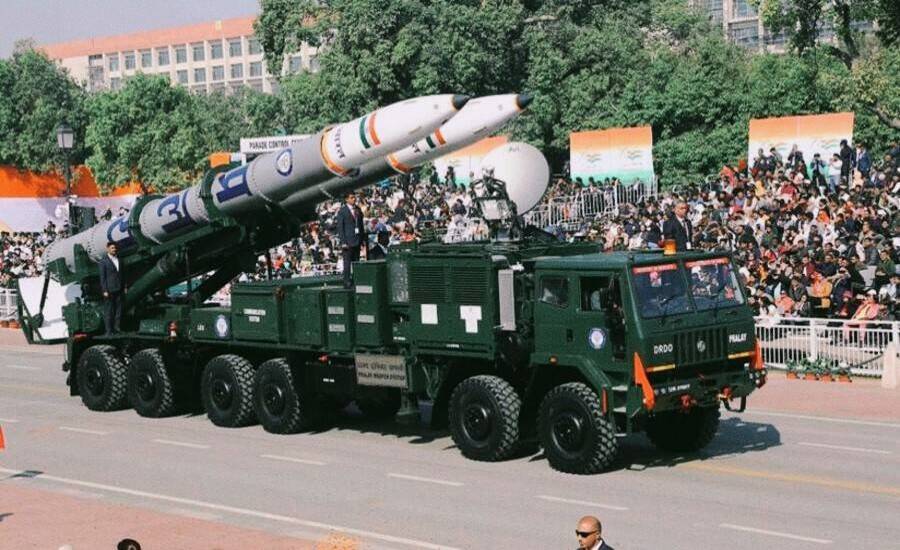
New Delhi: The Defence Research and Development Organisation (DRDO) has received Acceptance of Necessity (AoN) from the Indian Ministry of Defence to initiate full-fledged development of the BM-04 Short-Range Ballistic Missile (SRBM) — a major leap in India’s indigenous conventional strike capabilities.
The official clearance marks a pivotal moment in the expansion of India’s missile arsenal, bridging existing gaps between short-range battlefield systems like Pinaka and long-range strategic missiles such as the Agni series.
What is BM-04 Short-Range Ballistic Missile
The BM-04 is a mobile, two-stage solid-fuel ballistic missile tailored for conventional precision strikes.
Read also: Project Dhvani Explained: Inside DRDO’s Project Dhvani and Its Mach-7+ Strike Capability
Designed and developed by DRDO, it addresses a capability gap in India’s missile architecture.
What are the Features of BM-04 Short-Range Ballistic Missile
BM-04 Ballistic missile Range: 400–1,500 km — effectively covering strategic conventional strike distances between tactical rocket artillery and long-range deterrent missiles.
Warhead: ~500 kg conventional payload (non-nuclear).
Guidance: Satellite-aided inertial navigation (including GPS and India’s IRNSS/NavIC) for superior targeting accuracy.
Dimensions: ~10.2 metres in length and 1.2 metres in diameter, weighing around 11,500 kg.
Launch Mode: Road-mobile Transporter Erector Launcher (TEL) with a canisterised system for rapid reaction and enhanced survivability.
Experts also highlight hypersonic boost-glide vehicle (HGV) features and manoeuvrable re-entry vehicles to improve evasion against missile defence systems — though development and trials will determine final operational capabilities.
Impact of BM-04 Short-Range Ballistic Missile
Here are following impacts of BM-04 Short-Range Ballistic Missile;
Bridging the Capability Gap
India’s existing Pinaka multi-barrel rocket system serves short-range tactical needs with ranges of 40–90 km, while larger strategic missiles like Agni exceed 2,000 km primarily for strategic deterrence roles. The BM-04 sits between these extremes, providing deep conventional strike ability without resorting to nuclear escalation.
This range — 400 to 1,500 km — equips Indian armed forces with the ability to target strategic infrastructure such as:
- Enemy command and control centres
- Airbases and logistics hubs
- Mobile missile launchers or integrated air defences
With regional tensions persisting in South Asia and the Indo-Pacific, the BM-04 strengthens India’s self-reliant defence capabilities under the Atmanirbhar Bharat initiative.
It signals:
- Enhanced conventional deterrence against escalating crises
- Strategic depth in strike capability without nuclear escalation
- Continued DRDO commitment to indigenous warfighting technologies
The missile’s development aligns with India’s prioritisation of technology-intensive defence export potential and domestic industry participation in high-end weapon systems.
What is the Importance of BM-04 Short-Range Ballistic Missile
Here is the following importance of BM-04 Short-Range Ballistic Missile;
Precision and Survivability
Utilising advanced guidance systems and potential hypersonic maneuvering, BM-04 aims for high precision with less collateral damage — crucial for modern warfare doctrines emphasising calibrated responses instead of escalatory strikes.
Its mobile, canisterised launch design improves survivability and time-to-launch compared to older systems, especially in high-intensity conflict zones or pre-emptive strike scenarios.
Complementing India’s Missile Arsenal
The BM-04 will complement other Indian missile systems, such as; Pinaka, Pralay, Prithvi and Agni Series, plugging critical holes in the offensive spectrum.
The inclusion of BM-04 strengthens India’s graduated response doctrine, offering flexible options from conventional engagement to strategic deterrence.
What are the Implications of BM-04 Short-Range Ballistic Missile
The BM-04 has implications for India’s broader military strategy, especially regarding deterrence in South Asia.
- By positioning launch assets within Indian territory, BM-04 complicates adversary efforts to conduct effective counter-strikes.
- Operational deployment strengthens the Integrated Rocket Force (IRF) concept under discussion, where layered strike systems deliver calibrated response options across conflict spectrums.
- The weapon emphasises conventional deterrence, with possible impacts on force postures and doctrine vis-à-vis Pakistan and China.
What is the Timeline of BM-04 Ballistic Missile
Having received AoN, the BM-04 project will now move into development trials and hardware realisation. Basic prototype testing and user trials are expected within the next few years.
Successful performance during trials could lead to limited production and eventual induction, assuming favourable assessments by the Ministry of Defence and Army branches.
DRDO’s continual innovation in missile tech — from hypersonic vehicles to advanced solid rocket motors — supports improvements in future BM-04 variants or derivative platforms.