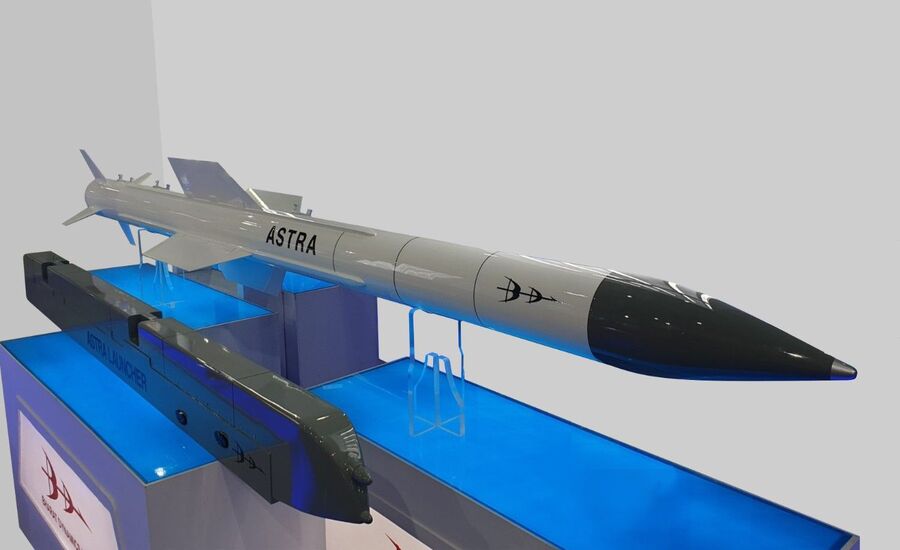
New Delhi: Defence Research and Development Organisation (DRDO) is advancing its indigenous air-to-air missile programme with the upgraded ASTRA MK2 Beyond Visual Range Air-to-Air Missile (BVRAAM), targeting early 2026 flight trials of a strengthened variant equipped with an enhanced 200 km class dual-pulse motor.
This development represents a strategic leap in India’s aerospace defence capabilities, bolstering aerial deterrence and regional air superiority.
Background of ASTRA MK2 Missile
The ASTRA family is India’s home-grown series of BVRAAMs designed to engage hostile aircraft, unmanned aerial vehicles (UAVs), and high-speed aerial targets at beyond visual ranges.
Read also: What Is Krasukha-2 EW System? and How It Can Protect S-400 Air Defence Without Firing a Shot
The first iteration, ASTRA MK-1, with an operational engagement range of over 100 km, has been successfully integrated into frontline Indian Air Force (IAF) platforms such as Su-30MKI, Tejas, Rafale, and MiG-29K jets.
Building on this heritage, the ASTRA MK-2 is evolving into a long-range interceptor with next-generation propulsion and guidance technologies that significantly expand its strike envelope.
A successful test campaign and subsequent induction would mark a pivotal milestone for India’s defence ecosystem.
What is the Importance of Dual-Pulse Motor in ASTRA MK2 Missile
At the heart of MK-2’s enhanced capability is its dual-pulse rocket motor — a propulsion architecture that provides two separate thrust pulses during flight.
Unlike single-pulse motors that lose energy rapidly after burnout, the dual-pulse design delivers sustained power — especially crucial during the terminal phase of engagement where higher kinetic energy is needed to track and intercept agile targets.
DRDO scientists have refined this dual-pulse system to push the missile’s effective range to nearly 200 km, enabling extended standoff engagements well beyond the reach of earlier variants.
This upgraded propulsion not only enhances range but also improves manoeuvrability and speed retention at long distances.
ASTRA MK2 Missile Trial Date
The experimental flight trials planned for early 2026 will focus on validating:
- Extended range performance of the upgraded propulsion system
- Aerodynamic stability at high sub-orbital velocities
- Seeker precision and guidance under maximum range engagement scenarios
The trials will employ increasingly complex flight profiles to confirm that the missile maintains supersonic speeds and reliable target tracking out to the extended envelope, ensuring readiness for operational use.
Experts suggest that, given the maturity of the missile’s subsystems and incremental testing already completed, a successful trial could accelerate its transition into production and service induction by mid-2026.
What is the Importance of ASTRA MK2 Missile
A BVRAAM with a near-200 km strike radius would considerably enhance the Indian Air Force’s stand-off engagement capability, allowing pilots to neutralise aerial threats well outside hostile missile envelopes.
This strategic advantage helps reduce exposure to enemy counter-fire and strengthens deterrence against potential adversaries.
Experts also point out that the MK-2’s capabilities directly address the evolving aerial threat landscape, including advanced missiles like China’s PL-15 series, which feature sophisticated seekers and extended ranges.
Self-Reliance and Atmanirbhar Bharat in Defence Manufacturing
The ASTRA MK-2 programme underscores India’s commitment to Atmanirbhar Bharat (self-reliant India) in defence technology.
With extensive participation from public and private defence industries, including entities like Hindustan Aeronautics Limited (HAL) and Bharat Dynamics Limited (BDL), the indigenous missile production lines are expected to scale rapidly post-clearance.
Early projections suggest an initial production order of about 700 missiles, supporting multiple strategic fighter squadrons and enabling economies of scale across manufacturing ecosystems.
Future Prospects: Beyond MK-2
While the ASTRA MK-2 is poised to be the near-term air defence game-changer, DRDO’s missile roadmap does not end here.
Future evolution could include MK-3 and MK-III variants with advanced propulsion like ramjet systems for even farther reach and performance enhancements through digital seekers.