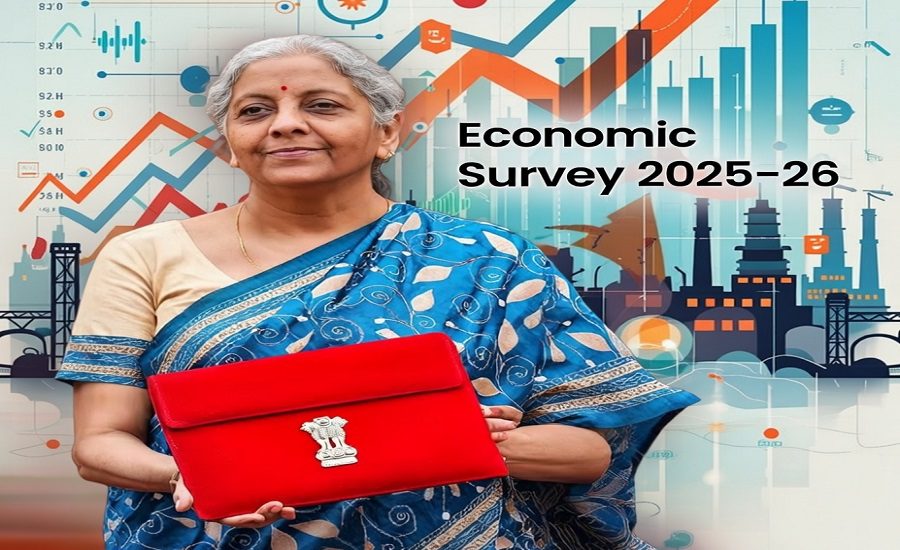
New Delhi: Union Finance Minister Nirmala Sitharaman on Wednesday presented the Economic Survey 2025–26 in the Lok Sabha, providing a detailed assessment of India’s macroeconomic performance, growth prospects, and structural reforms ahead of the Union Budget 2026–27.
Prepared by the Economic Division of the Department of Economic Affairs under the supervision of the Chief Economic Adviser, the Survey offers an analysis of short- to medium-term economic trends and outlines key strategies for sustainable growth.
GDP Growth Outlook: Steady Despite Global Challenges
The Survey projects India’s GDP growth at 6.8–7.2% for FY27, slightly lower than the 7.4% estimated for FY26. This moderation reflects adjustments to both global and domestic transitions, yet the report retains an optimistic medium-term outlook, noting that cumulative policy reforms have raised India’s growth potential closer to 7%.
“The outlook, therefore, is one of steady growth amid global uncertainty, requiring caution but not pessimism,” the Survey stated.
Domestic Demand to Anchor Growth
The Economic Survey highlights domestic consumption and investment as the key drivers of India’s growth trajectory. Factors supporting this resilience include:
Macroeconomic stability
Structural reforms in taxation and governance
Public capital expenditure, which is crowding in private investment
Inflation is noted to be broadly under control, while the balance of risks around GDP growth is described as “broadly even”. The Survey emphasizes the importance of prioritizing domestic growth and strengthening institutional capacity to weather global and geopolitical uncertainties.
Reforms, Trade, and Manufacturing Push
The Survey notes that recent reforms, including GST adjustments and other structural measures, have positioned India to convert global uncertainty into opportunity. FY27 is described as a “year of adjustment” as the economy adapts to systemic changes.
On trade, the Survey emphasizes the strategic importance of Free Trade Agreements (FTAs), particularly with Europe, to:
Strengthen manufacturing competitiveness
Enhance export resilience
Build strategic capacity
However, the Survey cautions that realizing the full benefits of FTAs will require competitive production at scale, highlighting the need for productivity gains and supply-side reforms.
Currency, Capital Flows, and Asset Valuations
The Survey flags that the rupee’s current valuation does not fully reflect India’s strong fundamentals. Factors contributing to its underperformance include:
Global economic uncertainties
Slowdown in foreign capital inflows in 2025
It also cautions that asset valuations, particularly those influenced by the ongoing AI-led productivity boom, could correct sharply if expected gains fail to materialize.
Ongoing Trade Talks with the US
The Economic Survey notes that trade negotiations with the United States are expected to conclude in 2026. Successful completion of these talks could reduce external uncertainties and provide a boost to exports and investor confidence.
The Survey also highlights potential external risks, such as:
Slower growth in key trading partners
Tariff-induced disruptions
Volatility in capital flows
Despite these, India’s domestic fundamentals are seen as resilient, ensuring stability amid global uncertainties.
System-Level Capacity and Long-Term Growth
Looking ahead, the Survey stresses the importance of building deep institutional and governance capacity to sustain growth amid a complex global environment. Key points include:
Continued structural reforms and capital formation
Strengthening financial resilience and adaptability to technology
Leveraging India’s rising global economic stature
The Survey positions India as one of the fastest-growing major economies, with stable fundamentals and a strong domestic growth engine, while noting that maintaining near-7% growth will require persistent reforms, competitive production, and effective governance.
Key Takeaways
GDP growth projected at 6.8–7.2% for FY27, slightly lower than FY26’s 7.4%
Domestic demand and public capex will anchor growth
Reforms and FTAs seen as tools to enhance competitiveness and exports
Rupee undervalued, capital inflows slowed in 2025
US trade talks expected to conclude in 2026, reducing external uncertainty
Sustained growth requires system-level capacity, governance, and technological adaptability