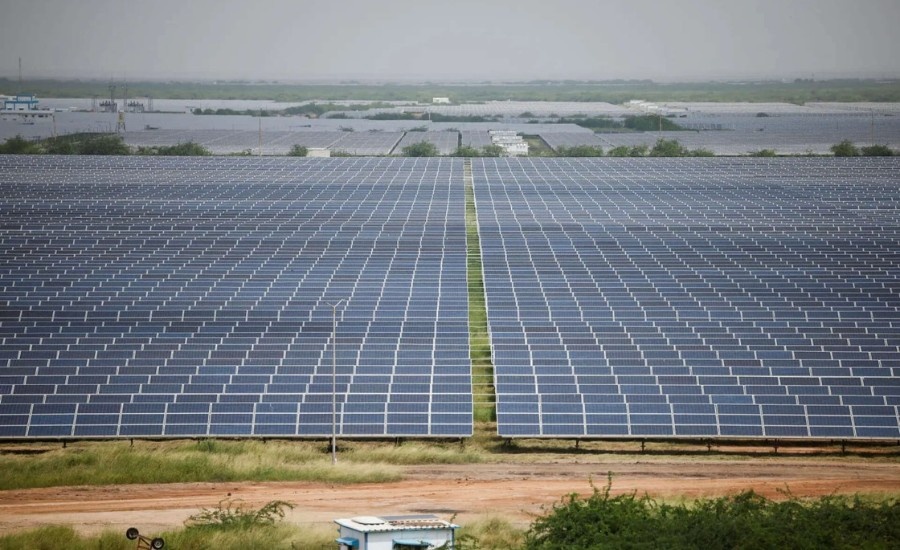
Gandhinagar: Gujarat is expanding its rooftop solar programme across government infrastructure, with 15,000 additional government buildings targeted for solar installations in 2026-27. The expansion is expected to add around 65 MW of renewable energy capacity, building on the 95 MW already installed across 6,014 government buildings.
The state has also introduced an Industrial Internet of Things (IIoT)-based Renewable Energy Monitoring System to digitally track renewable-energy installations and identify operational issues remotely.
The expansion is aimed at increasing renewable-energy use across public infrastructure while reducing conventional electricity consumption, government power expenditure and pollution associated with conventional power generation.
6,014 Government Buildings Already Have Solar
The rooftop solar programme has been implemented by the Gujarat Energy Development Agency (GEDA) under the Climate Change Department since 2011-12.
The programme gained significant momentum during 2025-26. Solar systems were installed on 1,377 government buildings, adding 17.1 MW of renewable-energy capacity during the year.
By March 2026, the cumulative coverage had reached 6,014 government buildings, with total installed capacity under the programme standing at 95 MW.
The latest expansion is substantially larger in terms of the number of buildings targeted. The state plans to cover 15,000 more government buildings during the current financial year, with around 65 MW of additional capacity expected from the installations.
If the target is achieved, the programme’s rooftop solar capacity would move beyond the existing 95 MW level and strengthen distributed solar generation across government infrastructure.
Read Also: Gujarat CM Bhupendra Patel Links Gandhi’s Ideals to Cleanliness and Self-Reliance
₹314 Crore Allocated for the Expansion
Gujarat has earmarked ₹314 crore for the rooftop solar programme in 2026-27.
According to GEDA Director Dharmendra Patel, the allocation includes:
- ₹278 crore for general government buildings
- ₹33 crore for buildings managed by the Tribal Development Department
- ₹3 crore for buildings under the Social Justice and Empowerment Department
The Climate Change Department provides 100% capital-cost support from its annual budget allocation for rooftop solar installations on buildings under the Gujarat government’s jurisdiction.
This funding model allows government departments to install solar systems without having to bear the initial capital cost themselves.
Why Gujarat Is Expanding Rooftop Solar
The government’s approach focuses on using existing public infrastructure to generate electricity rather than relying only on large-scale renewable-energy projects.
Government buildings offer a wide network of rooftops that can be converted into decentralised power-generation assets. Increasing solar generation at these locations can help reduce the amount of conventional electricity purchased for government offices.
The state government has also highlighted the potential financial benefit. Reduced dependence on conventional electricity can lower power expenditure for government offices over time.
There is an environmental benefit as well, as greater use of renewable electricity can reduce dependence on conventional power generation and associated pollution.
New IIoT System Adds Digital Monitoring
Gujarat’s renewable-energy programme is also receiving a technology upgrade.
The state has launched an IIoT-based Renewable Energy Monitoring System that connects smart meters, sensors and IoT gateways through communication technologies such as GPRS, 4G and Ethernet.
The system captures performance data at 15-minute intervals, generating up to 96 readings a day. It also provides automated remote alerts.
This means authorities can monitor renewable-energy installations without relying entirely on physical inspections. Performance data can help identify abnormal generation patterns and operational problems at individual installations.
According to the state government, the monitoring interface currently tracks 142.5 MW of solar generation and 68.3 MW of wind generation.
The digital system therefore adds an operational layer to Gujarat’s renewable-energy expansion, allowing officials to track performance and respond to problems more quickly.
Gujarat’s Larger Renewable-Energy Push
The government-building programme forms part of Gujarat’s wider renewable-energy expansion.
According to the latest data cited by the state government from the Union Ministry of New and Renewable Energy, Gujarat has 47,178 MW of installed renewable-energy capacity, placing it among the leading states nationally. Solar and wind power form major parts of its renewable-energy portfolio.
The state is now combining large-scale renewable-energy development with smaller, distributed generation on public infrastructure.
The government-building rooftop programme is particularly significant because it links renewable-energy generation directly with public facilities. Instead of treating rooftops as unused spaces, the programme seeks to turn them into productive energy assets.
From Solar Installation to Smart Energy Management
The next phase will test Gujarat’s ability to execute a much larger installation target. Moving from 6,014 buildings already covered to another 15,000 in a single financial year will require coordination across government departments, installation agencies and local infrastructure.
At the same time, the IIoT monitoring system could help the state manage a growing network of renewable-energy assets more efficiently.
Together, the rooftop expansion and digital monitoring system represent a shift from simply adding solar capacity to building a more integrated public renewable-energy network.
For government offices, the initiative could mean greater use of clean electricity and lower conventional power consumption. For Gujarat’s broader energy strategy, it adds another layer to the state’s effort to expand renewable generation through both large projects and decentralised public infrastructure.
Read Also: Gujarat UCC Bill Gets President Murmu’s Assent, Paving Way for Implementation